…as Nigeria funds ₦58.47trn budget with ₦25.9trn deficit
Nigeria will continue to rely on borrowing to fund its widening budget deficit as the Senate rules out any immediate alternative while drawing a firm line against the long-standing practice of rolling over unimplemented budgets and sustaining electricity subsidies.
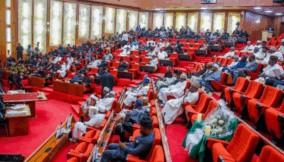
This position was taken on Monday by the Senate Committee on Appropriations during the Public Hearing on the 2026 Appropriation Bill, where lawmakers, economic experts, and government officials debated the implications of the proposed N58.47 trillion budget and its projected deficit of about N25.91 trillion.
Solomon Adeola, Chairman of the Committee, said borrowing had become inevitable given Nigeria’s unstable revenue base and enormous development needs, insisting that the real challenge is not the existence of a deficit but how it is financed and managed.
“Many countries in the world, including the United States of America, run budget deficits every year and even fund the deficit with borrowing.
“For us in Nigeria, we cannot do without borrowing as far as funding the budget deficit is concerned because projected revenues are not constant to bridge the gaps”, he said.
Adeola stressed, however, that the National Assembly would no longer tolerate weak budget discipline, announcing that lawmakers would not approve extensions of budget implementation cycles going forward.
“Never again will the National Assembly approve budget extensions. We must discipline our budgeting cycle, enforce strict adherence to appropriation timelines, and ensure better coordination between policy design and implementation,” he said.
Read also: Nigeria sets 30-second refund rule for failed airtime, data transactions
He also warned Ministries, Departments, and Agencies (MDAs) to expect tougher scrutiny during budget defence, noting that failure to justify proposals or demonstrate impact could lead to reallocations.
While acknowledging public concerns over rising debt and debt servicing costs, Adeola said the government was deliberately limiting domestic borrowing to avoid crowding out private sector credit.
Instead, he said the focus was shifting to external financing options, including Eurobonds, asset optimisation, privatisation, Public-Private Partnerships (PPPs) and joint venture arrangements.
“Government is deliberately avoiding excessive domestic borrowing that could crowd out private sector credit. Instead, we are exploring external financing, asset sales, and privatisation to bridge revenue gaps,” he said.
On fiscal reforms, the Senate chairman insisted that electricity subsidies must be fully removed, describing them as a major drain on public finances.
“We must complete the unbundling and subsidy removal in the electricity sector. States are now empowered to generate power, but subsidies in that sector remain a major fiscal burden.
“It must be fully addressed,” Adeola said, drawing parallels with the removal of petrol subsidies in 2023.
The stance comes amid growing concern among stakeholders over the size of the 2026 budget deficit.
Meanwhile, Adetilewa Adebayo, an Economic Expert and Chief Executive Officer of CFG Advisory, warned that without stronger fiscal discipline and realistic revenue assumptions, the deficit could become unsustainable.
He called for a comprehensive review and stricter enforcement of the Fiscal Responsibility Act (FRA), describing it as a “powerful but underutilised” framework for curbing fiscal excesses.
Despite his concerns, Adebayo argued that Nigeria has the capacity to run a far larger economy if her assets were properly managed.
“Nigeria’s asset base is estimated at about ₦300 trillion, while the debt profile is about ₦150 trillion, which clearly shows that with good leadership and the required fiscal discipline, the country can reach a $3 trillion economy,” he said.
Also speaking at the hearing, Shamseldeen Olujimi, the Accountant- General of the Federation, urged a shift away from allocation-driven budgeting to impact-focused implementation, warning that large budget figures meant little without tangible outcomes.
“For too long, we have been strong on budget formulation but weak on budget translation.
“The real question is no longer how much we allocate, but what changes in the lives of Nigerians because of these allocations,” Olujimi said.
He added that success should be measured by functioning schools, operational health centres, reliable electricity supply, and jobs created, rather than the speed of budget passage or headline figures.
Lawmakers said the issues raised at the hearing would shape further scrutiny of the 2026 budget, as pressure mounts on the government to balance borrowing, reforms, and accountability while delivering growth, jobs, and economic stability.

Join BusinessDay whatsapp Channel, to stay up to date
Open In Whatsapp