Nigeria’s 11-month disinflation trend may be ending soon with fresh projections pointing to a rebound in price pressures driven largely by fuel costs and lingering global shocks due to the war in the middle east.
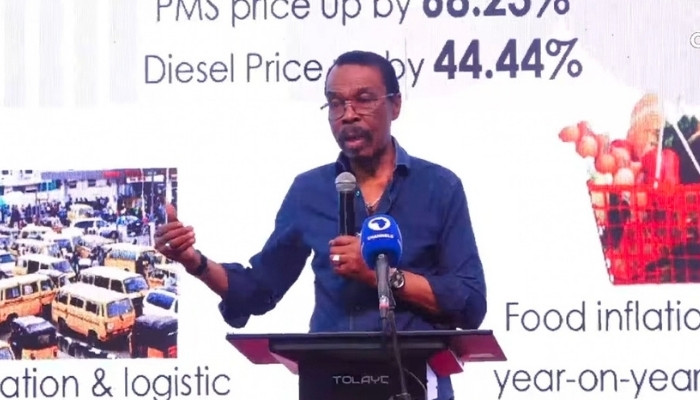
Bismarck Rewane, a top economist and chief executive of Financial Derivatives Company (FDC) at a 2026 economic summit in Lagos Saturday said inflation could climb from 15 percent to 19 percent by May and complicate the Central Bank of Nigeria’s policy path.
“Every one percent increase in the price of petrol will lead to a 0.079 percent increase in transportation costs and inflation,” he said. “We’ve seen a 42 percent increase in the price of petrol. That will translate to a 3 or 4 percent inflation. In the next two to three months, inflation will go from 15 percent to about 19 percent.”
Since the first joint attacks on Iran by the United States and Israel, the world economy has rippled from closures of key oil and commodity trade routes including the Strait of Hormuz, which accounts for 20 percent of the world’s oil trade.
The fighting has entered its fourth week and left behind a scourge of economic pain.
Strait of Hormuz and fuel prices
Across the Nigerian economy, diesel prices are up more than 44 percent and petrol has surged over 68 percent. Transport and logistics costs have also jumped by about 20 percent, according to the FDC report.
Rewane said food inflation rising year-on-year to just above 12 percent and accelerating on a month-on-month basis according to the National Bureau of Statistics further tightens Nigerians’ spending capacity. At the same time, global supply disruptions continue to push up the cost of imported goods, reinforcing domestic price instability.
These complications leaves the central bank in a tightening bind. Policymakers will meet May 19 and 20 to decide on the Monetary Policy Rate (MPR) after a 50-basis points trim in February dropped it to 26.5 percent.
Rewane anticipates a renewed inflation spike would make it difficult to justify any rate cuts or sustain efforts to support the naira. He expects the CBN will follow in the footsteps of the US Federal reserve and hold on cuts. “If inflation increases this way, the chances and probability that the CBN brings interest rates down further is low.”
Growth to remain positive despite inflation
Despite the inflation outlook, Rewane expects economic growth to remain modestly positive through the year. GDP is projected to expand by 3.08 percent in the first quarter of 2026.
But he said sustaining that growth will require deeper structural adjustments and a rebuilding of fiscal buffers, especially as external shocks intensify.
The naira, meanwhile, is expected to trade within a relatively narrow band of N1,400 to N1,450 per dollar in the near term, as authorities continue to defend the currency. Even so, Rewane fears that persistent inflation and global headwinds are likely to keep pressure on the exchange rate.
Nigeria’s stock market, which has posted strong gains in recent periods, may begin to give back some of those advances in line with global trends, according to the FDC.

Join BusinessDay whatsapp Channel, to stay up to date
Open In Whatsapp