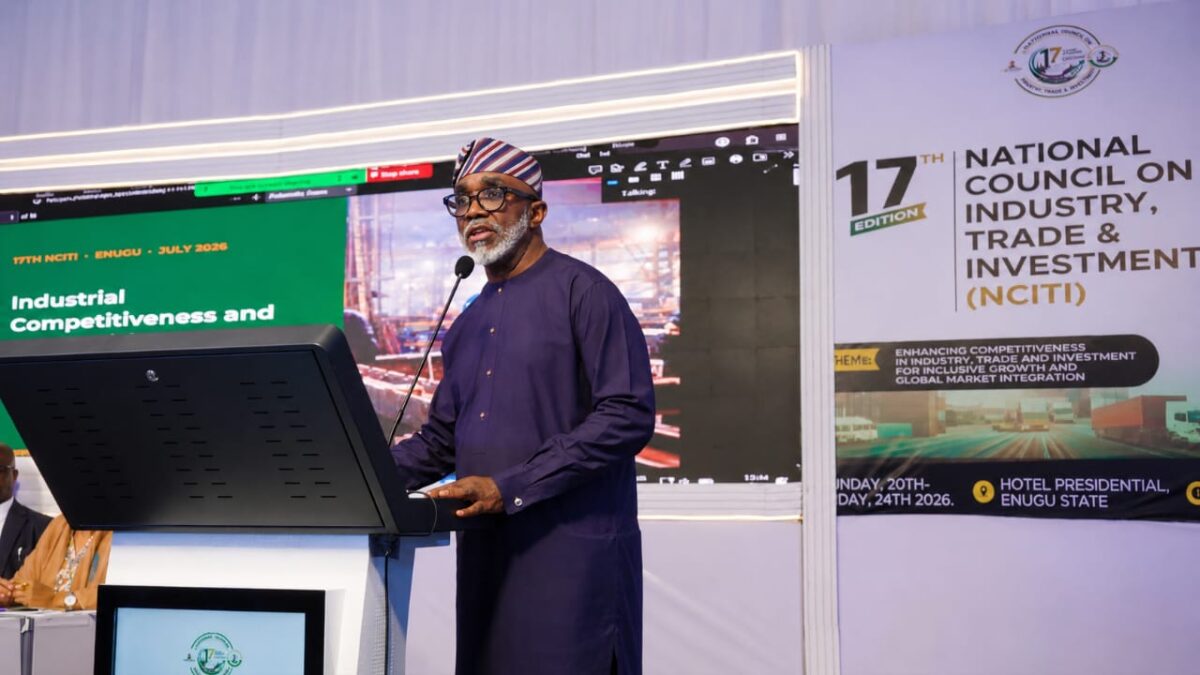
Nigeria must now choose between competing for the African market and conceding it to others, said Kamar Bakrin, executive secretary, National Sugar Development Council (NSDC).
Bakrin noted this during the technical session of the 17th National Council on Industry, Trade and Investment (NCITI) while presenting what he described as the arithmetic of a factory floor that has been priced out of contention — and four resolutions to reprice it.
The National Council on Industry, Trade and Investment (NCITI) is Nigeria’s highest policy advisory body on industry, trade and investment, convening federal and state governments annually.
Its 17th meeting held in Enugu under the theme “Enhancing Competitiveness in Industry, Trade and Investment for Inclusive Growth and Global Market Integration.”
Bakrin presented sub-theme 1, “Industrial Competitiveness and Productivity Enhancement,” and invited the Council to consider two factory managers — one in Aba, one in Ho Chi Minh City — running the same machines, employing equally capable people and chasing the same customers.
The NSDC boos told the National Council on Industry, Trade and Investment that Nigeria’s factories pay two to ten times more than competitors for power, credit and logistics — with proof from urea industry that disciplined pricing of inputs can turn an importer into a top-ten global exporter.
He said by the time their products reach the factory gate, the Nigerian has paid between two and ten times more for the three things every manufacturer on earth must buy: power, money and movement.
The numbers he presented were not close. Industrial power costs a Vietnamese factory about 8 US cents per kilowatt-hour and a Chinese factory about 10; the Nigerian pays 15 cents on the grid, rising towards 30 once the diesel generator takes over.
Nigerian manufacturers spent an estimated N1.34 trillion last year generating their own electricity — in Bakrin’s words, “every factory in Nigeria is running a second, unwanted business as a private power station.”
Working capital costs 27 to 35 percent in Nigeria against about 9 percent in Vietnam and 3 percent in China, while on the World Bank’s logistics performance index Nigeria ranks 88th of 139 countries, against Vietnam’s 43rd and China’s 19th.
The result: in a country of 230 million consumers, with duty-free access to 1.4 billion more under the African Continental Free Trade Area (AfCFTA), manufacturing contributes barely 8 percent of GDP, and capacity utilisation has slipped to 57.7 percent.
“None of this is a demand problem. Nobody on this continent needs persuading to buy what Nigeria makes,” he said. “It is a cost-of-production problem — and that distinction matters, because costs, unlike demand, are within our power to fix.”
The timing, he argued, could not be more consequential. The Government’s macroeconomic reforms have delivered stability — inflation roughly halved from its peak and reserves at $51 billion, the highest since 2009 — giving factories, for the first time in years, the conditions to plan and invest.
Global supply chains are being redrawn as companies diversify, and “a factory anchored in another country this decade will not move twice.” And AfCFTA cuts both ways: “Either our goods are crossing borders going out, or everyone else’s goods are crossing ours coming in. We are either going to compete, or we are going to concede the market.”
To demonstrate that the turnaround is achievable, Bakrin pointed to Nigeria’s own urea industry, which grew from half a million tonnes of capacity in 2005 to 6.5 million tonnes today — making Nigeria a top-ten global exporter of nitrogen fertiliser — on the strength of a single, unglamorous decision: pricing natural gas as an industrial input rather than a revenue opportunity. “The whole lesson is in one sentence,” he said.
“When a country prices inputs as if it wants industry to live, industry lives.” He drew parallels with Vietnam, whose biggest export to the United States is now electronics, and Bangladesh, whose garment industry earns some $38 billion a year. “Neither of them struck oil. They struck discipline — and held it for twenty years.”
Bakrin attached firm targets to each of the four costs he identified as deciding competitiveness: power delivered to industrial clusters at 8–10 cents per kilowatt-hour around the clock; industrial lending in single digits at meaningful volume; port clearance in under seven days, from 18–21 today; and output per worker doubled by 2030. “These are not aspirations to admire,” he said. “They are the line at which a made-in-Nigeria product stops apologising.”
He then tabled four resolutions for the Council’s adoption: that every state designate at least one industrial cluster for a dedicated power arrangement within twelve months; that a federal–state compact harmonise levies and clear informal checkpoints on industrial corridors; that an annual State Industrial Competitiveness Index rank every state publicly on power, land, levies and logistics; and that Nigeria First procurement be enforced at federal and state level with quarterly compliance dashboards.
“Every resolution needs a named owner, a date and a way to measure it. Otherwise it becomes another document that gets filed, framed and forgotten,” Bakrin noted.
Underpinning all four was a single operating principle: public support must be earned, continuously and in public. Every tax credit, every unit of subsidised power and every act of government patronage, he argued, should be conditional on performance that is verified and published — the same discipline the NSDC applies under the sugar Backward Integration Programme, where support is tied to independently verified production. “Nothing should be handed out as an entitlement — because once it is, it can never be taken back.”
Competitiveness, he stressed, is ultimately won sub-nationally. “No federal circular has ever cleared a roadside checkpoint,” he told the state delegations, urging them to build power markets under the Electricity Act 2023, make industrial land genuinely bankable — host-community compensation settled and physical possession secured, not merely a certificate issued — consolidate levies into one published list, and point technical colleges at the industries each state wants to attract. On the proposed state ranking, he noted: “We rank our football clubs every weekend. We can manage to rank our investment climates once a year.”
Beyond the statistics, Bakrin framed the stakes in human terms: factory jobs for the four million young Nigerians who enter the workforce each year, lower prices as goods made near their markets are shielded from currency shocks, a stronger naira built on displaced imports and new exports, growth reaching all six geopolitical zones — and, he noted, the strongest antidote yet invented to japa: a good job at home.
He closed by urging the Council to open every future meeting by publicly scoring six targets: manufacturing at 15 percent of GDP, industrial power at about 10 cents per kilowatt-hour, lending to manufacturers below 10 percent, port clearance under seven days, 1.4 billion African consumers reached duty-free, and four million workforce entrants a year absorbed into productive work.
“The reform half of Nigeria’s story has been written,” he said. “The industrial half will be written in kilowatt-hours, lending rates and port days. The window is open. No window stays open forever.”

Join BusinessDay whatsapp Channel, to stay up to date
Open In Whatsapp