Nigeria has reached a defining moment in its economic reform journey, where restoring macroeconomic stability is no longer enough and the next challenge is to translate policy gains into jobs, investment and higher living standards for millions of Nigerians.
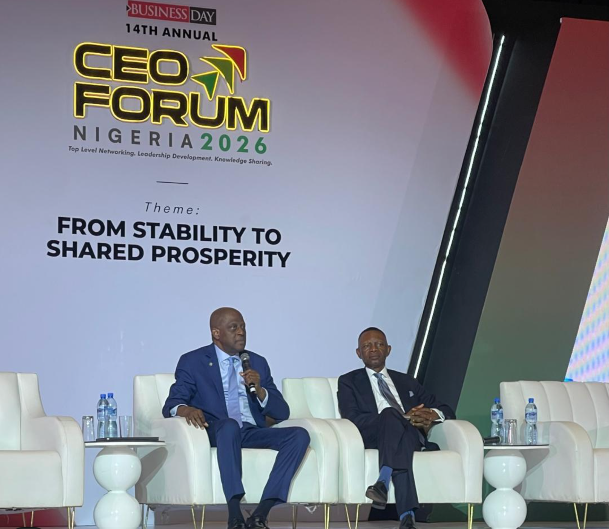
That was the consensus among policymakers, business leaders and economists at the 14th edition of BusinessDay’s CEO Forum 2026 on Thursday, where discussions shifted from celebrating recent reforms to confronting the harder question of how Africa’s most populous nation can convert stability into shared prosperity.
The forum, themed “From Stability to Shared Prosperity,” highlighted both sides of Nigeria’s economic story: stronger external buffers and improving investor confidence on the one hand, and persistent poverty, weak productivity, and inadequate infrastructure on the other.
Speaking during a fireside chat, Olayemi Cardoso, governor of the Central Bank of Nigeria (CBN), said Nigeria’s net foreign exchange reserves have climbed from roughly $3 billion at the onset of the country’s reform programme to about $40 billion, while gross external reserves have increased to approximately $52 billion, underscoring the restoration of confidence in the country’s foreign exchange market.
“When we started, the net exchange reserves figure was in the region of about $3 billion-plus. That figure created significant concern in the market,” Cardoso said.
According to him, the turnaround demonstrates the impact of monetary and exchange-rate reforms that have restored credibility to Nigeria’s external position.
“We’ve achieved hard-earned stability, and with stability comes potential for investment. With investment comes growth, and all our local CEOs should be part of that train that is moving,” he said.
The CBN governor argued that macroeconomic stability should now serve as a platform for increased private investment rather than an end in itself, urging domestic businesses to take advantage of improving economic conditions.
His comments come as Nigeria continues to rebuild external buffers following external shocks, sweeping reforms, including foreign exchange liberalisation and tighter monetary policies aimed at correcting long-standing market distortions.
This job in ensuring stability has certainly not been a walk in the park, Cardoso admitted. The CBN governor has had to make tough decisions in the process and work extraordinarily hard, ignoring criticisms to get to this level. According to him, Nigeria’s progress is top of mind for investors and development finance institutions who have continued to keep tabs on the nation’s wellbeing and economic policy.
Speaking earlier, Taiwo Oyedele, minister of Finance and coordinating minister of the Economy, said Nigeria is eyeing $100 billion in incremental economic value from expanding the country’s credit economy.
The minister said making the credit economy work more effectively was one of the key opportunities identified by the government in its plan to achieve a $1 trillion economy by 2030.
Stability alone will not create prosperity
However, the optimism surrounding stronger reserves contrasted sharply with fresh evidence presented by KPMG showing that Nigeria continues to trail comparable emerging economies on most measures of inclusive prosperity.
In a report unveiled at the forum, the advisory firm found that Nigeria met only two of fifteen indicators used to measure shared prosperity across four broad pillars: inclusive economic growth, well-being and living standards, equity and inclusion, and access to opportunity.
The assessment benchmarked Nigeria against Indonesia, Vietnam, Malaysia, Chile and Singapore using World Bank and IMF indicators.
According to the report, Nigeria’s 3.87 percent GDP growth remains below the level required to generate meaningful improvements in living standards.
The country’s GDP per capita of $1,224 is significantly below the benchmark average of about $10,000, while labour productivity growth remains subdued at 1.1 percent, compared with an average of 4.2 percent among peer economies.
The report also highlighted deeper structural challenges beyond headline economic growth.
Real household disposable income contracted by 2.63 percent, while 33 percent of Nigerians continue to live in multidimensional poverty—more than double the global average.
The findings suggest that although macroeconomic reforms have begun restoring confidence among investors, they have yet to produce broad-based improvements in household welfare.
Gas emerges as the missing industrialisation link
Beyond macroeconomic policy, industry leaders identified energy as the single biggest constraint preventing Nigeria from converting reforms into sustained economic expansion.
Adegbite Falade, managing director of Aradel Holdings, said gas already accounts for more than 80 percent of Nigeria’s electricity generation, making expanded gas infrastructure central to economic transformation.
“If we’re able to bring more gas to the table, we would be doing so much in enabling the environment and the economy,” he said.
Effiong Okon, chief executive officer-designate of Seplat Energy, described gas as Nigeria’s “industrialisation fuel,” arguing that fixing the country’s fragmented energy value chain could fundamentally reshape economic growth over the next five years.
“Five years from now, Nigeria should be running on gas,” Okon said.
Oladimeji Bashorun, chief executive officer of Energia, added that completing strategic infrastructure such as the AKK pipeline could unlock about 2.2 billion cubic feet of additional gas while improving commercial viability across the sector.
Energy executives said addressing pricing challenges, strengthening payment security and accelerating infrastructure investments would be critical to lifting millions of Nigerians out of energy poverty while supporting industrial production.
From difficult reforms to measurable outcomes
For Frank Aigbogun, publisher and chief executive officer of BusinessDay Media Limited, the country’s next policy objective should be ensuring that difficult reforms translate into tangible improvements in everyday lives.
Opening the conference, Aigbogun said Nigeria has undertaken some of its most significant macroeconomic reforms in decades across fiscal policy, monetary policy, foreign exchange management and regulation.
While acknowledging that opinions differ on the sequencing of those reforms, he argued that they have restored a degree of macroeconomic discipline that had long been absent.
The bigger challenge now, he said, is ensuring that the gains extend beyond financial markets into higher incomes, stronger businesses and more employment opportunities.

Join BusinessDay whatsapp Channel, to stay up to date
Open In Whatsapp