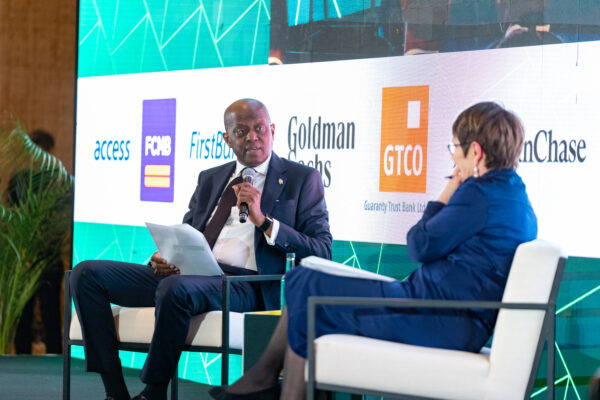
Speaking to a gathering of global financiers at The Peninsula London, Olayemi Cardoso, Governor of the Central Bank of Nigeria (CBN), declared the nation’s era of opaque financial management over.
Addressing the Africa Capital Forum during President Bola Tinubu’s UK State Visit, Cardoso signalled a definitive shift from stabilisation to capital mobilisation as Nigeria pursues a $1 trillion economy.
Cardoso acknowledged the severity of the crisis he inherited, noting that while inflation previously hit 37 percent and investors fled, the system has since seen 11 months of consistent disinflation.
“The financial system we had is dead and buried,” Cardoso told Odile Renaud-Basso, President of the European Bank for Reconstruction and Development (EBRD). “What we have now is a new system that has brought liquidity and transparency.”
Read also: CBN’s new spurs demand for automation as local AI platform claims early compliance edge
International observers provided a firm vote of confidence to anchor the Governor’s claims. Odile Renaud-Basso described the new framework as “open, transparent, and predictable,” while Ravi Bhatia, Director and Lead Analyst for Africa at S&P Global Ratings, confirmed the agency is “positive” on Nigeria’s outlook. Jonny Baxter, British Deputy High Commissioner in Lagos, noted that London remains the natural hub for this dialogue, with the UK accounting for nearly half of all capital inflows into Nigeria.
Transition to patient capital
The forum, moderated by senior executives from Standard Chartered and J.P. Morgan, emphasised a transition towards “patient capital” over speculative flows. Chris Chijiutomi, the head of Africa at British International Investment, argued that long-term equity is the only way to drive sustainable job creation, while Sanyade Okoli, special adviser to the President on Finance and Economy, noted that “investors are sticking with us” despite global flight-to-safety trends. This sentiment was echoed by Muhammad Sani Abdullahi, CBN Deputy Governor for Economic Policy, who reported that foreign reserves have now climbed above $50 billion.
Read also: UPDATED: Here are 31 banks that have met CBN’s capital rules
Nigeria’s banking titans, currently navigating a mandatory recapitalisation, framed these reforms as a launchpad for regional expansion. Roosevelt Ogbonna, Managing Director of Access Bank, pointed to a newfound “congruence” between fiscal and monetary policy that has restored reform credibility.
Meanwhile, Oliver Alawuba, Group Managing Director of United Bank for Africa, argued that currency stability allows Nigerian banks to “take home bigger transactions” across the continent, provided domestic power issues are resolved.
As the sector embraces digital transformation, Temi Popoola, Group Chief Executive Officer of Nigerian Exchange Group, described the market as being at a “massive inflection point” driven by technology. This tech-led growth is already reshaping the landscape, with Luis Oganes, Head of Global Markets Research at J.P. Morgan, noting Nigeria’s emergence as a premier fintech ecosystem.
To sustain this momentum, Phillip Ikeazor, the CBN deputy governor for Financial System Stability, assured investors that the current reforms are architected to outlast any single administration. The forum’s message was perhaps best distilled by Usman Okpanachi, the director of the Statistics Department at the CBN, who urged the international community to simply “follow the data.”

Join BusinessDay whatsapp Channel, to stay up to date
Open In Whatsapp