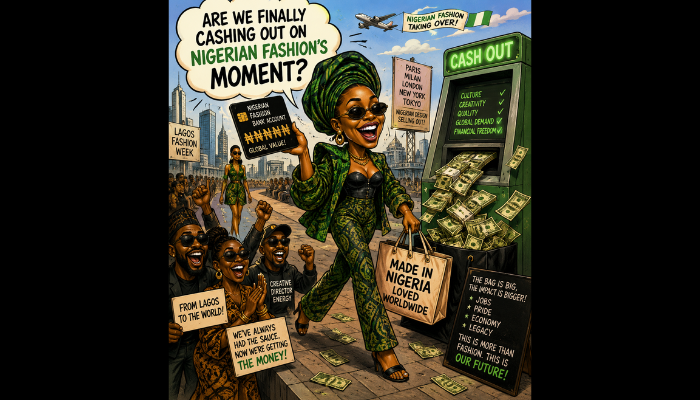
Every year, the Africa Magic Viewers’ Choice Awards produces looks that stop the internet. Beaded corsets. Hand-woven headpieces. Silhouettes that take weeks to construct. This year, those looks travelled far, all the way to the feeds of people who have never set foot in Lagos. But BusinessDay May Gen Z 2026 poll asked the uncomfortable question nobody wants to answer out loud: Is the industry actually making money from any of it?
The numbers are revealing. Nearly 38 per cent of respondents say only a select group of top designers ever benefit from AMVCA’s viral moments, while the rest are left in the shadows. Another 20 per cent say the clout is visible, but the money is not following fast enough. Only 27.5 per cent believe the visibility is genuinely converting into real orders and global clients.
It is a pattern that Afrobeats once knew intimately. Before streaming deals and world tours, the music was everywhere, and the cheques were not. The question Nigerian fashion is now facing is whether it can learn from that journey or is condemned to repeat it.
“Nigerian fashion has the potential to become a serious export economy like Afrobeats because the creativity and global appeal already exist,” one respondent wrote. “However, achieving that level of success will require stronger manufacturing, better infrastructure, consistent branding, and investment that can turn talent into a scalable global industry.”
Read also: Nollywood’s future takes shape through youth stories and platform evolution
The admiration gap
When asked whether a show-stopping AMVCA look influences their actual spending, 35 per cent of respondents said they admire the looks but cannot yet afford those designers. Another 25 per cent said the looks are “too art-forward”, spectacular on a red carpet, impractical for everyday life.
Only 10 per cent said they actively look up the designer after seeing the look.
This is the admiration gap, the space between cultural excitement and commercial transaction. It is where most of Nigerian fashion currently lives. The audience is watching. The audience is proud. The audience is just not yet buying.
“The onus falls on the designer to sell his or her designs as one-offs or multiple wearable outfits,” one respondent noted, before shifting focus. “What should be of more concern to the government is creating a garment production base, cotton grown in-country, wool-shearing or weaving clusters, and the provision of power supply.”
That shift in focus is telling. The creative product is not the problem. The infrastructure behind it is.
What is actually missing?
When the poll asked what is stopping AMVCA from generating the kind of revenue the Met Gala produces for the global fashion economy, 37.5 per cent pointed to the absence of a global retail footprint for Nigerian brands. A further 30 per cent said the event lacks major luxury sponsors with the networks to push it into international markets.
“It’s going to be very personal until it succeeds,” one respondent wrote of the journey into the global market. “There is a market, but the competition from well-established brands, such as Zara, doing Ankara prints, is significant. It is easier for established brands to copy or be inspired by Afro culture than for small brands to defend their price tags.”
The IP question surfaced repeatedly in open-ended responses. “The intellectual property ought to have been protected before it goes viral,” one respondent wrote plainly. “We need to do more for the IP assets in this sector.”
Another respondent, describing themselves as an international art dealer in contemporary Nigerian and African art, offered a practical prescription: “I would advise getting such designers into international fashion shows where they will gain exposure and access to major clothing brands that can help monetise their designs.”
Where should the investment go?
The poll’s sharpest finding may be this: when asked where government and private sector money should go, two options tied at 37.5 per cent each. Export programmes, getting Nigerian designers physically into global markets, and building a “Made in Nigeria” luxury identity internationally. Just 7.5 per cent want resources directed at creating a Lagos Fashion Week to rival Paris or Milan.
“We need to ship thousands of outfits weekly,” one respondent wrote. “Where is the global brand that is actually pushing out the clothing?”
On the question of who should profit from a viral AMVCA moment, respondents were split almost evenly. Designer and celebrity each drew 32.5 per cent support when framed as a collaboration. Thirty per cent said the Nigerian fashion industry as a whole should benefit through better IP and licensing frameworks. Only 5 per cent said the celebrity alone deserves the reward.
The afrobeats comparison
Respondents were asked directly: Will Nigerian fashion ever become the kind of serious export economy Afrobeats has? The answer, overwhelmingly, was yes, but nearly every affirmative came with conditions attached.
“Yes, I believe Nigerian fashion can become a serious export economy like Afrobeats, but it will take more structure and coordination,” one respondent wrote. “The talent, creativity, and production capacity already exist, especially in places like Aba International Market. What’s missing is strong global branding, quality standardisation, financing, manufacturing infrastructure, and distribution.”
“Afrobeats succeeded because the industry became organised around exports, collaborations, streaming, and global partnerships. Fashion can follow the same path.”
Another respondent offered the most practical summary of what needs to happen after a look goes viral: “The designer should immediately capitalise on the attention by pushing international PR, opening global order channels, securing strategic partnerships, and converting the visibility into sales, distribution deals, and long-term brand positioning, before the moment fades.”
Read previous poll results here.

Join BusinessDay whatsapp Channel, to stay up to date
Open In Whatsapp