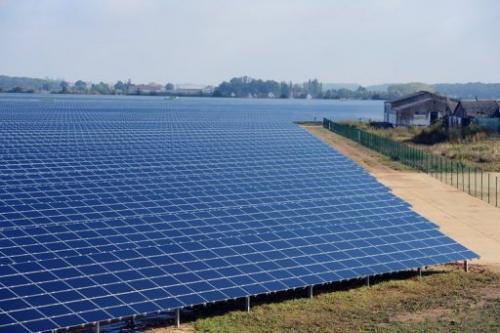
A major private sector investment aimed at tackling Nigeria’s chronic electricity shortage while boosting industrial production is taking shape in Niger State, where Abuja Steel Mills Limited plans to build what could become sub-Saharan Africa’s largest solar-powered steel manufacturing facility.
The project, which will be developed by Abuja Steel Mills Limited, a subsidiary of African Industries Group (AIG), is expected to combine large-scale renewable energy generation with steel production, offering a model for energy-intensive industries seeking alternatives to Nigeria’s unreliable national grid.
The Niger State Government has allocated 500 hectares of land for the project in Sabon Wuse, Tafa Local Government Area, near the nation’s capital Abuja, where the groundbreaking ceremony was held in late June. The proposed facility will be located alongside the AIG Industrial Park.
The investment comes at a time when persistent electricity shortages continue to undermine Nigeria’s economic growth, raising production costs, discouraging investment and forcing manufacturers, businesses and households to depend heavily on diesel and petrol generators. Despite having one of Africa’s largest economies, Nigeria still struggles to generate enough electricity to meet demand, with frequent grid collapses and inadequate transmission infrastructure limiting power supply to industries and consumers.
Manufacturers have repeatedly identified inadequate electricity as one of the biggest constraints to competitiveness, with many firms spending billions of naira annually on self-generation. The situation has contributed to factory closures, reduced industrial output and higher prices of locally manufactured goods. For investors in energy-intensive sectors such as steel production, access to stable and affordable electricity remains critical to sustaining operations.
Raj Gupta, chairman of African Industries Group, described the land allocation as a historic milestone, saying the project is designed to transform both Nigeria’s steel industry and its renewable energy landscape.
According to Gupta, the proposed facility could become the largest solar power installation in Nigeria and possibly the biggest in West Africa and sub-Saharan Africa. He said the investment reflects the company’s long-term confidence in Nigeria’s industrial potential and its commitment to integrating renewable energy into heavy manufacturing.
He said the project would position Nigeria more prominently on the global steel production map while demonstrating the country’s capacity to attract large-scale investments in clean energy infrastructure.
Mohammed Bago, governor of Niger State, said the state government intends to expand its industrial corridor by gazetting an additional 200,000 hectares of land stretching towards the Kaduna State border to accommodate more manufacturing investments.
According to him, the state’s comparative advantages include its vast land resources, abundant solar radiation, hydropower assets and strategic access to the Ajaokuta-Kaduna-Kano gas pipeline. He said these assets position Niger State to become one of Nigeria’s leading industrial hubs capable of supporting large-scale manufacturing and energy projects.
Bago noted that the availability of electricity from the Kainji, Jebba, Zungeru and Shiroro hydroelectric dams, combined with growing renewable energy investments, offers significant opportunities for industries seeking reliable power.
Joseph Tegbe, Minister of Power, described the land handover as an act of industrial statesmanship capable of accelerating economic transformation through strategic collaboration between government and private investors.
Shuaibu Audu, Minister of Steel Development, said African Industries Group has evolved into one of the largest steel producers in Nigeria and West Africa, employing about 10,000 workers across its operations. He said investments of this scale would strengthen domestic steel production, reduce dependence on imported steel products and deepen local value addition.
John Enoh, Minister of State for Industry, Trade and Investment, said the project aligns with the Federal Government’s industrialisation agenda by supporting import substitution, expanding manufacturing capacity and creating employment opportunities across the steel value chain.
Founded more than five decades ago in the early 1970s, African Industries Group has grown into one of Nigeria’s largest manufacturing conglomerates, with operations spanning steel, mining, chemicals, glass and real estate. The company operates about 31 manufacturing plants across the country. Raj Gupta serves as chairman of the group, while Alok Gupta is its managing director.
Although details of the project’s investment value, production capacity and construction timeline were not disclosed during the groundbreaking ceremony, industry observers say the development reflects a growing trend among private investors to build dedicated power infrastructure alongside manufacturing facilities in response to Nigeria’s persistent energy constraints.
Analysts argue that renewable energy is becoming increasingly attractive for industrial users as rising fuel costs, grid instability and global climate commitments encourage companies to adopt cleaner and more reliable sources of electricity. Solar-powered industrial projects also offer the potential to reduce carbon emissions while improving operational efficiency and long-term competitiveness.
For Nigeria, where electricity deficits have remained a major obstacle to economic diversification and industrial development for decades, investments that combine manufacturing with independent power generation could help bridge infrastructure gaps that have slowed the country’s industrial ambitions. If successfully implemented, the Niger State project could serve as a template for future industrial developments seeking to overcome power shortages through integrated renewable energy solutions.

Join BusinessDay whatsapp Channel, to stay up to date
Open In Whatsapp