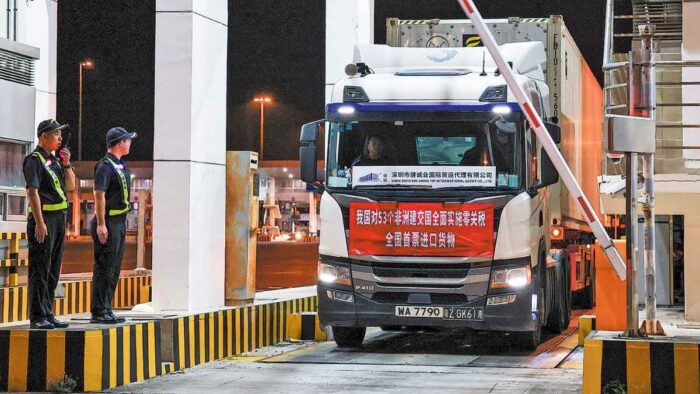
Nigeria was absent from the first batch of shipments that entered China under the country’s expanded zero-tariff policy to African countries on May 1.
A truck carrying 24 metric tons of fresh apples from South Africa cleared customs at Shenzhen Bay Port within hours of the policy going live, becoming the first shipment under the initiative, according to local Chinese newspapers and State-run China Global Television Network (CGTN).
In Shanghai, 516 tonnes of oranges from Egypt were received under the new measures, benefiting from a tariff exemption amounting to 320,000 yuan (about $47,000). Another 24 tonnes of avocados from Kenya arrived in Shanghai, while over 6,000 bottles of wine from South Africa were cleared through customs at the Changsha Huanghua International Airport, all benefiting from relaxed tariffs.
Nigeria, China’s second-largest trading partner on the continent, was missing from the early wave of exporters despite having nearly three months’ notice before the policy went live.
In February this year, at the 39th African Union Summit, Xi Jinping, president of China announced that from May 1, Chinese buyers will import duty-free from all 53 African countries with diplomatic ties with the country. This came on the back of an initial notification of intent in 2025.
Nigeria’s slow action has raised concerns that it may once again struggle to capitalise on a major export opportunity at a time the government is seeking to diversify away from oil.
“The zero tariffs are expected to help diversify African export products, increase their added value, and optimise export structures, benefiting farmers and MSMEs, supporting job creation, and boosting people’s livelihoods,” Benedict Obhiosa, executive secretary of the Manufacturers Association of Nigeria Export Promotion Group (MANEG), told BusinessDay.
Yet he warned that Nigeria risks underperforming because of familiar structural weaknesses, including high shipping costs, poor cold chains for perishables, port inefficiencies, slow certifications, and coordination issues between government agencies.
“There should be more awareness for manufacturing companies to take advantage of the opportunities by joining webinars or informative sessions, reviewing the product eligibility list, and taking advantage of the policy,” Obhiosa added.
Yet exporters who spoke to BusinessDay admitted they were unaware the policy existed or has already taken effect despite belonging to organised trade associations.
BusinessDay could not confirm that any major awareness sessions or coordinated mobilisation efforts had been carried out by relevant government agencies or export promotion bodies in the months leading up to the rollout. MANEG itself admitted it had not officially engaged ministries, departments and agencies on the initiative despite its role in non-oil export advocacy. The Ministry of Trade did not immediately respond to questions.
Nigeria has long struggled to build a balanced trade relationship with China. Trade between both countries reached $7.7 billion in the first quarter of 2026, but Nigerian exports accounted for just $929.3 million, or roughly 12 percent of total trade.
Data from the International Trade Centre shows that Nigeria’s exports to China remain dominated by mineral fuels, oil seeds and raw materials. Industry players say the new Chinese policy could help change that if properly utilised.
“Every Agro-processing and value-added item should take advantage of this policy. Some processed agricultural goods, and manufactured products like cocoa products, sesame seeds, cashew nuts, textile garments, leather goods, etc., where Nigeria has raw material advantages, and some processing base for some products, are a good start,” MANEG told BusinessDay.
The timing of China’s tariff waiver comes as African economies reassess their trade relationships after the tariff hikes imposed by Donald Trump, the president of the United States last year.
Nigeria was hit with a 15 percent tariff wall, increasing pressure on policymakers to find alternative export destinations and reduce dependence on traditional Western markets.
The uncertainty surrounding the future of the African Growth and Opportunity Act (AGOA), despite its temporary extension through December 2026, has further pushed Nigeria to pursue new trade alliances. Earlier this year, Nigeria signed a Comprehensive Economic Partnership Agreement with the United Arab Emirates, granting duty-free access to more than 7,300 Nigerian products.
Read also: Nigeria’s exporters pivot to China amid US uncertainty
Yet not everyone is convinced the policy will automatically benefit Nigeria’s industrial ambitions. Otunba Oladunjoye, chairman of the Cocoa Processors Association of Nigeria, warned that duty-free access alone does not guarantee competitiveness if Nigeria continues exporting mostly raw materials.
“At face value, it is a positive development. But we must ask whether the removal of tariffs is going to bring competitiveness,” Oladunjoye said. According to him, many Chinese buyers still prefer unprocessed raw commodities from Africa rather than finished or semi-processed goods, reinforcing a pattern in which African countries export primary products and import higher-value manufactured items.
“What they need are raw materials for their industries, while we bring back the finished goods,” he said. Oladunjoye argued that Nigeria’s weak industrial base has already forced many local processors out of business, leaving mostly foreign-owned factories still operating in manufacturing.
Nigeria launched its 2025 industrial policy in February, promising to move from consumption-driven to production-driven economy by increasing manufacturing’s contribution to GDP to 25 percent by 2030. China’s tariff waiver has become an early test of whether those policies can deliver.

Join BusinessDay whatsapp Channel, to stay up to date
Open In Whatsapp