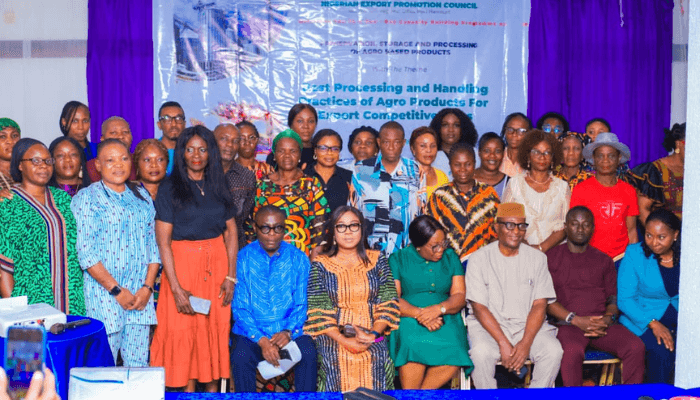
The Nigerian Export Promotion Council (NEPC) has boosted processing and handling capacity of exporters in the south-south zone.
Addressing participants at the one-day training, Ngozi Ibe, the regional coordinator of NEPC, said the training was on preservation, storage and processing of agro-based products to achieve competitiveness.
Ibe who said the day was a strategic gathering of minds and hands being producers, processors, entrepreneurs, stakeholders, regulators, and development partners who understand that Agriculture remains one of the nation’s strongest economic pillars.
She said: “Beyond providing food for our tables, agriculture creates jobs, supports families, drives rural development, and contributes significantly to national revenue.
“We, however, must also acknowledge a hard truth: a significant portion of our agricultural produce never reaches its full market value. “Poor handling, inadequate preservation methods, substandard storage facilities, and limited knowledge of export requirements often lead to high post-harvest losses and rejection in international markets. The effort invested in planting and harvesting is sometimes undone by what happens post harvest.”
She said the reality was sobering in 2025 because the Food and Agriculture Organization (FAO) estimated that about 14% of food produced globally was lost after harvest, before it even reached the market.
“In Nigeria and across Sub-Saharan Africa, the situation is even more concerning, with losses for perishable crops such as fruits and vegetables reaching up to 50%, and grains averaging between 20% and 30%.”
Globally, she said, about one-third of food produced is lost annually. This means that a large share of the hard work of our farmers does not translate into income. “It represents lost revenue, reduced export volumes, and missed opportunities for growth. At a time when global trade standards—guided by institutions such as the World Trade Organization—are becoming increasingly stringent, we simply cannot afford to lose value at the post-harvest stage.”
She said this was why the day’s theme was very important. “Export competitiveness is not only about producing more, it is about producing better and handling smarter.
“Global markets are increasingly guided by strict quality and safety standards. Institutions such as the World Trade Organization and the Food and Agriculture Organization continue to emphasize sanitary and phytosanitary measures, traceability systems, food safety protocols, and proper packaging as critical requirements for international trade.”
The regional coordinator gave tips which she said non-oil exporters must understand, including proper preservation techniques help extend shelf life and maintains nutritional value. The other is that appropriate storage systems prevent spoilage, pest infestation, and contamination.
“Good handling practices maintain product integrity from farm to market. Value addition through processing enhances product appeal and increases profitability. Compliance with international standards builds credibility and opens access to premium markets.”
She went on: “When we get these processes right, we reduce waste, improve quality consistency, and strengthen our brand reputation in the regional and global markets. More importantly, we increase income for farmers, processors, exporters, and everyone along the value chain.
“As organizers of this programme, we are proud to have put together this important initiative as part of our continuous commitment to strengthening capacity within the agricultural sector.”
Chinyere Nwoga, President, Port Harcourt Chamber of Commerce, Industry, Mines and Agriculture (PHCCIMA), delivered goodwill message where she called for practical solutions to cut down on post-harvest losses to boost non-oil export.
One of the resource persons, Ofon Udofia, executive secretary of the Institute of Export Operations and Management Nigeria Ltd, (IEOM), equipped the participants with international best practices on agro based products including handling and processing for the international market.
Umandu Inana, zonal coordinator of the Nigerian Stored Products Research Institute made a presentation on ‘Standard Operating Procedures and Practical Hands-on and Guide on Preservation of Agro-Foods for Export’.

Join BusinessDay whatsapp Channel, to stay up to date
Open In Whatsapp