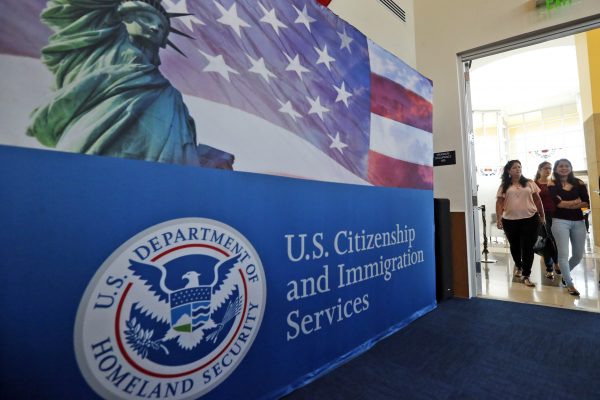
The United States naturalised 47,819 Nigerians as citizens between 2019 and 2023, according to the latest U.S. Naturalisations Annual Flow Report released by the Department of Homeland Security (DHS).
The report, updated in August 2025 and compiled by the Office of Homeland Security Statistics (OHSS), draws its figures from the N-400 naturalisation application forms and electronic case files used by U.S. Citizenship and Immigration Services (USCIS) to track applications from fingerprinting to oath ceremonies.
Data revealed that 8,930 Nigerians were naturalised in the 2020 fiscal year, covering October 2019 to September 2020, a period heavily disrupted by the COVID-19 pandemic, which halted oath ceremonies for 11 weeks.
In 2021, the number jumped to 10,921 as USCIS worked through its pandemic backlog.
The upward trend continued in 2022, when 14,438 Nigerians took the oath of citizenship, the highest-ever annual tally for the country and a 32 per cent increase from the previous year.
Although the figure declined to 13,530 in 2023, the four-year total still placed Nigeria among the top 30 source countries for new American citizens, alongside the Democratic Republic of the Congo (DRC), Ethiopia, Ghana, and Kenya.
Read also: US Supreme Court backs Trump on aggressive immigration raids
Together, Africans accounted for 11 per cent of all U.S. naturalisations in 2022 and 2023, the highest share on record, compared to an average of 9.6 per cent in the decade from 2010 to 2019.
It further revealed that between 2020 and 2023, African naturalisations in the U.S. surged by 43 per cent, the sharpest growth of any continent.
Globally, Mexico remained the largest source country for new citizens with 437,697 naturalisations during the four years, followed by India (230,164), the Philippines (180,073), Cuba (159,393), the Dominican Republic (116,523), Vietnam (113,487), China (113,126), Jamaica (77,335), El Salvador (73,489), and Colombia (65,486). Collectively, these 10 countries accounted for more than half of the 3.3 million naturalisations recorded.
Under the Immigration and Nationality Act of 1952, lawful permanent residents (green card holders) can apply for naturalisation after five years, or three years if married to a U.S. citizen.
Applicants must demonstrate continuous residence, meet physical presence requirements, show good moral character, and pass English literacy and civics tests.
USCIS conducts FBI name checks and fingerprint searches, interviews applicants, and reviews their immigration histories before approving them for the mandatory oath ceremony before a judge or designated official.
“Naturalisation confers U.S. citizenship upon applicants who have fulfilled the requirements established in the Immigration and Nationality Act,” DHS stated, adding that application volumes and approvals often fluctuate as some petitions are denied or carried over into later years.
U.S. naturalisations stood at 878,460 in 2023, a decline from 969,000 in 2022, but higher than the 814,000 recorded in 2021.
The 2021 total represented a 34 per cent increase over the decade-long average of 721,000 between 2010 and 2020.

Join BusinessDay whatsapp Channel, to stay up to date
Open In Whatsapp