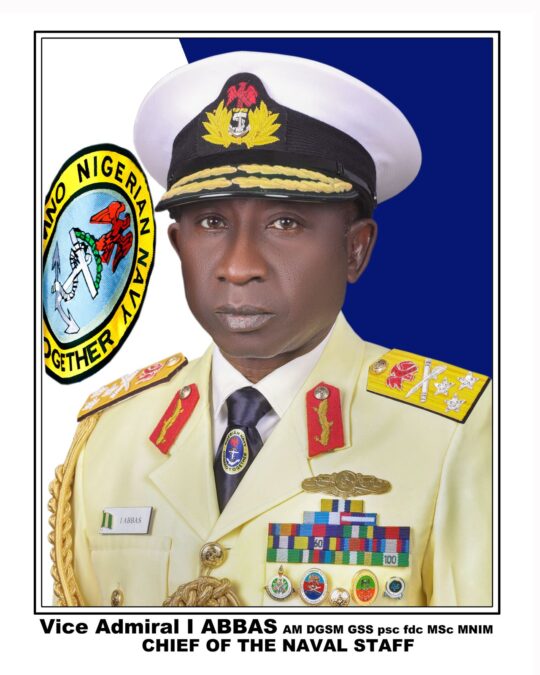
The Nigerian Navy has blamed persistent crude oil theft and pipeline vandalism in the Niger Delta on weak relationships between host communities and International Oil Companies (IOCs), warning that unresolved disputes around oil facilities continue to create opportunities for criminal networks operating across Nigeria’s waterways.
The Navy said it is intensifying its crackdown on oil theft syndicates through expanded surveillance operations, deployment of drones and advanced maritime platforms, as well as closer collaboration with other security agencies to protect critical oil infrastructure and boost crude production.
Just as it declared that its sustained crackdown on crude oil theft and illegal refining operations in the Niger Delta is yielding significant results, with Nigeria’s crude oil production climbing to a five-year high amid intensified maritime security operations.
Speaking during a press briefing marking the Nigerian Navy’s 70th anniversary celebrations in Abuja on Thursday, Akinola Olodude, Chief of Policy and Plans, said the Navy had remained at the forefront of efforts to combat oil theft both on the high seas and within Nigeria’s intricate inland waterways.
According to him, the anti-crude oil theft operations are being carried out in collaboration with other security agencies and stakeholders in the Niger Delta as part of the federal government’s efforts to raise crude production and safeguard strategic national assets.
Olodude disclosed that Nigeria’s average crude oil production rose from about 1.25 million barrels per day in January 2023 to approximately 1.71 million barrels per day as of April 2026, a development he attributed partly to intensified naval operations against pipeline vandalism, illegal refining camps, and maritime crude theft syndicates.
He explained that the operations align with the Federal Government’s directive to boost crude oil production to three million barrels per day by 2030, with an interim target of 2.5 million barrels daily by 2027.
“The Nigerian Navy has been leading in executing anti-crude oil theft and anti-illegal refinery operations over the years in collaboration with sister services and security agencies within the Niger Delta,” he said.
The naval chief identified the difficult terrain of the Niger Delta, sprawling creeks, and community-related disputes as some of the major obstacles confronting the anti-oil theft campaign.
According to him, criminal networks exploit both offshore and inland waterways to siphon crude oil, while strained relationships between oil-producing communities and International Oil Companies (IOCs) sometimes create vulnerabilities around critical oil infrastructure.
“These practices take place both at sea and also within the inland waters.
“One consideration is the terrain. Another consideration is also the community. There is a responsibility that the IOCs have because the communities are the ones within those areas where pipelines and investments are located”, Olodude stated.
He stressed that stronger engagement between oil firms and host communities would significantly reduce sabotage and pipeline vandalism.
“It is important that the IOCs have good engagement with the communities so that the communities themselves can take ownership of these national assets,” he added.
Olodude noted that where disputes exist between communities and oil companies, the Navy is often compelled to intervene to stabilise the situation and prevent criminal exploitation of the tensions.
He revealed that the Navy is increasingly deploying advanced surveillance technologies, including drones capable of operating across dense foliage and difficult riverine environments, to detect illegal activities and improve monitoring of oil infrastructure.
“The Nigerian Navy keeps improving through the acquisition of requisite platforms that can move within those terrains and through technologies such as drones that can maneuver across foliages to detect and carry out surveillance,” he said.
The Navy’s intensified anti-oil theft operations come amid efforts to reposition Nigeria’s maritime security architecture and restore investor confidence in the oil and gas sector.
Olodude said Nigeria had remained off the global list of piracy-prone nations since 2022, a development he noted had helped lower shipping insurance and trade costs within the Gulf of Guinea.
He added that the Navy’s growing operational capacity, fleet expansion, and strategic regional partnerships have strengthened maritime security across West Africa.
The Navy also highlighted its increasing role in multinational maritime security initiatives, including the newly established Combined Maritime Task Force for the Gulf of Guinea, endorsed by the African Union Peace and Security Council in April 2025.
The multinational force, headquartered in Lagos, includes Nigeria, Ghana, Liberia, Sierra Leone, and The Gambia, and is expected to coordinate efforts against transnational maritime crimes such as oil theft, piracy, smuggling, and illegal trafficking across the Gulf of Guinea’s over 6,000-kilometre maritime corridor.
Olodude said the official launch of the task force would form part of activities marking the Navy’s 70th anniversary celebrations scheduled to run until June 4, 2026.
He noted that President Bola Tinubu would review an international fleet display at the Eko Atlantic Waterfront in Lagos and commission three naval vessels into service during the anniversary events.
The Navy also announced plans to host heads of navies from Africa and other regions, alongside maritime security experts, at the sixth Symposium of the Gulf of Guinea Navies and Coast Guards for Africa.
The symposium, themed “Leveraging Technology for Enhanced Maritime Security in Africa,” will focus heavily on combating evolving threats such as crude oil theft, piracy, and other forms of maritime crime through innovation and regional collaboration.
Olodude further stated that the Nigerian Navy had evolved from a modest coastal force established in 1956 with only 250 personnel and 11 inherited vessels into what he described as Africa’s strongest naval fleet, according to the 2026 Global Firepower ranking.
He said the Navy now boasts over 34,000 personnel, growing shipbuilding capabilities, and expanding international operational reach.
“As we look towards the next decade, the evolving maritime security challenges demand innovative strategies beyond traditional frameworks,” he said.
He added that the Navy remains committed to protecting Nigeria’s maritime interests and sustaining pressure on crude oil theft networks threatening the country’s economic stability.

Join BusinessDay whatsapp Channel, to stay up to date
Open In Whatsapp