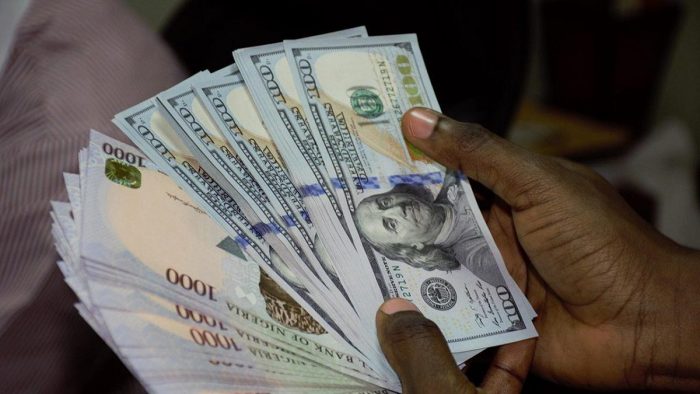
The naira gained strength on Monday, appreciating to N1,650 per dollar in the parallel market, as the U.S. dollar experienced its most significant weekly loss.
This marked a 0.6 percent gain, or N10, from the N1,660 per dollar recorded on Friday in the black market.
In the official foreign exchange (FX) market, the naira closed out last week on Friday at N1,531 per dollar, reflecting an improvement over the prior week. This represents a 1.1 percent appreciation week-on-week, with the dollar quoted at N1,531, N17 stronger than the previous Friday’s N1,548 rate in the Nigerian Foreign Exchange Market (NFEM), according to data from the Central Bank of Nigeria (CBN).
The U.S. dollar saw a decline on Friday, positioning it for its biggest weekly loss in more than a year after President Donald Trump hinted at a more lenient approach toward tariffs on China. This uncertainty surrounding trade policy contributed to volatility in equity markets.
The U.S. dollar dropped as much as 0.8 percent against a basket of currencies on Friday but narrowed its losses to a 0.65 percent drop by day’s end. Despite this recovery, the dollar still faced its most significant weekly decline since November 2023, down by 1.8 percent since Monday.
In an interview with Fox News, Trump discussed his recent conversation with President Xi Jinping, calling it amicable and expressing optimism about reaching a trade deal with China. “We have one very big power over China, and that’s tariffs, and they don’t want them. I’d rather not have to use it, but it’s a tremendous power over China,” Trump remarked.
Muda Yusuf, CEO of the Centre for the Promotion of Private Enterprise (CPPE), highlighted ways the Trump’s administration could affect the naira. Trump’s policies could potentially strengthen the dollar, as indications point to increased U.S. investment and a rise in employment. Yusuf noted that there have already been signs of this in the stock market, where investor confidence is on the rise, which in turn could have an impact on the currency’s strength.

Join BusinessDay whatsapp Channel, to stay up to date
Open In Whatsapp