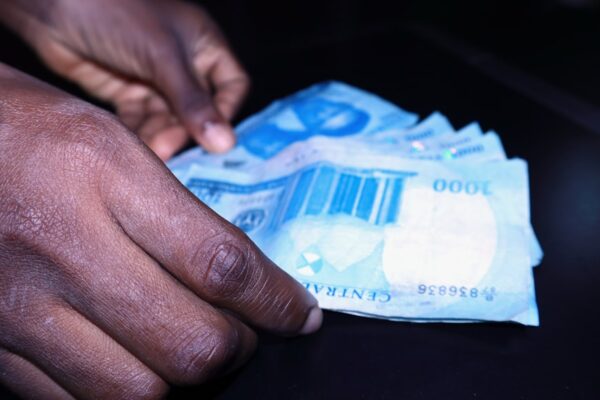
The naira has maintained stability relative to the dollar in the official foreign exchange (FX) market as stronger foreign exchange inflows, rising external reserves and improved market liquidity continued to support the local currency.
Data published by the Central Bank of Nigeria (CBN) showed that the naira was quoted at N1,380.11 per dollar on Thursday, virtually unchanged from N1,380.08 recorded on Wednesday at the Nigerian Foreign Exchange Market (NFEM).
Interbank turnover increased to $195.37 million on Thursday, marking a 55.56 percent jump from $125.58 million recorded on Wednesday, indicating stronger market activity. However, the number of interbank deals declined slightly by 3.97 percent from 126 on Wednesday to 121 on Thursday.
Although the NFEM deals and turnover figures were not available as at the time of reporting, deals had increased slightly by 2.2 percent from 320 to 327 between Tuesday and Wednesday. Total turnover at the NFEM window on Wednesday also rose to $779.02 million, representing a 21.02 percent increase from $660.25 million recorded on Tuesday.
Read also: Naira cools to two-month low despite rising liquidity, reserves
In the parallel market, also known as the black market, the local currency opened at N1,395 per dollar on Friday morning, unchanged from Thursday’s closing rate. Consequently, the gap between the official and parallel market exchange rates narrowed to N15 per dollar from N20.
Nigeria’s external reserves, which provide the CBN with the firepower to support the naira, maintained their steady growth, rising to $51.20 billion as of June 24, 2026. This represents a 36.86 percent increase from $37.41 billion recorded in the corresponding period of 2025, according to data published on the CBN’s website.
The improved liquidity in the FX market comes as the CBN’s latest monthly economic report showed that total foreign exchange inflows into the economy climbed to $12.2 billion in January 2026, up from $8.4 billion in December 2025 and $9.6 billion recorded in the corresponding period of the previous year.
The increase was driven largely by stronger autonomous inflows, which accounted for about 62 percent of total FX inflows during the month. In absolute terms, autonomous inflows rose by 60 percent month-on-month to $7.6 billion, while inflows through the CBN also increased by 60 percent to $4.7 billion.
The stronger inflows, combined with a sharp decline in FX demand, resulted in a record net FX surplus of $9.2 billion in January, significantly higher than the $3.1 billion recorded in December and the $4.8 billion posted a year earlier.
Read also: Naira steadies as external reserves surpass CBN target
According to the report, aggregate FX outflows declined by 43 percent month-on-month and 38 percent year-on-year to $9.2 billion as post-festive trade-related payments eased and corporate demand for foreign exchange weakened.
CBN outflows moderated by 48 percent month-on-month to $1.6 billion, reflecting reduced official FX sales during the period. This was consistent with activity at the NFEM window, where FX sales by the apex bank dropped by 95 percent month-on-month to $34 million in January.
Similarly, autonomous outflows declined by 37 percent month-on-month to $1.4 billion, reflecting softer trade-related transactions.
Analysts at Quest Merchant Bank said the strong inflow conditions have improved FX market liquidity and helped sustain relative stability in the naira despite lower levels of official intervention.
Looking ahead, the analysts expect FX flows into the Nigerian market to remain in surplus, supported by the CBN’s ongoing reforms, elevated interest rates and liquidity management measures aimed at improving market liquidity, preserving external reserves and sustaining naira stability.

Join BusinessDay whatsapp Channel, to stay up to date
Open In Whatsapp