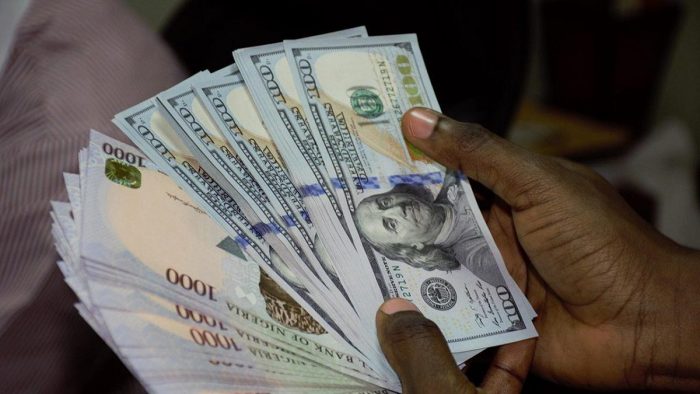
The official and parallel-market exchange rates for the naira converged for the first time in nearly two years on Thursday, according to data tracked by BusinessDay.
The naira was quoted at N1,510 at the parallel market on Thursday, at par with the official closing rate of N1,510/$ on Wednesday.
The last time both rates were at par was in June 2023.
The exchange rate crashed in the black market after the Central Bank of Nigeria (CBN) extended its dollar sales to Bureau De Change Operators (BDCs) till May 30 2025. The apex bank also retained its benchmark interest rate at 27.5 percent on Thursday.
Read also: Nigeria’s Naira rebound: Stability or temporary relief?
The current rate in the black market brings the naira’s year to date gain to N155/$ or 10.3 percent, compared to N1,665 quoted at the beginning of the year, according to data from street traders and online platforms that collate foreign exchange (FX) data.
At the Nigerian Foreign Exchange Market (NFEM), the nation’s official forex market, the naira steadied at the rate of N1,510 for the past two trading days, resulting in the exchange rate convergence.
Olayemi Cardoso, governor of the CBN said on Thursday that the exchange rate differential between the official market and the retail bureau has come down to less than one percent at the last count.
He disclosed this while briefing Journalists on the outcome of the first two-day Monetary Policy Committee (MPC) meeting in the year, on Thursday in Abuja.
He said the committee was unanimous in its decision to hold all parameters and thus decided to retain the Monetary Policy Rate (MPR) at 27.50 percent, retain the asymmetric corridor around the MPR at plus 500 minus 100 basis points, retain the cash reserve ratio (CRR) of deposit money banks at 50 percent and merchant banks at 16 percent, and to retain the liquidity ratio at 30 percent.
Read also: Naira masks Nigeria struggling non-oil exports
“At this meeting, the Monetary Policy Committee noted with satisfaction recent macroeconomic developments, which are expected to positively impact price dynamics in the near to medium term. (These include the stability in the foreign exchange market, with the resultant appreciation of the exchange rate and the gradual moderation in the price of PMS. Members, however, were not oblivious to the risk of persisting inflationary pressures, driven largely by food prices,” he said.

Join BusinessDay whatsapp Channel, to stay up to date
Open In Whatsapp