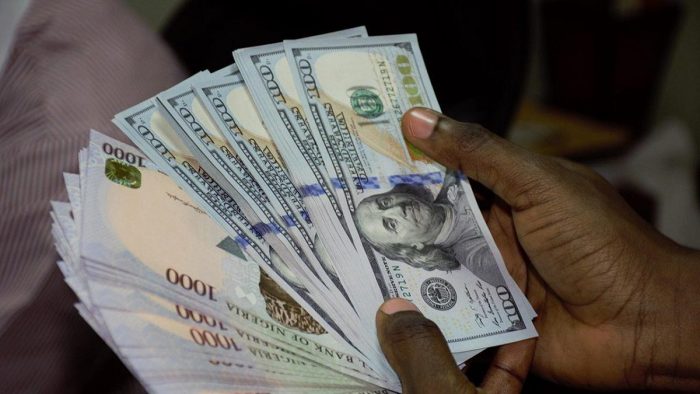
The naira on Tuesday strengthened to a record high of N1,401.22 per dollar at the official foreign exchange (FX) market, marking its strongest level since the introduction of the Electronic Foreign Exchange Matching System (EFEMS).
Data released by the Central Bank of Nigeria (CBN) showed that the local currency appreciated by 1.26% on the day, as the dollar was quoted at N1,401.22, representing a gain of N17.73 compared with N1,418.95 recorded on Monday at the Nigerian Foreign Exchange Market (NFEM).
The data revealed that FX market participants placed bid as high as N1,400 per dollar.
Read also: Why CBN $51bn reserves target matters for Naira
The appreciation at the official window came amid relative stability in the parallel market, also known as the black market, where the naira closed flat at N1,485 per dollar.
Nigeria’s external reserves have continued on a steady upward trajectory, providing additional support for the domestic currency. According to figures published by the CBN on its website, external reserves rose to $46.03 billion as of January 26, 2026, reflecting sustained inflows and improved confidence in the foreign exchange market.
Analysts largely expect the naira to remain within a relatively stable range in the medium term. Many projections suggest the currency will trade between N1,400 and N1,500 per dollar this year, supported by improved FX liquidity and ongoing macroeconomic reforms.
Tilewa Adebajo, chief executive officer of CFG Advisory, said the naira is likely to trade within the N1,400 to N1,500 per dollar band, citing strengthening fundamentals. According to him, ongoing reforms in the oil sector, rising foreign capital inflows, and stronger diaspora remittances are combining to underpin exchange rate stability and sustain confidence in the FX market.
Similarly, the Nigerian Economic Summit Group (NESG) has projected that the naira will trade around N1,480 to the dollar in 2026. The group also expects Nigeria’s external reserves to rise steadily to about $52 billion over the same period, driven by the consolidation of recent macroeconomic reforms and sustained stabilisation efforts.
The CBN’s own outlook aligns broadly with these expectations. The apex bank assumes an average exchange rate of N1,451.63 per dollar in the Nigerian Foreign Exchange Market during the fourth quarter of 2025, with a further moderation to around N1,400 per dollar in 2026. This projection is anchored on expectations of improved FX market efficiency, stronger capital inflows, a current account surplus, and a broad-based economic recovery.
The recent strengthening of the naira has coincided with reforms in the FX market architecture. On October 3, 2024, the Central Bank of Nigeria announced the introduction of the Electronic Foreign Exchange Matching System, a platform designed to curb speculative activities and improve transparency and price discovery in Nigeria’s foreign exchange market.
Read also: Cadbury makes first profit in two years on naira rally
The EFEMS platform, which is used by authorised dealers in the Nigerian Foreign Exchange Market, became fully operational on December 2, 2024, following a two-week test run conducted in November. Since its launch, market participants have pointed to improved confidence, better price alignment, and enhanced transparency as key benefits supporting recent movements in the naira.

Join BusinessDay whatsapp Channel, to stay up to date
Open In Whatsapp