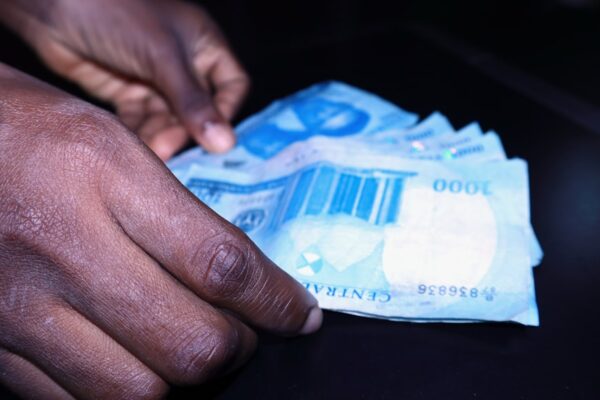
The naira extended its gains against the dollar in the official foreign exchange (FX) market on Thursday, supported by improved dollar liquidity and stronger external reserves, despite a decline in market turnover.
Data published by the Central Bank of Nigeria (CBN) showed the naira appreciated marginally by N1.87 as the dollar closed at N1,367.76 on Thursday, representing a 0.14 percent gain from N1,369.63 quoted on Wednesday at the Nigerian Foreign Exchange Market (NFEM).
In the parallel market, however, also known as the black market, the local currency weakened by N7 to close at N1,407 per dollar on Thursday, a 0.5 percent decline from N1,400/$1 recorded on Wednesday. As a result, the spread between the official and parallel market rates widened to 2.93 percent from 1.8 percent the previous day.
Activity at the interbank segment of the FX market slowed, with total turnover declining by 19.76 percent to $334.13 million on Thursday from $416.42 million on Wednesday. The number of transactions also fell to 122 deals from 198 recorded a day earlier.
Although NFEM turnover and deal data for Thursday were unavailable at the time of filing this report, the market had recorded stronger trading activity earlier in the week. The number of deals at the NFEM window rose by 33.23 percent to 417 on July 22, 2026, from 313 deals on July 21. However, total turnover declined by 24.06 percent to $1.2 billion from the single-day transaction of $1.5 billion recorded the previous day.
Nigeria’s external reserves, which provide the CBN with the capacity to support the naira and meet external obligations, continued their upward trajectory, rising to a 17-year high of $52.03 billion as of July 22, 2026. The reserves were 35.6 percent higher than the $38.37 billion recorded in the corresponding period of 2025, according to CBN data.
Analysts at Coronation Merchant Bank said the naira had shown greater resilience than expected in the first half of 2026, despite heightened global uncertainty. “The naira exhibited notable resilience during H1 2026, outperforming our expectations despite heightened global uncertainty,” the bank said. It noted that while it had projected the exchange rate to average N1,382/$ during the first half and end the year at N1,456/$, the currency instead averaged about N1,365/$, supported by improved FX liquidity, stronger external reserves, recovering oil production and sustained foreign capital inflows.
The analysts added that although crude oil production remained weaker than expected for much of the first half before rising to about 1.74 million barrels per day in June, the impact on foreign exchange earnings was largely offset by higher global crude prices driven by geopolitical tensions in the Middle East.
- “The stronger-than-expected performance reflected robust foreign portfolio inflows into the fixed-income market, particularly Open Market Operations (OMO) securities, driven by elevated domestic interest rates and attractive real yields, alongside improved FX liquidity supported by sustained CBN interventions and stronger external reserves,” the report said.

Join BusinessDay whatsapp Channel, to stay up to date
Open In Whatsapp