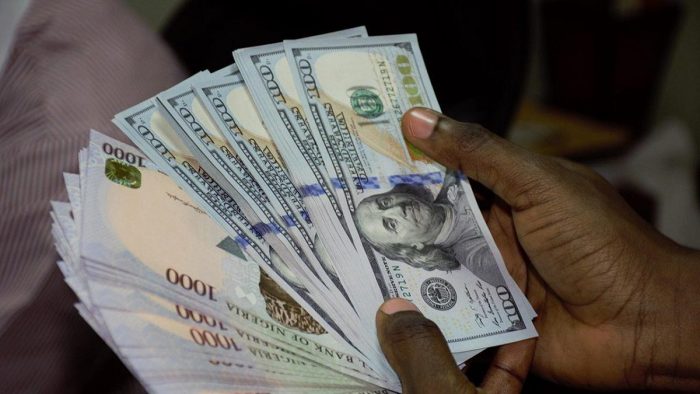
The naira on Monday witnessed further depreciation as it fell sharply to N1,530 on renewed dollar shortage at the official Foreign Exchange (FX) market.
After trading on Monday, the naira lost N19.91 or 0.8 percent as the dollar was quoted at N1,530.15 compared to N1,517.24 quoted on Friday at the Nigerian Foreign Exchange Market (NFEM), data from the Central Bank of Nigeria (CBN) indicated.
The data showed that the authorised dealers quoted the dollar at the highest rate of N1,540, stronger than N1,615 on Friday. The market recorded the lowest rate of N1, 512 per dollar on Monday, weaker than N1,505.75 quoted on Friday.
Read also: Weak naira boosts Nigeria’s competitiveness to 25-yr high
At the parallel market, popularly called black market, the naira steadied at between N1,570 and N1,580 per dollar, according to data from street traders and online data collating platforms.
Against the other key currencies, the naira also depreciated against the pound by 4.2 percent as the pound closed at N2010 on Monday from N1,925 on Thursday last week. One Euro was sold at the rate of N1,660 on Monday, representing a N40 loss for the naira compared to N1,620/Euro closed on Thursday in the black market.
The Canadian dollar was quoted at N1,150 on Monday as against N1,200 quoted on Thursday last week, marking a 4.3 percent or N50 loss to the naira.
The CBN has reaffirmed its commitment to upholding best practices in the foreign exchange market by aligning with the principles outlined in the FX Global Code.
In a statement, the apex bank acknowledged that the FX Global Code represents globally recognised standards for good practices in the foreign exchange market. As the regulatory authority overseeing market participants, the CBN noted its dedication to regulating FX market activities in line with these principles.
“The Bank has taken appropriate steps, considering the size and complexity of the FX market, to ensure its regulatory role aligns with the principles of the Code,” the statement noted.
Read also: Banks’ dollar hoarding threatens naira stability, say BDCs
The commitment was formally endorsed by Olayemi Cardoso, governor of the CBN, Muhammad Sani Abdullahi, deputy governor for Economic Policy, and Omolara Omotunde Duke, director of the Financial Markets Department.

Join BusinessDay whatsapp Channel, to stay up to date
Open In Whatsapp