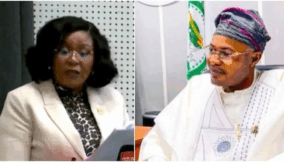

Governor Caleb Mutfwang of Plateau State on Tuesday reaffirmed his administration’s commitment to sustainable development, security, and good governance.
In a media chat with members of the Nigerian Union of Journalists (NUJ) in Jos, the governor expressed appreciation for the media’s balanced reportage and described journalists as key partners in the Plateau project.
The governor recalled the security vacuum he met on assumption of office, noting that no Security Council meeting had been held in the state for close to a year before his inauguration.
He said his government immediately convened a council meeting and began working closely with security agencies to assess and address the situation. He assured the public that, compared to neighboring states, Plateau remains relatively safer.
He highlighted that no local government in Plateau is entirely inaccessible due to banditry, unlike some parts of the North Central and Northwest regions.
Read also: Bauchi govt tackles insecurity, builds Police station in gov town
Mutfwang explained that opportunistic attacks, not organized bandit camps, are the primary threats in Plateau, except in Wase and Kanam, where long-standing security issues had festered. He said his government has since reclaimed lost ground in those areas.
“Those who followed us would remember that we convened a Security Council meeting just two days after we were sworn in. To our surprise, we discovered none had been held for close to a year.
“We immediately swung into action, trying to appraise the security situation and re-motivate the security agencies. It is unfortunate that the security challenge has not abated as much as we had hoped, but one thing we have done and I need you to know is that if we hadn’t done as much as we did, with the intelligence at our disposal, Plateau State would be in a worse situation.
“There are many details we cannot unveil, but I’m glad to tell you that, among the states in North Central Nigeria, Plateau is relatively safer than others. At the moment, there is no local government in Plateau State that is completely a no go area. But if you go to the Northwest, or to some North Central states, there are local governments you cannot enter because they have been taken over by bandits.
“To the glory of God, we don’t have such a scenario here. What we have are opportunistic aattacks, they strike, then disappear. We do not have resident bandit camps on the Plateau, except for the situation that arose in Wase and Kanam, where we actually had decades old challenges”; governor Mutfwang said.
Operation Rainbow, a state security outfit, was revitalized to support existing agencies. While acknowledging complaints about its operations, the governor said its impact is evidence of its effectiveness. He described hope as one of his administration’s major achievements, stressing that people now believe in the potential of governance to improve lives across all sectors.
Speaking on workers’ welfare, Mutfwang recounted how he inherited salary arrears and a demoralized civil service. Within two months, his administration stabilized salary payments and implemented the new minimum wage. He insisted that salary payment is a duty, not an achievement, but emphasized that improved office conditions and regular training have restored dignity to public service.
On economic relief, the governor noted that his government focused on public transportation rather than palliatives after fuel subsidy removal.
He said commuters now save between ₦39,000 and ₦50,000 monthly due to subsidized fares. He also disclosed the revival of rail services and increased flight connectivity to Lagos and Abuja, which have boosted tourism and business activity.
Mutfwang further highlighted strides in education, citing the recovery of lost accreditations at Plateau Polytechnic and a surge in student admissions. He said the government also secured new degree programs at the College of Education Gindiri and is working to improve WAEC performance. In healthcare, he pointed to major upgrades at Plateau Specialist Hospital and the plan to establish a teaching hospital.
Read also: Food security: Oyetola charts new direction to improve local fish production, livelihood
On agriculture, the governor outlined his administration’s plan to overhaul potato farming using modern seed technology and to improve yields. He said the state is partnering with a Dutch seed company and has extended the AfDB-backed tissue culture project. In livestock, he clarified that the government is promoting ranching—not RUGA—and will soon commission a modern abattoir in Jos.
He also addressed market development, coffee revival, and Plateau’s entry into the international coffee market, noting that a Coffee Festival will soon be held in Jos.
He said mining, though a major economic asset, had to be suspended temporarily through an Executive Order to address illegal activities and enhance revenue collection.
In sports, Governor Mutfwang announced plans to complete the Zaria Road Stadium and upgrade Rwang Pam Stadium to meet CAF standards.
He pledged to depoliticize sports and support grassroots talent, assuring the public that his administration remains focused on delivering tangible results across Plateau State.

Join BusinessDay whatsapp Channel, to stay up to date
Open In Whatsapp