…showcases massive projects across state
Governor Peter Mbah has set a target of growing Enugu State’s economy to $30 billion by 2031, attributing the ambition to the economic reforms of President Bola Tinubu and increased federal allocations that, according to him, have strengthened the capacity of subnational governments to drive development.
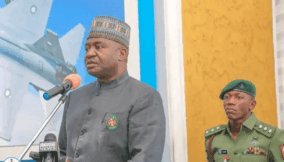
Speaking during a media chat on Tuesday as part of the second round of the Presidential Media Tour of projects in the South-East, Mbah said the scale of ongoing infrastructure expansion in Enugu reflects policy shifts at the federal level that have improved fiscal space for states to invest in critical sectors.
Governor Peter Mbah said the breadth of his administration’s investments in infrastructure, education, healthcare, security, aviation and urban renewal would have been difficult to achieve without the policy direction of the Federal Government.
“I think it would have been impossible, to say the least, for us to have done things at this scale indeed, without some of the bold and courageous policies of Mr President,” Mbah said.
According to him, the reforms introduced under President Bola Tinubu have significantly improved revenue flows to states and reshaped their development capacity.
“What the policies of Mr President did for subnational is largely to free up resources.
“The President has been very intentional in terms of how this one trillion dollar economy is to be achieved. He believes strongly that this is not going to come from up, but it’s going to come from the periphery,” he stated.
According to him, the administration’s reforms have significantly increased resources available to subnational governments and strengthened their capacity to drive development.
“What the policies of Mr President did for subnational is largely to free up resources.
“The President has been very intentional in terms of how this one trillion dollar economy is to be achieved. He believes strongly that this is not going to come from up, but it’s going to come from the periphery,” he stated.
Mbah recalled the financial difficulties faced by states before the reforms, noting that many governors struggled to meet basic obligations.
“If you just cast your mind back, even having a conversation with my predecessor, he would tell you what he went through. Sometimes he struggled when he came back from FAAC to pay salaries, or maybe after the payment of salaries, nothing is left for projects,” he said.
“So what we’re seeing today at a scale is only possible because we now have more funds coming from the federation and, of course, a lot of support from the centre to the subnational. And for us, it’s to make good use of that opportunity. That’s essentially all we’re doing.”
The governor specifically cited the removal of fuel subsidy, foreign exchange reforms, tax reforms and the Nigerian Education Loan Fund (NELFUND) as initiatives that have expanded opportunities for states.
“Whether you want to look at things from the removal of the subsidies, the unification of the foreign exchange, if you look at the reform in the tax sector, quite a whole lot of great initiatives,” he said.
“Now we’re also having a look at the NELFUND policy. This is something for us that we’re excited about because typically the list of scholarship applications you get is almost unimaginable, but today we encourage them to access NELFUND and again it frees funds for us to do other things.”
“The impact is invaluable,” he added.
Mbah also disclosed that federal backing was instrumental in the successful concessioning of the Akanu Ibiam International Airport, describing it as a landmark achievement for the South-East.
“We always, anytime we have the opportunity, give credit to Mr President because it took Mr President’s intervention behind this deal for this success to be recorded,” he said.
“This is the first airport in history that has been successfully concessioned and very soon it will be operational.”
He added that the development would transform air connectivity in the region and support Enugu’s ambition of becoming a major tourism and investment destination.
“I think the entire South-East is grateful that this has happened because very soon we’re going to have a functional international airport from the South-East.”
The governor said his administration was targeting three million visitors annually and had embarked on major tourism projects, including what he described as Africa’s longest zipline and a 5.6-kilometre cable car system.
According to him, these investments are part of a broader strategy to grow Enugu’s economy from $4.4 billion to $30 billion within eight years, eradicate poverty and position the state as the leading destination for business, tourism and investment.
Mbah said the state was simultaneously investing in security, healthcare and education to create an enabling environment for private-sector growth.
On security, he said the government had deployed technology-driven solutions, including artificial intelligence-enabled surveillance systems and a command-and-control centre.
“We believe that if we don’t get this security thing right, it will almost be impossible to attract the level of investment we expect to have,” he said.
The governor also highlighted investments in education, noting that the state had dedicated 33 per cent of its budget to the sector over the past three budget cycles.
“We’ve built, as of today, 267 smart learning schools, equipping them with all the features of a typical smart school. You have robotics centres, AI, ICT and 3D printers,” he said.
Mbah said teacher training remained central to the programme, with the state establishing a Centre for Experiential Learning and Innovation to prepare educators for emerging technologies and modern teaching methods.
Earlier, Commissioner for Health George Ugwu described the Enugu International Specialist Hospital as a key component of the state’s strategy to reverse outbound medical tourism and attract patients from across Africa.
“This is the Enugu State International Hospital, a 300-bed specialist quaternary facility,” Ugwu said.
“It is established intentionally by the government of Enugu State to reverse medical tourism and make the state a destination for world-class healthcare.”
He added that the facility was designed to serve as the apex of the state’s healthcare system and eventually provide services capable of treating even African heads of state.
Also speaking, Chidiebere Onyia, Secretary to the State Government said the New Enugu Smart City project was conceived to decongest the existing city and create a globally competitive urban centre.
Nkeiru Arum, Managing Director and Chief Executive Officer of the New Enugu Smart City Development Authority, , said the city would feature underground utility infrastructure, 24-hour electricity, fibre-optic connectivity, central sewage systems and dedicated water supply.
Ben Osy Okoh, the Commissioner for Works and Infrastructure described the project as “the most ambitious infrastructure development to be undertaken by any state government in Nigeria.”
According to him, the 10,000-hectare city project is larger than the entire Phase One of the Federal Capital Territory and is being developed with integrated underground infrastructure, including roads, water, power, telecommunications and sewer systems.
“We are not just building a new city. We are building a city with the highest infrastructure standards obtainable anywhere,” Okoh said.

Join BusinessDay whatsapp Channel, to stay up to date
Open In Whatsapp