Independent oil marketers may have carted away an estimated N132 billion in the past eight months by maintaining supposedly deregulated diesel prices at an average N145 per litre, despite a 55 percent drop in global crude prices.
BusinessDay gathered that Nigeria’s total diesel consumption of about 12 million litres per day, is still sold at varying prices across the country, ranging from N140 up north to N150 down south and it appears that the Petroleum Product Pricing Regulatory Agency (PPPRA) is either unwilling or incapable of calling the diesel cartel to order.
Last week, the Federal Government reduced the pump price of petrol by 10 percent, to N87 per litre and many in the public space commended the government for transmitting perhaps the only benefit of the falling oil prices to Nigerians.
However, independent oil marketers have yet to align their prices with the massive drop in global crude oil prices.
According to the latest AGO pricing template released by the Petroleum Product Pricing Regulatory Authority (PPPRA) on Friday 23 January, the estimated open market price (EOMP) of diesel is N99.75 while the landing cost is N90.41.
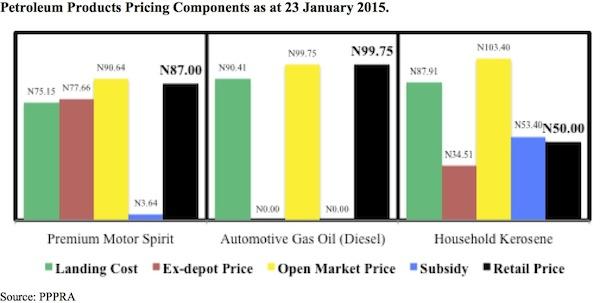
Yet actual pump prices across several filling stations visited by BusinessDay as at Sunday 25 January, averaged N145 per litre, which is equivalent to a 45 percent margin above the open market price recommended by PPPRA.
Read also: Russian teapots pose next big threat to global crude oil prices
This reality raises the question of why diesel prices are yet to fully reflect the price adjustment.
Investigations by BusinessDay revealed that independent oil marketers appear to be having an internal price war and no one wants to be caught dancing when the music stops.
One industry source admits that the diesel stock bought when oil prices were relatively high, have been sold off, leaving marketers with no excuse for selling diesel at a price that does not reflect the cheaper stock now being either directly imported, or bought off other suppliers.
Nonetheless, marketers are careful not to adjust prices downward too sharply, especially when competitors have not reduced prices in similar proportion.
The control of the market by a few, has therefore created a support level for the price of diesel, bestowing on the marketers a huge premium above actual landing costs.
More so, BusinessDay gathered that supplies originating from the Nigerian National Petroleum Corporation (NNPC) are sold at N137 per litre, which creates a natural benchmark for the marketers to build sales margins on.
“Although the NNPC accounts for at least 25 percent of industry supply, we let market forces determine the diesel price. We cannot fix it,” says Ohi Alegbe, NNPC spokesman, in defence of alleged price fixing by the oil corporation.
“It appears the diesel prices are not fully driven by market forces … there may be still be some form of government regulation or extraneous costs beyond the pricing template.” says Biodun Adedipe, economist and chief consultant at BAA Consult, a leading economic research firm.
The recent devaluation of the naira has also been cited as a major factor for maintaining diesel prices at N145, on the premise that 75% of supply is imported and devaluation has led to higher importation costs for the product.
Evidently, this is not the case as shown by the PPPRA template.
The adverse effect of the diesel prices being sticky downwards is a sustained high cost of energy generation for the Nigerian economy, where most manufacturers and middle- to-high income households rely on diesel-powered generators for alternative power supply.
A recent report released by the National Bureau of Statistics (NBS) shows that generator fuel is the greatest of all intermediate inputs in the manufacturing sector, with the cost overhead growing by a compound annual growth rate of 17%, which could rise to about N2 trillion in 2015, by our estimates.
Industry watchers are of the view that the silence of the NNPC and the PPPRA as regulators could be interpreted as being complicit in such a pricing conspiracy.
Nonetheless, it remains to be seen if oil marketers will deflate their appetite for excessive margins and adjust diesel prices to fully reflect the present reality of a sub-$50 international oil price.
Akin-Olusoji Akinyele & Edozie Ifebi

Join BusinessDay whatsapp Channel, to stay up to date
Open In Whatsapp