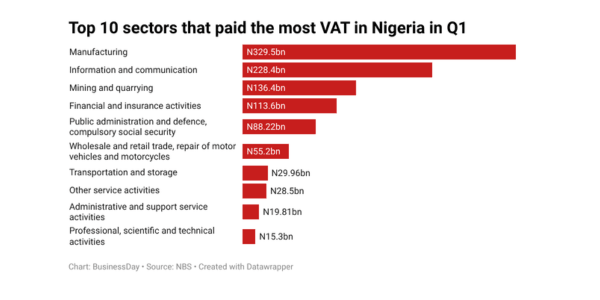
Manufacturing, information and communication, and mining and quarrying top sectors in Nigeria that generated N2.42 trillion in revenue from value-added tax (VAT) in the first quarter (Q1) of 2026.
This is contained in the latest sectoral distribution of value-added tax report released by the National Bureau of Statistics (NBS).
From a quarter-on-quarter basis, the figure represents a 9.98 percent increase compared to the N2.20 trillion recorded in the fourth quarter (Q4) of 2025.
However, on a year-on-year basis, VAT collections in Q1 2026 increased by 17.06 percent (N2.06 trillion) from Q1 2025.
Read also: Corporate taxes fall for first time since 2023 as VAT surges
VAT, which is a consumption tax, is being administered by the Nigeria Revenue Service (NRS).
Revenue generated from VAT is usually disbursed to the three tiers of government through the Federation Accounts Allocation Committee (FAAC).
NBS said of the total VAT collected in Q1 2026, local payments stood at N1.11 trillion, foreign VAT payments were N830.47 billion, and import VAT contributed N477.55 billion during the quarter.
“On a quarter-on-quarter basis, activities of households as employers, undifferentiated goods and services producing activities of households for their own use, recorded the highest growth rate with 74.36 percent; followed by Arts, entertainment and recreation with 20.91 percent; and manufacturing with 12.82 percent,” NBS said.
“On the other hand, Education had the lowest growth rate with –31.96 percent, followed by Public administration and defence, compulsory social security with –31.38 percent; and Activities of extraterritorial organizations and bodies with –29.89 percent”
Read also: Nigeria’s VAT collections hit N2.42 trillion in Q1 2026, up 10% – NBS
Here are the top 10 sectors by VAT contributions in 2023, underscoring their economic impact, the growth in their tax contributions compared to 2022, and the challenges they continue to face.
Manufacturing
Leading the way, the manufacturing sector contributed the highest VAT of N329.5 billion in Q1 2026, up from N286.9 billion in Q1 2026, marking a 14.86 percent increase.
While it stands as the backbone of Nigeria’s industrialisation, the sector contends with high operating costs, infrastructural constraints, and global supply chain disruptions.
Efforts to streamline operations and invest in infrastructure are crucial for the sustainability of this sector.
Information and Communication
The Information and Communication sector showed an increase of 18.36 percent in VAT payments, up from N192.9 billion in Q1 2025 to N228.4 billion in Q1 2026.
As a rapidly evolving sector, it faces challenges such as digital infrastructure needs, regulatory clarity, and the acceleration of digital transformation across industries.
Mining and Quarrying
The Mining and Quarrying sector’s VAT contributions fell sharply to -27.24 percent from N187 billion to N136 billion.
The sector is confronted with environmental and regulatory issues that need careful management to ensure sustainable development.
Financial and insurance activities
The Financial and Insurance Activities sector VAT contributions increased marginally by 7.11 percent, from N106.1 billion to N113.6 billion.
The sector’s boom is shadowed by challenges including the integration of fintech, regulatory compliance, and cybersecurity risks.
Public administration and defence, compulsory social security
This sector saw a -16.6 percent decline in VAT contributions, from N105.7 billion to N88.2 billion.
Wholesale and retail trade, repair of motor vehicles and motorcycles
Demonstrating a stellar performance, this sector’s VAT contributions more than doubled with an 18.52 percent increase, rising from N46.5 billion to N55.2 billion.
Despite this, the sector faces challenges with informal competition and market volatility that need to be navigated for sustained growth.
Transportation and storage
Transportation and storage reported a -14.6 percent decline in VAT contributions, from N35.1 billion to N29.9 billion.
The sector’s decline is hampered by infrastructural deficits and regulatory inefficiencies that, if addressed, could unlock further economic value and efficiency.
Other service activities
The sector reported a -10.15 percent decline in VAT contributions, from N31.7 billion to N28.5 billion.
Administrative and support service activities
Demonstrating a stellar performance, this sector’s VAT contributions more than doubled with a 12.86 percent increase, rising from N1.5 billion to N19.8 billion.
Professional, scientific, and technical activities
The Professional, Scientific, and Technical Activities sector saw VAT contributions decline by -18.94 percent from N18.9 billion to N15.3 billion.

Join BusinessDay whatsapp Channel, to stay up to date
Open In Whatsapp