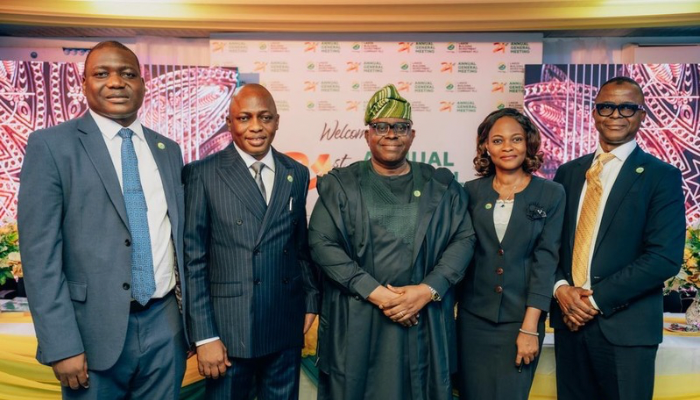
Against the backdrop of Nigeria’s deepening housing deficit, the Lagos Building Investment Company (LBIC) is strengthening its capital base as it positions to expand access to affordable housing and deepen mortgage penetration.
Speaking at the company’s Annual General Meeting in Lagos, Olusola Faleye said the mortgage lender is aligning its growth strategy with government efforts to reduce the country’s housing shortfall and improve home ownership.
Faleye said the company’s improving financial performance was underscored by the payment of its first dividend in its corporate history last year, a milestone he described as evidence of stronger operational performance and a growing commitment to shareholder returns.
“For the first time in the history of LBIC, we paid a dividend last year,” he said. “Our commitment is to sustain that trajectory. We will continue paying dividends, while also issuing bonus shares for every 15 units held.”
He said a major challenge across Africa remains limited understanding of flexible home ownership structures, noting that mortgage institutions must play a stronger role in broadening financial inclusion within the housing market.
“Across the continent, many people still do not understand that they do not need the full amount upfront to own a home,” Faleye said. “With the government’s agenda to reduce the housing deficit, we are well positioned to deepen access.”
According to him, LBIC’s backing by the Lagos State provides a strategic advantage in accessing low-cost funding capable of supporting long-term mortgage financing.
“State backing gives us significant leverage in accessing cheaper funding across the continent, which ultimately helps more people gain access to housing,” he said.
Faleye said the proposed bonus share issuance also forms part of a broader effort to proactively strengthen the company’s capital position ahead of anticipated regulatory changes by the Central Bank of Nigeria (CBN).
“The reason for the bonus issuance is to ensure that, even before any new CBN pronouncement, we would already have met the minimum capital threshold required,” he said. “If there is still a need to raise additional capital afterward, the gap would be relatively small.”
He added that the capital strengthening plan reflects LBIC’s longer-term sustainability and growth ambitions, hinting that the proposed capital raise could be in the region of N5 billion, although formal details are yet to be announced.
At the meeting, Hakeem Ogunniran disclosed that LBIC grew profit before tax by 43 percent to N1.65 billion in the 2025 financial year, from N1.16 billion in the previous year, as the lender intensified efforts to scale operations and expand its capital base.
The company’s mortgage loan portfolio also rose sharply to N2.07 billion in 2025, compared with N794 million in 2024, with no impairments recorded, an indication of improving asset quality despite macroeconomic pressures.
Gross earnings increased by 41 percent to N3.56 billion from N2.54 billion.
Ogunniran said the performance reflected the resilience of the company’s strategy and its focus on core mortgage banking operations.
“All the indices were strong, shareholders’ funds, mortgage creation, gross earnings and profit before tax,” he said. “For the second consecutive year, we are paying dividends, while also issuing bonus shares to further reward shareholders. That reflects the strength of the company’s performance.”
He acknowledged the pressures within the broader economy but said LBIC’s strategic positioning continued to deliver results.
“It is a difficult operating environment, but the strategies we have implemented are delivering the outcomes we desire in the marketplace,” he said.
Ogunniran added that partnerships with institutions within Lagos State to finance housing project offtakers had strengthened earnings and reinforced the company’s long-term growth outlook.
On the outlook for 2026, he expressed optimism, citing strong first-quarter performance.
“2026 will be a much stronger year for us,” he said. “We expect to surpass our targets, and the first-quarter numbers already point in that direction.”
Babajide Sanwo-Olu commended the company’s performance and called for deeper collaboration to address housing challenges across the state.
Represented by Moruf Akinderu-Fatai, the governor described housing as a critical economic driver capable of stimulating enterprise, supporting livelihoods and strengthening household sustainability.
“Housing is not just a social project; it is an economic driver,” he said. “It supports businesses, drives development and promotes family-based economic stability.”
He added that the Lagos State government would continue supporting institutions such as LBIC in expanding housing supply and improving affordability.

Join BusinessDay whatsapp Channel, to stay up to date
Open In Whatsapp