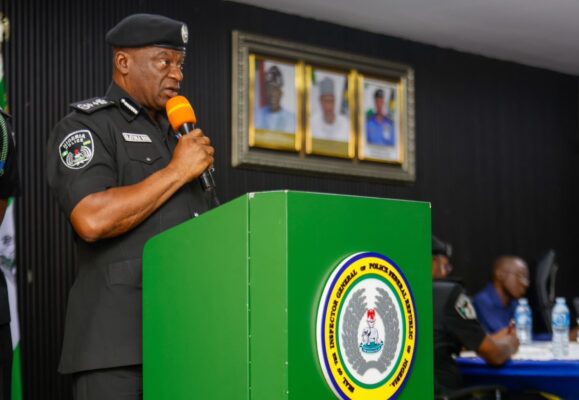
Olatunji Disu, Inspector-General of Police, has directed all police personnel nationwide to wear visible name tags on their uniforms as part of efforts to strengthen accountability and public trust in the force.
The directive, issued on Tuesday, makes it compulsory for officers on regular duty to display their names clearly, while only those engaged in undercover operations are exempted.
Speaking during a meeting with commissioners of police, the IGP emphasised that proper identification is a basic professional standard that must be upheld across all commands.
He noted that senior officers present at the meeting were already complying with the directive, underscoring the expectation that the same standard be enforced nationwide.
“All police officers should have their name tags. Those of us here, including commissioners of police, are properly identified, except for officers on undercover assignments.
“This is not negotiable; it is part of our operational standard,” he said.
Read also: Police arrest six kidnappers, rescue victims in Kaduna crackdown
The police chief further stressed that commissioners of police bear full responsibility for activities within their respective jurisdictions, warning that lapses in discipline or enforcement would not be tolerated.
According to him, the meeting was convened to address key operational and administrative issues, including compliance with identification protocols.
On the ongoing national conversation around the establishment of state police, the IGP disclosed that the force has proactively developed and submitted its position to the National Assembly of Nigeria.
He explained that following indications from the Federal Government of Nigeria on plans to introduce state policing, the Nigeria Police Force undertook a detailed internal review to outline how such a system could function effectively.
“Since we received indications that the federal government intends to establish state police, we decided to take the initiative by presenting our perspective on how it should be structured and managed,” he said.
The IGP added that the proposal was developed after extensive consultations and comparative analyses of policing models in other jurisdictions, with the aim of ensuring that any future state policing framework aligns with national security priorities and operational efficiency.

Join BusinessDay whatsapp Channel, to stay up to date
Open In Whatsapp