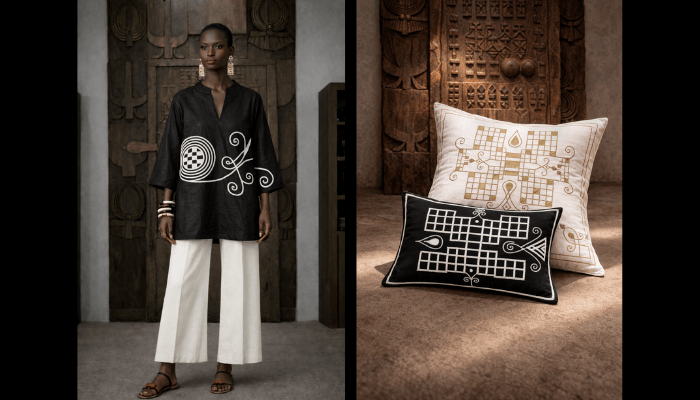
In the old cities of northern Nigeria, embroidery was never merely decoration. It was identity stitched into fabric – a language of prestige worn across generations. The flowing babban riga, with its elaborate chest patterns and geometric detailing, carried the memory of empires, trade routes and craftsmanship refined over centuries.
But for a long time, the women who made much of that beauty remained unseen in the economics of it.
In Kano, Zaria and other Hausa communities, women sat for hours bent over fabric, their fingers moving patiently through dense patterns that required years to master. They embroidered wedding garments, ceremonial robes and traditional attire prized across West Africa. Yet once the work was completed, the garments often passed into the hands of male intermediaries who handled pricing, sales and payments.
The women produced. Others controlled the market.
“It was simply how the system worked,” recalls one artisan familiar with the structure that defined the trade for decades. Women worked largely from home, balancing embroidery with childcare and domestic responsibilities. Their labour generated value, but they rarely determined what that value was worth.
That imbalance stayed largely unquestioned until Hassana Yusuf began asking a different question in the mid-1990s: what if the women doing the work also controlled the income from it?
Queen Amina became the answer
Founded in 1994 and named after the legendary Queen Amina of Zazzau – the sixteenth-century Hausa warrior queen remembered for political and military leadership – the cooperative began modestly in Zaria with a small group of women artisans. Its purpose was straightforward but quietly radical: connect women directly to buyers and ensure they were paid fairly for their craft.
At the time, northern Nigeria’s informal textile economy operated through layers of intermediaries. Many artisans had little visibility into how their products were priced once they left their homes. The issue was not lack of skill. Hausa embroidery is among West Africa’s most technically demanding textile traditions, requiring extraordinary precision, symmetry and patience. The issue was market structure. Queen Amina attempted to change that structure from within.
Rather than treating embroidery as charity or cultural preservation alone, the cooperative approached it as economic participation. Women were organised collectively, given stronger visibility into pricing, and connected to more formal markets.
Over time, the model expanded beyond embroidery into broader artisan training and income generation. The transformation was gradual, almost quiet. But its effects accumulated over decades.
Today, Queen Amina continues to operate as one of Nigeria’s most enduring examples of women-led craft enterprise. The cooperative has partnered with Ibu Movement, a U.S.-based organisation focused on supporting women artisans globally. Through the partnership, Hausa embroidery produced by Nigerian women has reached international buyers who increasingly value handmade heritage products and traceable craftsmanship.
The collaboration also helped improve working conditions. According to information published by Ibu Movement, support has included solar-powered lighting systems for artisans, allowing women to work more safely and consistently in communities where electricity supply is unreliable. Workshops and training programmes have further strengthened production capacity and market access.
For the artisans, the shift is not merely financial
In many households, access to independent income changes how decisions are made. Women who once depended entirely on male-controlled sales channels now participate more directly in household economics – paying school fees, supporting family income and building savings through their own labour.
Across Africa, policymakers and development economists increasingly speak about “women’s economic inclusion” as a pillar of long-term development. The argument is backed by evidence. The World Bank and United Nations have repeatedly noted that expanding women’s access to income and markets improves household welfare, educational outcomes and broader economic productivity.
Yet many initiatives struggle because they focus narrowly on skills without addressing systems. Queen Amina’s significance lies precisely there. The women already possessed extraordinary skill. What they lacked was negotiating power inside the value chain. That distinction matters.
Development is often described as the creation of opportunity. But as economist Amartya Sen argued, development is also about expanding people’s capabilities and freedoms – their ability to shape the economic outcomes tied to their own lives. In northern Nigeria, embroidery had long generated value. The question was who captured it.
Queen Amina did not industrialise the craft or remove its cultural essence. Instead, it reorganised the relationship between labour and market access. It allowed women to move closer to the point where value was priced and exchanged. The timing is important too.
Globally, demand for handmade and culturally authentic products has grown steadily as consumers seek alternatives to mass-produced goods. African fashion and textile traditions, once treated largely as ethnographic curiosities, are increasingly entering luxury and premium lifestyle markets. What was once local heritage is becoming part of global commerce. That creates opportunity, but also pressure.
Preserving authenticity while scaling market access is delicate work. Handmade embroidery cannot easily be industrialised without losing part of what gives it value. The challenge for cooperatives like Queen Amina is therefore not simply growth, but sustainable growth – expanding earnings while preserving craftsmanship and cultural identity.
Back in Zaria, that balance still plays out in small rooms where women sit together stitching elaborate patterns onto fabric stretched tightly across wooden frames. The work remains painstaking. Hours disappear into symmetry and detail. But something fundamental has changed from the old system.
The women no longer disappear economically inside the craft they sustain. And perhaps that is the larger lesson hidden inside this story.
For decades, northern Nigerian women created beauty while others controlled the market around it. Queen Amina did not invent the craft. It changed the structure surrounding the craft. In doing so, it showed that development is sometimes less about creating new industries than about reorganising old ones so the people producing value are finally allowed to keep more of it.

Join BusinessDay whatsapp Channel, to stay up to date
Open In Whatsapp