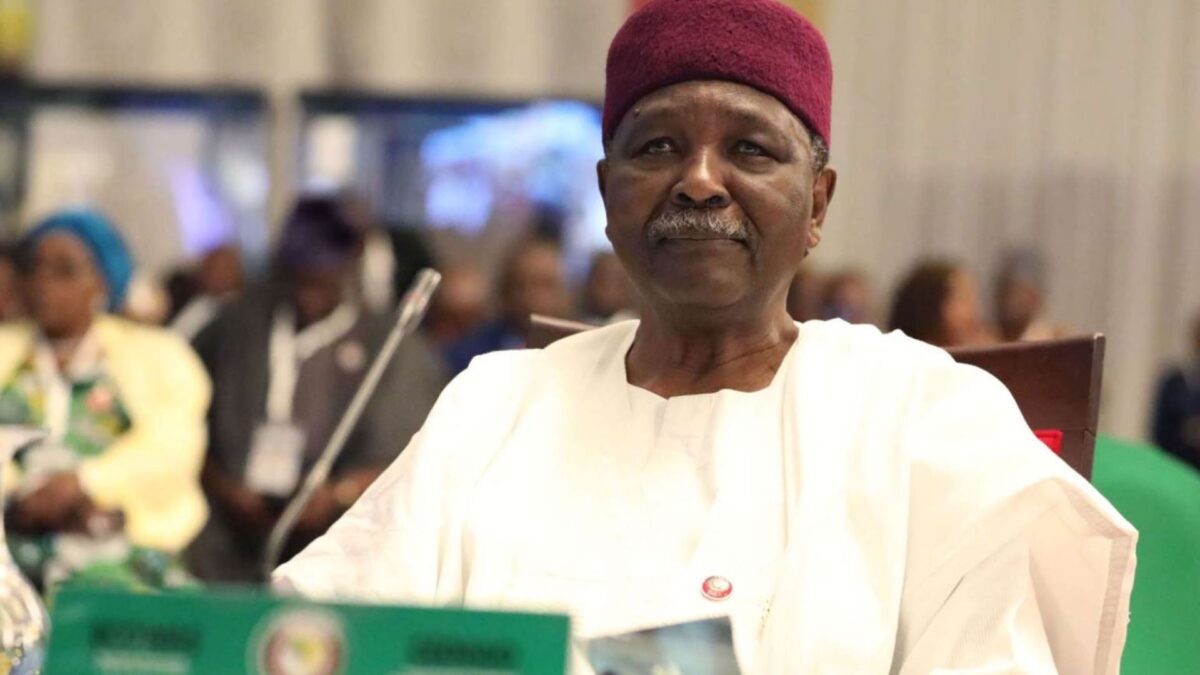
Yakubu Gowon, former Nigerian Head of State, has revealed how the refusal of the United States and Britain to supply arms to Nigeria during the civil war pushed his government into an unlikely alliance with the Soviet Union and a Lebanese businessman operating through the international black market.
Gowon said the decision ultimately altered the course of the Nigerian Civil War, which lasted from July 1967 to January 1970, as his administration struggled with severe shortages of ammunition and military equipment while attempting to keep the country united.
The former military ruler made the revelations in Chapter Fifteen of his newly released 859-page autobiography, My Life of Duty and Allegiance, unveiled in Abuja on Tuesday during a launch attended by top political and military figures.
President Bola Tinubu was represented at the event by Kashim Shettima, Vice President.
In the chapter titled If The Devil’s Ready To Help, Gowon recounted what he described as one of the darkest moments of the war, when Nigeria’s ammunition reserves dwindled to barely half a million rounds for the entire Army by late 1968.
According to him, international restrictions on arms sales left the Federal Government unable to replenish depleted military stockpiles despite escalating battlefield demands.
He wrote that the shortage became so severe that he ordered Federal troops to halt their advance after capturing Enugu, fearing that continued offensives without adequate ammunition would endanger soldiers and jeopardise military operations.
“As the weeks of fighting wore on, our stock of ammunition was steadily depleted,” Gowon wrote.
He added that foreign suppliers refused to sell military hardware to Nigeria because of international restrictions.
The former Head of State said he was deeply disappointed by what he viewed as indifference from Western allies, particularly at a time when the United States was actively deploying massive military force in conflicts in Vietnam and Cambodia.
Gowon disclosed that he personally met with British and American ambassadors in what he described as one of the most consequential meetings of the war, hoping to secure military assistance.
Recalling the encounter, he said he openly warned the diplomats that Nigeria would seek help from any available source if Western powers refused to assist.
“If I say I’m not disappointed, it will be an understatement,” he recalled telling the envoys.
He added that as the ambassadors prepared to leave the State House, he informed them that he was prepared to “go to any devil” to obtain the weapons needed to defend Nigeria’s unity and territorial integrity.
According to Gowon, both diplomats departed without offering any commitment.
Gowon said he immediately instructed Hamza Ahmadu, his Principal Secretary, to establish contact with Aleksandr Romanov, Soviet Ambassador, at Dodan Barracks.
He explained that beyond securing weapons, he believed Soviet willingness to arm Nigeria could also pressure Britain and the United States into reconsidering their positions.
A high-powered Nigerian delegation comprising Anthony Enahoro, Information Commissioner, Edwin Ogbu, Permanent Secretary, Emmanuel George Kurubo, Chief of Air Staff and John Ukegbu (Ambassador) was subsequently dispatched to Moscow.
According to Gowon, the Soviet Union responded positively, supplying MiG-15 trainer aircraft and MiG-17 bombers to Nigeria.
He described the mission to Moscow as “a huge success,” noting that the wartime cooperation laid the foundation for what later became a “special” relationship between Nigeria and the Soviet Union after the conflict.
However, Gowon stated that Soviet support alone could not immediately solve the pressing ammunition shortage confronting the Federal troops.
To bridge the gap, he said he turned to Ali Jamal, a Lebanese businessman with access to international black-market arms networks.
Gowon described Jamal as a businessman who strongly believed in Nigeria and who offered to personally finance the procurement of military hardware and ammunition despite knowing the Federal Government lacked immediate funds.
According to the former ruler, Jamal assured him that payment could be made later without interest.
“With his support, we were able to get some of the hardware and the ammunition we needed to change the face of the war,” Gowon wrote.
The arrangement, however, reportedly sparked tension within the Federal Executive Council.
Gowon revealed that Obafemi Awolowo, then Finance Commissioner, initially resisted authorising payment to Jamal, arguing that due process had not been followed and that the expenditure was outside approved budgetary procedures.
The disagreement escalated during a council meeting, with Gowon insisting that the urgency of the war justified extraordinary executive action.
“I was aghast because it suddenly appeared to me that the Finance Commissioner and others at the FEC did not understand the depth of the problem,” he wrote.
Gowon said he eventually invoked his authority as Head of State to approve the payments needed to sustain military operations.
Despite the confrontation, the former Head of State said he later appreciated Awolowo’s insistence on accountability and due process, describing it as evidence of a disciplined government structure even during wartime.
He confirmed that Jamal was eventually paid in full.
The autobiography, spanning 36 chapters, chronicles Gowon’s journey from his Angas roots in present-day Plateau State through his rise in the military, leadership during the civil war, his overthrow in 1975, and his years in exile and academic pursuits abroad.
The Nigerian Civil War, also known as the Biafran War, remains one of the most defining and devastating conflicts in Nigeria’s history, with estimates suggesting that more than one million people died during the three-year conflict.

Join BusinessDay whatsapp Channel, to stay up to date
Open In Whatsapp