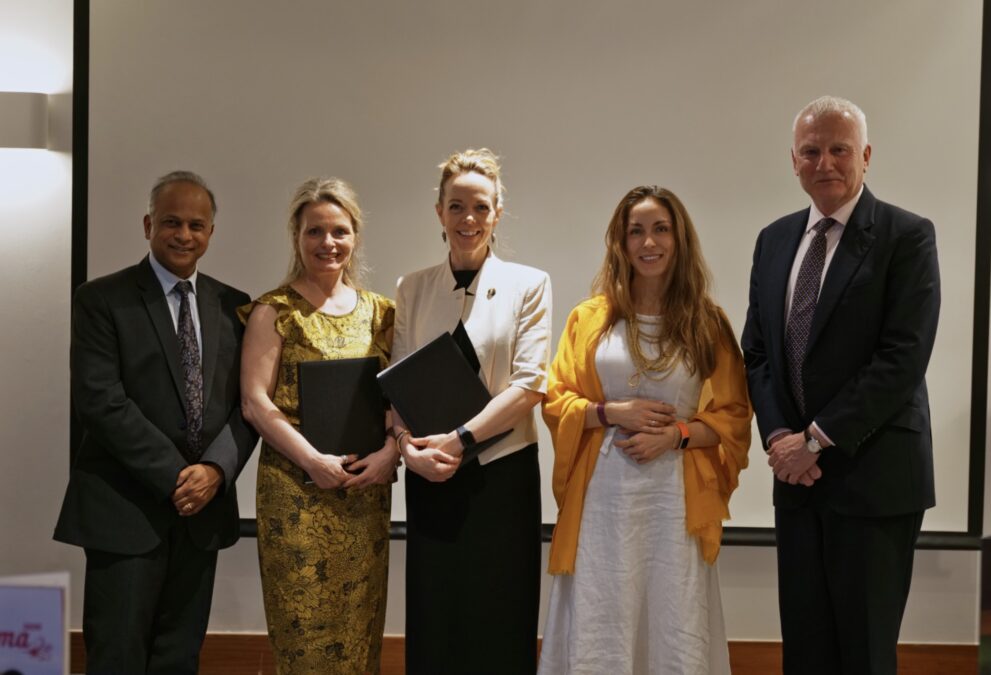
Cambridge University Press & Assessment (Cambridge) and the NGO Alsama Project have pledged to collaborate on a new qualification for refugees and displaced young people, to be rolled out in Nigeria and worldwide.
According to the organisation, the new G12++ qualification is designed to tackle the education crisis faced by displaced youth excluded from university, training and employment, providing them with a recognised pathway to further education and skilled employment.
Nigeria is home to 3.6 million forcibly displaced people, according to UNHCR data. Globally, there are 117.3 million forcibly displaced people, including 49 million displaced children.
Only 9 percent of refugees around the world attend higher education, compared with an average of 42 percent among the global population. Millions of talented young people are locked out of higher education and skilled work, not through lack of ability, but lack of proof. Without a formal high school certificate to show universities, vocational programmes and employers, displaced young people are being left behind, and the world is missing out on access to this talent pool.
Speaking after the signing of the agreement during the Education World Forum, Jane Mann, managing director, Partnership for Education, Cambridge, said that in times of conflict, education is so often among the first casualties, adding that the global education crisis caused by forced displacement will only grow as climate change and conflict uproot more young people.
According to Mann, when young people are forced to leave school and flee, it’s not only their past they leave behind, but their future too.
“Working with Alsama Project, we will help them take back their futures through a new global qualification that will open pathways to universities, vocational programmes and employment. Displaced youth in Nigeria and across the globe need models that reflect their realities – and the world needs their talents.
“What began as an idea in a Lebanese refugee camp will, we hope, transform the life chances of millions of refugees and displaced youth worldwide. We are proud to partner with Alsama Project to develop and scale up the G12++. This grassroots NGO has been driving much-needed innovation in non-formal education for displaced youth in the Middle East and beyond, and we look forward to helping them deliver these innovations globally,” Mann said.
Meike Ziervogel, co-Founder and CEO of Alsama Project, said the G12++ partnership with Cambridge is a milestone not just for Alsama’s students, but for the millions of displaced youth worldwide who have been told that their education doesn’t count because it happened outside a formal system.
“Cambridge has spent over 160 years defining what rigorous, credible assessment looks like. Their involvement sends a clear signal: a qualification built inside a refugee camp can demonstrate a level of academic rigour that meets global benchmarks, opening doors for students who have survived war and displacement,” Ziervogel said.
Bhaskar Vira, Pro-Vice-Chancellor for Education and Environmental Sustainability, University of Cambridge, said that as a University of Sanctuary, the University of Cambridge is committed to supporting displaced people who come to the UK.
Vira said that by working with Alsama Project, Cambridge will be able to support them in Nigeria and across the world, while demonstrating that high-quality assessment for displaced and marginalised learners is both achievable and replicable, adding that the G12++ is a unique, transformative opportunity for refugee youth, universities and the global education community alike.
On his part, Patrick Derham, G12++ advisor and former headmaster of Westminster School, said that in both his personal experience and his work in education, he continuously sees firsthand the unjust barriers that disadvantaged youth across the world face.
Derham noted that while the solution is multi-faceted, the G12++ offers a critical part of it: an internationally recognised qualification that is curriculum-agnostic.
To Wissal Al-Jaber, a refugee student who fled Syria to Lebanon at the age of 9, after having spent a year imprisoned by the Islamic State with her family, “the G12++ gives me that. It is exactly what I need to show the world what I am capable of and to finally follow the dream that grew inside me for years. I want to study psychology, to build a future where my story becomes my strength.”

Join BusinessDay whatsapp Channel, to stay up to date
Open In Whatsapp