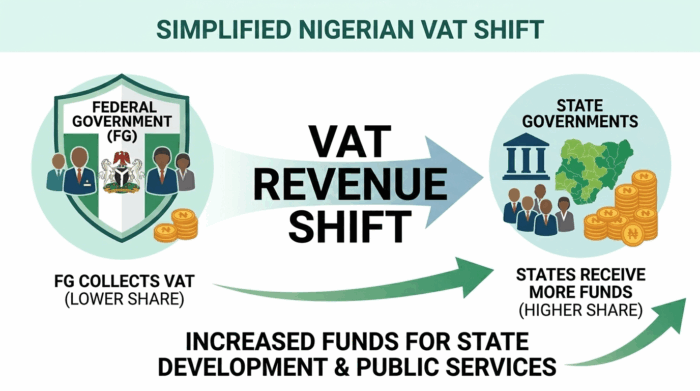
States across Nigeria could gain stronger fiscal capacity as rising Value Added Tax (VAT) collections and a revised allocation framework increase the funds available to subnational governments, raising expectations that state administrations will channel the additional revenue into infrastructure, industrial development, and improved public services.
According to Oluwasegun Osundina, a tax consultant, the additional revenue accruing to states and local governments places greater responsibility on them to manage public funds transparently and deliver tangible improvements in public services.
“They need to be more accountable with the funds they have received,” he said.
Read also: Lagos tops list of top 5 VAT-contributing states for January
Osundina explained that for years, many state governments argued that limited allocations from the federation account constrained their ability to invest in infrastructure and social services.
With higher revenues now flowing to subnational governments, he said, citizens and businesses will increasingly expect better fiscal management and more visible development outcomes.
He also pointed out that local governments are expected to receive VAT allocations more directly, which could strengthen fiscal activity at the grassroots level if properly managed.
Read also: Manufacturing, mining sectors paid highest Company Income Tax in Nigeria in Q3 2025
Latest data from the Federation Accounts Allocation Committee (FAAC), a total of N1.08 trillion was collected as VAT by the Nigeria Revenue Service (NRS) in January 2026, up from N913.96 billion in December 2025.
The increase in VAT revenue comes as Nigeria adjusts the distribution of consumption taxes in favour of subnational governments, a shift analysts say could provide states with additional fiscal space to meet obligations and invest in economic development.
For businesses and households, the change could shape how effectively state governments translate higher revenues into improved infrastructure, stronger security, and policies that support private investment.
According to Dumebi Oluwole, a senior economist, the revised allocation structure means states will retain more of the consumption tax generated within their economies, potentially strengthening their ability to fund development priorities.
“This is additional revenue for state governments to meet statutory obligations like salary payments and, more importantly, engage in meaningful capital expenditure,” she said.
Economists say the additional revenue presents an opportunity for state governments to move beyond routine spending and invest more strategically in sectors where they hold a natural economic advantage.
Oluwole noted that states could use the funds to develop commodity value chains and attract private investment into sectors where production costs are lowest.
“States should invest in commodities where they have a comparative advantage and build industries around those value chains,” she said.
Such investments could include improving road networks, logistics infrastructure, and industrial clusters that support manufacturing and processing activities.
For instance, states with strong agricultural output could invest in infrastructure linking farms to processing facilities and export markets, helping to stimulate industrial activity and job creation.
“The government is a catalyst for private sector activity,” Oluwole said, noting that strategic infrastructure investment could encourage businesses to expand operations within key sectors.
However, analysts caution that the benefits of higher VAT allocations will depend largely on how effectively state governments deploy the additional revenue.
Persistent insecurity and weak infrastructure in some regions could limit the ability of states to attract investment and build new industries, potentially reducing the broader economic impact of higher revenue allocations.
Oluwole said improvements in security and infrastructure will be essential if states are to fully harness the opportunities created by stronger VAT inflows.
She pointed to reforms underway in Abia State as an example of how improvements in security and infrastructure can help stimulate economic activity and attract private investment.
Ultimately, analysts say the revised VAT framework could strengthen fiscal capacity at the state level, but its success will depend on whether governments prioritise productive investments that expand economic activity, support businesses, and sustain consumption growth.

Join BusinessDay whatsapp Channel, to stay up to date
Open In Whatsapp