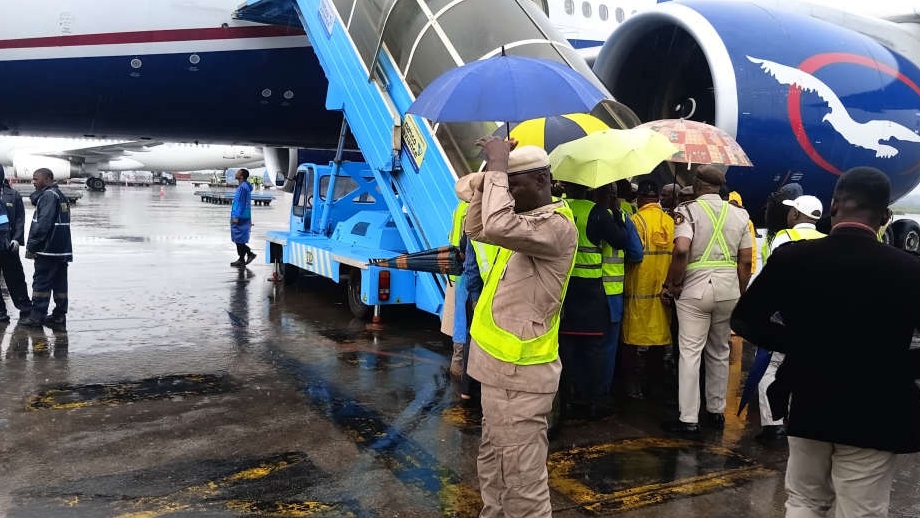
The Federal Government is considering a financial support package for Nigerians evacuated from South Africa as part of a reintegration programme that will provide vocational training, educational placement for displaced students, and other assistance to help returnees rebuild their lives after fleeing renewed xenophobic attacks.
Just as the Federal Government said it has evacuated 859 Nigerians from South Africa following renewed xenophobic violence, while assuring that more evacuation flights are being arranged for citizens who have voluntarily opted to return home.
Kimiebi Ebienfa, Spokesperson,
Ministry of Foreign Affairs, Abuja disclosed this in an interview with BusinessDay, saying the government activated a voluntary evacuation programme after anti-foreigner protests escalated across parts of South Africa.
According to him, the latest wave of xenophobic tensions was triggered by campaigns led by groups including March for March and Operation Dudula, which had issued an ultimatum demanding that foreign nationals leave the country before June 30, accusing them of taking jobs from South Africans and contributing to illegal migration.
Ebienfa said the deadline was followed by widespread protests, attacks on foreign-owned businesses and isolated killings, forcing many Nigerians to seek assistance from the Nigerian government.
“So far, we have operated three evacuation flights and brought back a total of 859 Nigerians from South Africa. We are still expecting two additional evacuation flights in the coming days,” he said.
He clarified that while several foreign nationals had been attacked during the protests, no Nigerian had been killed directly as a result of the ongoing xenophobic demonstrations.
However, he noted that four Nigerians had died in South Africa over the past three months under separate circumstances, including one who was recently shot dead outside a shop by unknown gunmen.
“We remain deeply concerned about the safety of Nigerians living in South Africa. That is why we activated voluntary evacuation for vulnerable citizens who requested to return home,” he added.
The ministry’s spokesman explained that Nigeria continues to engage South African authorities to ensure the protection of Nigerians who have chosen to remain in the country.
Responding to concerns over delays experienced during the evacuation exercise, Ebienfa attributed the setbacks to logistical and administrative processes involving both Nigerian and South African authorities.
He explained that chartered evacuation flights required landing permits and immigration clearances before departure, while some aircraft experienced delays of up to five hours before being cleared for take-off.
According to him, Nigerian missions in South Africa have also reported unnecessary delays by some South African airport authorities.
He disclosed that over 200 Nigerians displaced by the unrest are currently being accommodated at the Nigerian High Commission, where they are receiving temporary shelter, bedding and feeding while awaiting evacuation.
“Our commitment is that everyone who has indicated interest in returning home will be evacuated,” he assured.
Amid growing public calls for tougher action against South Africa, Ebienfa said Nigeria would continue to prioritise diplomacy rather than sever bilateral relations.
He noted that Nigeria played a historic role in supporting South Africa’s anti-apartheid struggle and remains committed to African unity despite recent tensions.
“It is not that Nigeria lacks the capacity to take stronger measures, but we believe dialogue remains the best option. We will continue engaging South Africa to resolve issues affecting both countries,” he said.
Ebienfa revealed that Nigerian diplomatic missions in Pretoria and Johannesburg have begun documenting businesses and properties abandoned by Nigerians fleeing the violence.
He said the Federal Government intends to seek compensation from South Africa for Nigerians who were legally resident in the country and suffered losses due to the attacks.
He, however, acknowledged that the situation was more complicated for undocumented migrants, many of whom claimed they had applied for legal residency but faced prolonged administrative delays before becoming classified as illegal immigrants.
The Foreign Ministry spokesman said returning Nigerians undergo comprehensive profiling on arrival involving agencies including the Nigerian Immigration Service, the National Emergency Management Agency (NEMA), the National Commission for Refugees, Migrants and Internally Displaced Persons, the National Agency for the Prohibition of Trafficking in Persons (NAPTIP), and Port Health Services.
He said returnees requiring rehabilitation are linked with vocational training programmes, while students whose education was disrupted would be assisted by the Federal Ministry of Education to continue schooling in Nigeria, similar to interventions provided for evacuees from Sudan, Russia and Ukraine.
Ebienfa also disclosed that some state governments had introduced reintegration packages for returnees, while the Federal Government was considering additional financial support.
According to him, telecommunications firms and non-governmental organisations are also partnering with government agencies by providing SIM cards, airtime, National Identification Number (NIN) registration and other forms of assistance.
On whether Nigeria had formally petitioned the African Union over the attacks, Ebienfa said Abuja had not submitted an official complaint but had raised the matter during engagements with the AU Peace and Security Council.
He said the Minister of State for Foreign Affairs recently urged the continental body to place the issue on its agenda, stressing that African countries that supported South Africa during the struggle against apartheid should not see their citizens subjected to xenophobic violence.
He criticised inflammatory remarks by some protest leaders and urged the South African government to publicly condemn hate speech targeting Nigerians.
Ebienfa said the Federal Government expects South Africa to investigate killings involving Nigerians, including allegations that three Nigerians died following police interrogations in recent months.
He warned that South Africa has an international obligation to protect all persons within its territory regardless of nationality.
While insisting that “all options remain on the table” should diplomatic efforts fail, he appealed to Nigerians not to retaliate against South African businesses operating in Nigeria.
“We are calling on Nigerians not to take the law into their hands. Trust the government to engage South African authorities and pursue all lawful measures to protect the interests of our citizens,” he said.

Join BusinessDay whatsapp Channel, to stay up to date
Open In Whatsapp