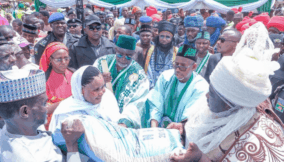
The Federal Government has received the final report of the National Technical Working Group on the World Bank-supported $500 million Sustainable Agricultural Value Chains for Growth Programme (AGROW).
BusinessDay gathered that submission of the report marked the conclusion of the programme’s design phase and its transition to implementation.
Vice President Kashim Shettima, who announced this on Tuesday, said the Government, through the AGROW programme, is bridging the gap between farmers and national planning as well as policy making decisions at the centre.
Stanley Nkwocha, the Senior Special Assistant to the President on Media and Communications, Office of the Vice President, in statement, quoted the Vice President to have noted the challenge in the agricultural sector, acknowledging the distance between farmers who till the earth and the systems that determine what their labour is worth.
The US$500 million World Bank-supported programme was developed through seven zonal consultations involving 32 States, reflecting the increasing commitment of subnational governments to agricultural development and their readiness to assume greater responsibility for productivity, infrastructure, extension services and market development.
The Vice President described the AGROW programme report as “the conclusion of a design process that restores the farmer to the centre of our national economic reasoning, where he has always belonged.
“Today marks the transition of AGROW from programme design to implementation,” he added, maintaining that the World Bank US$500 million Nigerian agriculture programme is targeted at developing a programme rooted in the realities of farmers, delivered through our States, and capable of attracting the private investment required to move agriculture from subsistence to scale”, the statement said.
He observed that agriculture, a sector that accounts for 23 per cent of the nation’s GDP and sustains 34 per cent of its workforce, must not be treated as “a negligible sector, attended to at leisure and financed at the margins.”
He also noted that most Nigerians earn a living from the tilling of the soil, he said no other sector carries as many livelihoods or touches as many households as the agriculture sector.
“When yields rise, food prices ease, rural incomes recover, industries receive raw materials, and the pressure on our cities and foreign reserves begins to relax. When yields fall, the entire economy discovers the price of hunger.
“Productivity on the farm is therefore a question of growth, employment, food security and poverty reduction. What we do to the farm, we do to the nation,” he stated.
The Vice President expressed satisfaction with the response from States, saying it reveals the scale of the opportunity before the nation, even as he stressed that the participation of 32 states in seven consultations to shape AGROW reflects “both the urgency of the challenges confronting agriculture and the growing appetite across Nigeria for agricultural development and investment.”
On the method of implementation, the VP said, “Of the US$500 million financing envelope, US$355 million, representing 71 per cent, will be implemented through participating States. This rightly places State Governments at the centre of delivery because agriculture ultimately takes place within our communities, Local Government Areas and States.
“The participation of 32 States, however, also makes one fact unmistakable: US$500 million cannot meet the scale of demand or close the gaps accumulated over decades in extension services, infrastructure, technology, processing and market access. The appetite is evident. The resources are not yet sufficient.”
Earlier, Governor Abdullahi Sule of Nasarawa State, had informed the Vice President of the commitment of the sub-nationals, stating that at a previous Nigerian Governors’ Forum (NGF) meeting, the World Bank had briefed the governors on the objectives of the working group and the initiative.

Join BusinessDay whatsapp Channel, to stay up to date
Open In Whatsapp