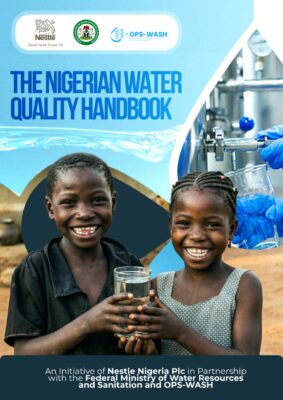
The Federal Ministry of Water Resources and Sanitation, in partnership with Nestlé Nigeria Plc, UNICEF, WaterAid and the Society for Family Health, SFH on Tuesday launched the National Water Quality Handbook aimed at strengthening regulatory standards, improving compliance, and catalyzing investment in Nigeria’s water sector.
Speaking at the 2026 Annual Water Quality Conference, in Abuja, tagged “Water Quality in a Changing Climate: Policies, Innovation and Practice”, Joseph Terlumun Utsev, minister, of Water Resources and Sanitation, said the initiative responds to growing climate pressures on water systems and the need for integrated management.
According to the minister, “Climate change is no longer a distant threat. It is a present reality that is already altering rainfall patterns, increasing the frequency of extreme weather events, and placing additional pressure on water resources and water quality.”
He added, “Flooding can mobilize pollutants into water sources, drought can concentrate contaminants, and poorly managed waste systems can further degrade our water bodies.
Addressing these complex challenges therefore requires integrated, science based, and climate resilient approaches.” Utsev said the handbook would support policy coherence and operational clarity across sectors.
Utsev emphasized the Water Quality Handbook developed in collaboration with other partners will further take the campaign to the communities and support informed decision making.”
On reforms, he said, “The Ministry is working towards integrating a National Water Quality Dashboard into the WASH Information Management System. This will enhance transparency, improve monitoring efficiency, and support evidence-based planning.”
In his remarks, Wassim Elhusseini, managing director, Nestlé Nigeria Plc, represented. by Victoria Uwadoka, Corporate Affairs and Sustainability Lead, at NESTLE, said water stewardship is central to business sustainability and industry operations.
She said, “Water is fundamental to life, public health, and economic development. As a food and beverage company, water is indispensable across our value chain, from responsible agricultural sourcing to manufacturing.”
According to her, “Our responsibility extends beyond efficient water use within our operations to active participation in protecting shared water resources and supporting access to safe water for communities.”
On the handbook, she said, “This handbook embodies our joint commitment to strengthening water quality standards, enhancing compliance, and building technical capacity across various sectors.”
She further said, “Designed as a practical resource for policymakers, regulators, industry practitioners, and community stakeholders, it supports informed decision making and the consistent application of best practices to safeguard public health.”
Uwadoka emphasized partnership impact saying, “This collaboration illustrates the impact achievable through aligned public private engagement. It underscores the importance of partnerships in tackling systemic water challenges and delivering sustainable outcomes.”
Also speaking, Kenneth Eze, chairman Senate Committee on Water Resources and sanitation, said climate change is already degrading freshwater systems and threatening economic stability.
“This climate change is a very significant threat to our freshwater system, raising water temperature, increasing concentration levels and intensifying nutrient runoff during extreme weather events.”
He added that the reality is not only degrading water quality, but also threatening public health, food security and sustainable development.”
Eze stressed the role of innovation and funding. He said, “We must continue to embrace innovation, refreshing our modern solutions such as solar powered systems, advanced monitoring technologies and compact water treatment plants. As the Senate, we assure you our deep commitment in supporting policy, legislation and funding mechanisms.”
In her welcome remarks earlier, Emanso Okop Umobong, permanent secretary, Ministry of Water Resources and Sanitation, said water quality has become a national economic and public health priority requiring coordinated action.
She noted that, “Safe water is not merely a development objective but a national public health priority, a socio-economic necessity, and a fundamental human right.”
She warned of rising health and cost implications, “Contaminated water remains a major contributor to waterborne diseases such as cholera and typhoid, which continue to pose serious threat to public health and place considerable pressure on our health care system.” she said
On policy direction, she stressed that, “Achieving SDG 6;1 and 6:3 targets require deliberate policy actions, stronger regulatory enforcement, and sustained investment in water safety infrastructure.”
She highlighted collaboration, noting that “Effective water quality management cannot be achieved by government alone. It requires strong partnerships and collective responsibility across all sectors.”
The conference, organized with the partners, is expected to shape policy direction and investment flows in Nigeria’s water sector.
Stakeholders said the handbook will improve standardization, reduce regulatory uncertainty, and open opportunities for private capital in water infrastructure, treatment technologies, and climate resilient systems.

Join BusinessDay whatsapp Channel, to stay up to date
Open In Whatsapp