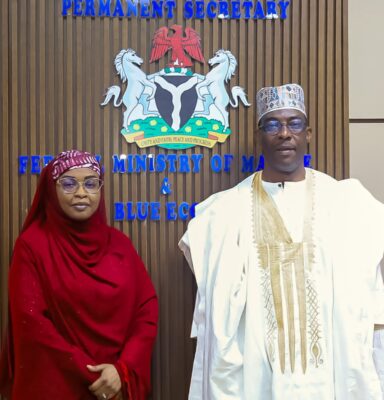
The Federal Government is considering a partnership with Admiralty Maritime Services Limited as part of efforts to expand the use of inland and coastal waterways as a cost-effective alternative for transporting cargo and passengers across the country.
This was disclosed by Fatima Sugra Tabi’a Mahmood, Permanent Secretary of the Federal Ministry of Marine and Blue Economy, during a courtesy visit by Muhsin Abba, Chief Executive Officer of Admiralty Maritime Services Limited, in Abuja.
In a statement signed by Anastasia Ogbonna, Director of Information and Public Relations at the ministry, Mahmood said optimising Nigeria’s vast aquatic resources is central to reducing national logistics costs.
According to her, since assuming office about ten weeks ago, one of her key priorities has been to fast-track the transition of freight movement from road to water.
“Data confirms that water transportation is significantly more affordable than road or rail. By shifting a substantial portion of cargo to our waterways, we will directly reduce the market price of goods and services, making the Nigerian economy more competitive,” she said.
Read also: High labour, logistics costs squeeze farmers amid petrol price hike
Mahmood added that the ministry is working under the policy direction of Adegboyega Oyetola, Minister of Marine and Blue Economy, to realise the vision of President Bola Ahmed Tinubu of positioning Nigeria as a global maritime leader.
The Permanent Secretary also highlighted Nigeria’s success in maintaining piracy-free territorial waters for three consecutive years. However, she stressed that sustaining this progress would require deeper collaboration with neighbouring countries and international partners to secure critical shipping routes in the Gulf of Guinea.
Earlier, Abba said Admiralty Maritime Services Limited, a subsidiary of Navy Holdings Limited, is ready to support the ministry’s blue economy roadmap.
He identified key operational challenges affecting Nigeria’s maritime gateways in Lagos, Warri, Calabar and Port Harcourt, noting that underwater wrecks and the need for strategic dredging remain major obstacles to efficient maritime operations.
“Addressing these obstructions will improve navigational safety, increase vessel traffic, and streamline the coastal transportation of petroleum products and other essential cargoes,” Abba said
He added that the company remains committed to aligning with government policies to unlock the sector’s full potential.

Join BusinessDay whatsapp Channel, to stay up to date
Open In Whatsapp