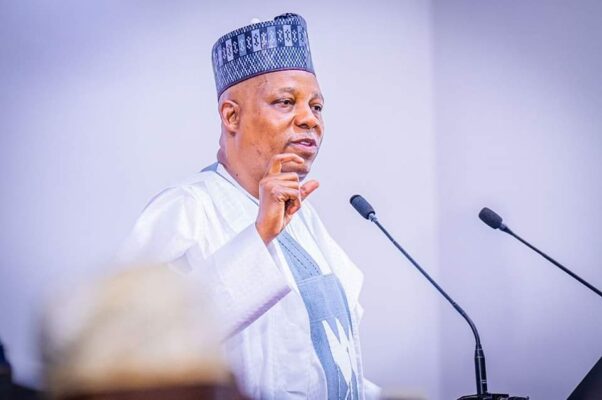
Vice President Kashim Shettima, on Wednesday, flagged off the $500 million Niger Delta Agricultural Investment Fund, aimed at boosting food production and cutting reliance on crude oil and natural gas as main source of revenue.
The move have been described as laudable development for a nation whose foundation was built on agrarian economy and whose soil paid its bills before the discovery of oil.
Shettima, while speaking at the event, observed that Nigeria cannot afford to take the promise of an agricultural boom for granted, noting that while nations survive on many resources, they endure because they can feed themselves.
The multi billion naira program was unveiled on Wednesday, at the Niger Delta Agricultural Development and Investment Summit jointly convened by the Office of the Vice President and the Niger Delta Development Commission (NDDC).
Stanley Nkwocha, Senior Special Assistant to the President on Media and Communications, office of the Vice President, said Shettima also described the event as “not only the foundation of civilisation but also the first guarantee of political stability”
The region which presently sits on approximately 23 billion barrels of proven crude oil reserves, estimated gross in-ground value of roughly $1.81 trillion, generates about $122.8m, daily for the country.
The region is also rich in gas with about 93.8 trillion cubic feet of recoverable gas discovered to date.
Despite the massive market valuation, however, local communities within the region had for several years, face severe environmental degradation and poverty, with an average of 240,000 barrels of oil spilled annually.
Despite rich agricultural soil for the production of cassava, rice, yam, Palm oil, cocoa and several species of vegetables, agriculture had been left at the levels of shifting cultivation.
The absence of commercial agriculture left food production in the at the levels of subsistence agriculture, producing barely enough to feed the people
Shettima noted that “Before a people raise cities, they must learn to feed them, and before a state earns the loyalty of its citizens, it must secure their daily bread.”
Underscoring the significance of agriculture to Nigeria, Shettima said “the groundnut pyramids of the North, the cocoa estates of the West, and the palm produce of the East and the Delta financed our earliest schools and hospitals and underwrote the young institutions of a new republic.”
He however, regretted that “the oil boom came with an ease that dulled the industry of the cutlass, teaching the country that once fed itself to, instead, import what its own soil could grow.”
Shettima while applauding the Nigerian Delta region for the Agriculture Investment Fund Initiative, said “what makes this vision inspiring is that it arises from a region that could have rested on its oil wealth and left feeding the nation to other hands.
He noted that the Niger Delta has, instead choosing to return to an identity older than crude itself, for the palm oil of these creeks fuelled the commerce of continents long before the first barrel was drilled, has chosen to transform this region, feed the nation, and attract the world,
“This is where philosophy must give way to action. The Niger Delta Agricultural Investment Fund of 500 million dollars, which we launch today, is a commercial, returns-driven vehicle spanning the value chain, from aquaculture and palm oil to cassava, cocoa, rice, horticulture, marine resources, and livestock.
“Around it, we coordinate the commitments already pledged by the World Bank, the African Development Bank, the Islamic Development Bank, the European Bank for Reconstruction and Development, and our private and commercial financiers.
“Above both stands the Niger Delta Agricultural Development and Investment Council, which I am honoured to chair, with the NDDC as its Secretariat. Beneath it lies a demand-side strategy preparing bankable projects across all nine mandate states.”
Shettima explained why on assumption of office in 2023 “President Bola Ahmed Tinubu, GCFR, placed food security among the earliest priorities” of his administration, noting that the idea was driven by the understanding that “nations that lose control of their food eventually surrender control of their future.
“His July 2023 declaration of a state of emergency shifted our national approach from the boardroom to the ground, across production, market stabilisation, and food access.
“This is why mechanisation has been the centrepiece of the drive, and why the administration launched the Renewed Hope Agricultural Mechanisation Programme for 10,000 tractors over five years, alongside local assembly plants, and in parallel with the John Deere Tractorisation Programme, the Greener Hope Project, and the Green Imperative Programme,” he further stated.
The outcomes, the VP continued, speak for themselves, with sustained dedication of the Minister of Agriculture and Food Security, Senator Abubakar Kyari, through which he said the administration has seen the prices of several essential food commodities fall, by as much as 50 per cent for some.
He implored investors, development partners, and state governors to treat the Summit “as the start of an obligation rather than the end of a ceremony,” emphasising that “the fund is launched, the commitments are aligned, the council is constituted, and the pipeline awaits your conviction.”
Earlier, Abubakar Momoh, minister of Regional Development, had informed the audience that ” due to its potential for job creation and improvement in lives and livelihoods, the current administration places agriculture at the heart of Nigeria’s economic transformation.
“The national regional development policy recognises the potentials of every region not just in transforming livelihoods but in attracting investments and growth, hence the Niger Delta Agricultural Development and Investment summit is particularly significant in transforming the fortunes of youths and women across the Niger Delta,” he stated.
The minister therefore, urged the private sector, development partners and other stakeholders to collaborate and work more closely with governments at all levels to achieve objectives outlined for the transformation of all regions of the country, noting that government alone would not be able to achieve full transformation of Nigeria’s economy.
In a keynote speech, Samuel Joseph, the chairman of Origin Group, said the NDDC under the administration of President Tinubu is reinvigorated and better positioned to ensure the economic transformation of the Niger Delta region and has demonstrated greater commitment to achieving set objectives.
He commended the Federal Government for its renewed commitment towards the transformation of the Niger Delta region through the various programmes and initiatives that are continously unlocking potentials and tramsforming lives and livelihoods across the region.
For his part, the Managing Director of the NDDC said the summit is not the end of a conversation but the beginning of a long-term partnership to unlock the agricultural potential of the Niger Delta.
He urged stakeholders in the region to seize the opportunities of the summit with purpose and build partnerships that endure and also mobilize investments that create jobs, strengthen food security and grow our economy.
Also, Chiedu Ebie, chairman of the Governing Board of the NDDC, said the Niger Delta cannot afford to remain a region of untapped promise, noting that the people deserve a future built on productivity, enterprise, dignity, and shared prosperity.
He said the young people deserve opportunities, farmers deserve access to finance, technology, infrastructure, and markets, and our communities deserve development that is sustainable, inclusive, and measurable.

Join BusinessDay whatsapp Channel, to stay up to date
Open In Whatsapp