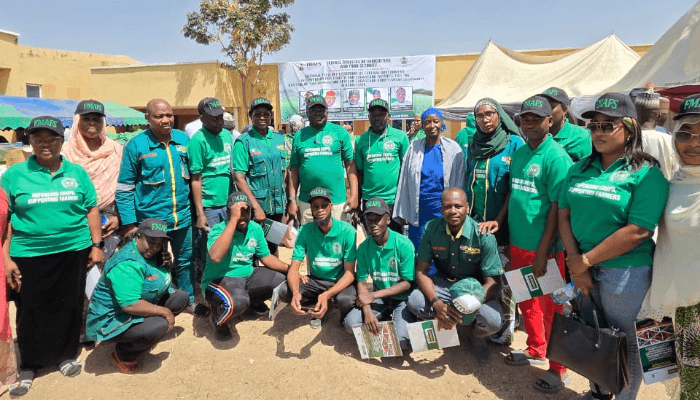
The Federal government has launched an emergency intervention programme to curb the spread of Tuta absoluta and African Sugarcane Borer, two destructive pests threatening tomato and sugarcane production in Nigeria.
The intervention was flagged off at the Federal Crop Production Technology Transfer Station, Dan Hassan, Kano, with the government describing the outbreak as a national agricultural emergency.
Aliyu Sabi Abdullahi, minister of state for agriculture and food security said the initiative is designed to strengthen farmers’ capacity to detect, manage and contain pest infestations.
He said the programme would focus on farmer and extension worker sensitization, distribution of approved pest control inputs, provision of technical guidance, and the deployment of integrated pest management strategies.
According to him, the intervention underscores the Federal Government’s commitment to food security, farmers’ welfare, agricultural resilience, and sustainable pest management, especially in frontline agricultural states such as Kano.
Abdullahi said tomato production remains a critical economic activity, providing income and employment for millions of Nigerians across farming, processing, transport and marketing value chains.
He noted that persistent post-harvest losses and repeated infestations, particularly by Tuta absoluta, have continued to undermine farmers’ productivity and livelihoods.
On sugarcane, he said the crop has supported job creation, import substitution, and the development of by-products such as ethanol and bio-energy, but productivity has been threatened by the African Sugarcane Borer.
The minister said the scale and impact of the pest outbreaks require urgent and coordinated government response, stressing the importance of farmer sensitization and federal-state collaboration.
He commended the support of Bola Ahmed Tinubu, president, Federal Republic of Nigeria , under the Renewed Hope Agenda on Food Security, which led to the release of two improved tomato varieties, HORTITOM4 and HORTITOM5, by the National Horticultural Institute in April 2025.
He said the current intervention aligns with the Renewed Hope Agenda and the broader objective of boosting national food production.
Abdullahi assured that ministry officials, in collaboration with the Kano State Government and farmers’ leaders, would ensure that the distributed inputs reach genuine beneficiaries.
He also announced the upgrading of the pest control division into a full-fledged Federal Department of Plant Health and Pest Control Services to strengthen farmer protection, safeguard strategic crops, and promote climate-smart and environmentally responsible agriculture.
The minister commended Abba Kabir Yusuf, governor, Kanon state government, for prioritising agriculture and described Kano as a major pillar of agricultural production, particularly in tomato cultivation and irrigated farming systems.
He urged farmers and beneficiaries to apply the free inputs responsibly, follow expert guidance, and avoid reckless pesticide use that could harm human health and the environment.
Represented by Danjuma Mahoud, commissioner of agriculture, Yusuf lauded the Renewed Hope Agenda and said the state’s agricultural programmes are aligned with the Federal Government’s agricultural transformation drive.
Earlier, Marcus Ogunbiyi, permanent secretary, FMAFS , said the intervention marks a crucial step in safeguarding agricultural productivity and empowering farmers to tackle major pest challenges.
Read also: Erisco witness admits Okoli never told consumers to boycott tomato paste
He said Kano was deliberately selected due to its strategic role in irrigated agriculture, horticultural production, and agro-processing.
According to him, the programme is science-driven, partnership-based, and aimed at repositioning agriculture as a cornerstone of national development.
Highlights of the event included farmer and stakeholder sensitization on early pest detection, safe control methods, and best agronomic practices, as well as the distribution of approved pest control inputs, farmers’ manuals, and personal protective equipment.
Trained extension and plant protection officers are also to provide continuous technical guidance to minimise crop losses and prevent the spread of infestations across farming communities and neighbouring states.

Join BusinessDay whatsapp Channel, to stay up to date
Open In Whatsapp