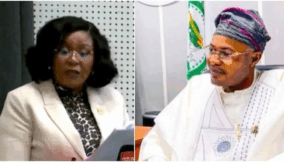
An economist, Danladi Saba, on Wednesday urged Nigeria to implement structural reforms to withstand inflation, trade disruptions and exchange rate pressures arising from escalating geopolitical tensions in the Middle East.
Saba, of the Department of Economics, Ahmadu Bello University, Zaria, Kaduna State made the call during a discussion organised by the Bashir Adeniyi Centre for International Trade and Investment of the Nigerian Institute of International Affairs, Lagos.
The discussion had the theme, “Global Tensions, Local Consequences: Implications of the Middle East Conflict for Bystander Economies.”
He said that the impact of a conflict might not be uniform because countries were being exposed to the crisis in different ways.
“While some are oil importing countries, some are exporting and some are trade dependent economies, and some countries will be affected via financial exposure.”
He listed India, Turkey and South Africa as oil-importing Emerging Market Economies (EMEs), Nigeria and Angola as oil exporters, Germany and China as trade-dependent economies, and Brazil and Indonesia as financially-exposed EMEs.
His presentation adapted a three-channel transmission framework involving oil/ energy, trade and financial channels.
According to him, political tensions in oil-rich regions cause supply disruptions, leading to price volatility and global inflation.
Saba said that the channels were not mutually exclusive but interacted and reinforced one another, ultimately manifesting in inflationary pressure and exchange rate instability.
He said trade disruptions, such as the Suez Canal incident increased shipping costs and supply chain fragmentation.
He added that financial instability would ensue with capital flows shift, leading to currency depreciation and rising interest rates.
“In essence, a geopolitical shock, especially from the Middle East, has the capacity or tendency to trigger oil price rise, trade disruptions and financial market uncertainties, and this will lead to inflation and reduce outputs
“Ultimately, policymakers in these bystander economies will be faced with a trade off between inflation control and economic growth.
“It is important to know that the Middle East is a dominant global oil supplier and any conflict in that area can affect global oil prices through supply uncertainty and price spikes, and this will be linked to energy costs in other countries that are not directly involved in this war.”
The economist said that periods of geopolitical uncertainty would typically induce a “risk-off” sentiment among investors, prompting re-allocation of capital toward safer assets in advanced economies.
Saba added that institutions such as the International Monetary Fund frequently documented these dynamics, particularly in the context of emerging market vulnerabilities.
“For Nigeria, shifts in global risk sentiment result in capital outflows, reduced portfolio investment, and heightened exchange rate pressures,” he said.
He said that rising energy prices, increased import costs and exchange rate depreciation collectively generated ‘ imported inflation’.
According to him, this form of inflation is particularly challenging to manage, as it originates outside the domestic economy but has profound implications for household welfare, real incomes, and overall economic stability.
The expert recommended that, in the short term, policy responses should focus on mitigating immediate economic disruptions.
This, he said, might include targeted interventions to stabilise fuel prices, measures to manage exchange rate volatility, and social protection programmes aimed at cushioning the effects on vulnerable populations.
“Over the medium term, structural adjustments are essential.
“Expanding domestic refining capacity can reduce dependence on imported fuel, and diversifying trade partners can mitigate exposure to specific geopolitical risks.
“In the long run, a deeper structural transformation is required, and it is important to recognise that in an increasingly interconnected global economy, no country is truly insulated from external shocks.
“Geopolitical tensions, though geographically distant, are internalised through price mechanisms, financial markets, and policy constraints.”
According to him, for economies such as Nigeria, understanding and managing these transmission channels is not an academic exercise but a policy imperative.

Join BusinessDay whatsapp Channel, to stay up to date
Open In Whatsapp