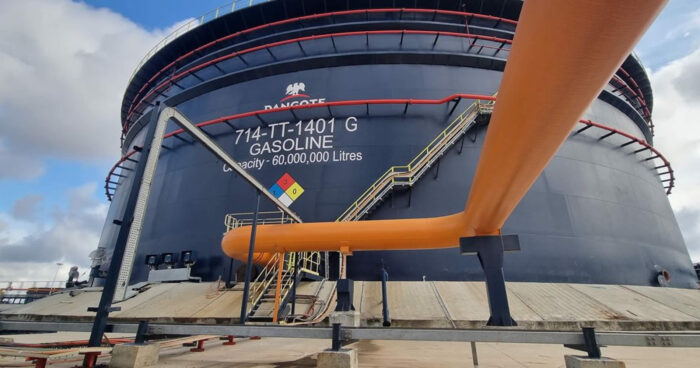
Dangote Petroleum Refinery has restarted a free petrol delivery scheme for independent marketers, opening a new front in Nigeria’s fight over who controls the country’s fuel supply chain and at what price.
The first phase covers Lagos, Ogun, Rivers, Kaduna, the Federal Capital Territory and Delta, according to a notice on Petroleumprice.ng published Wednesday.
Marketers in those locations can now buy Premium Motor Spirit, the technical name for petrol, at N1,075 a litre with delivery included, a 10-day credit window for qualified buyers, and a minimum order of 250,000 litres.
The refinery said more states would be added as the rollout continues, without giving a timeline.
The move comes weeks after Dangote scrapped its consortium arrangement, an exclusive supply structure that had funnelled product through a fixed group of marketers, including NIPCO Plc/11 Plc, MRS, TotalEnergies, Conoil, AA Rano, AYM Shafa, Rainoil/Eterna, Ardova Plc and NNPC Retail among them.
Ending that setup threw loading gates open to any qualified buyer, a shift marketers had pushed for since the refinery began selling domestically.
“For nearly two years the conversation in this industry was about who had access and who didn’t,” said the head of a mid-sized marketing firm that trucks fuel into the southwest. “Free delivery on top of open access changes the math for everybody, not just the big nine.”
Haulage from Lekki to inland depots can add anywhere from N15 to N40 a litre depending on distance and diesel costs, according to marketers who move product on that route.
Stripping that cost out, even for a defined list of states, lowers the landing price for petrol sold onward to retail stations, pressure that filters down to pump prices in principle, though rarely on a one-to-one basis in Nigeria’s downstream market.
“Delivery cost has always been the silent tax on this business,” said an official at a downstream trade association who asked not to be named because the group had not authorised comment. “If Dangote is absorbing that for six states, marketers there gain real breathing room on margin. The question is whether it holds once volumes climb.”
The 10-day credit facility drew separate attention from analysts who track marketer liquidity. Working-capital strain has long been cited as a barrier to entry for smaller operators who can source product but struggle to finance the purchase and haulage in one cycle.
A short credit window, even limited to qualified buyers, can let a marketer sell part of a consignment before the bill comes due.
“Credit terms matter more than headline price in this trade,” said a Lagos-based oil and gas analyst at a local investment research firm. “A marketer who has to pay upfront and wait for trucks is exposed to price risk the whole time. Ten days of breathing room changes who can compete, not just how much they pay.”
The 250,000-litre minimum, however, sets a floor that some independent marketers say still favours larger players. That volume is roughly six to seven fully loaded trucks, a threshold industry participants describe as manageable for established distributors but a stretch for smaller depot operators without existing storage capacity or a base of retail stations to absorb the product quickly.
Dangote’s refinery, with installed capacity of 650,000 barrels a day, has spent the past year adjusting its domestic sales model as it works through disputes with marketers, regulators and international traders over pricing, quality claims and market access.
The consortium’s collapse and the reintroduction of free delivery mark the latest recalibration, one that puts the refinery more directly in competition with the logistics arms of established marketers rather than relying on them as intermediaries.

Join BusinessDay whatsapp Channel, to stay up to date
Open In Whatsapp