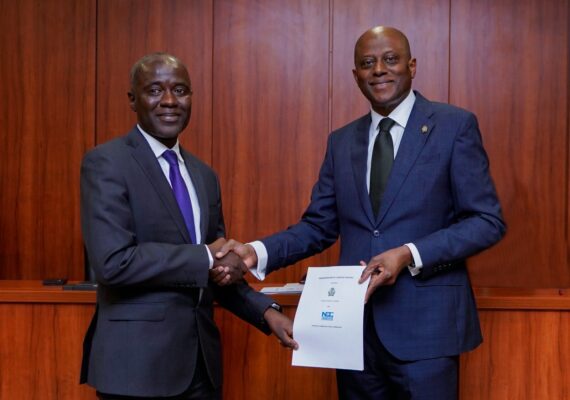
In response to the complexity of the current digital financial ecosystem, which requires a more comprehensive, forward-looking framework, the Central Bank of Nigeria has signed a Memorandum of Understanding (MoU) with the Nigerian Communications Commission (NCC) to reinforce the stability of Nigeria’s payment system.
Speaking during the signing ceremony in Abuja on Monday, Olayemi Cardoso, CBN governor, noted that across Nigeria, citizens and businesses increasingly depend on digital channels to save, pay, trade, access credit, and build livelihoods, adding those channels, in turn, depend on resilient telecommunications networks, trusted identity systems, and secure data flows.
He emphasised that when the communications sector is strong, the financial system is more inclusive and more efficient; and when the financial system is sound, investment and innovation in the digital economy can thrive.
Cardoso explained that the rise in digital adoption has also attracted increasingly sophisticated fraud schemes, stating that addressing these threats requires joined-up action—shared intelligence, clearer escalation paths, stronger operational readiness across regulated entities, and consistent public education.
Under this MoU, he said measures such as strengthened authentication for higher-risk transactions, effective transaction monitoring, functional fraud reporting channels, and a harmonised consumer sensitisation programme—particularly for underserved segments and MSMEs—will be introduced.
“That is why this MoU is not merely an administrative document—it is a practical statement of national interest. CBN and NCC have a history of constructive engagement on matters such as short code governance for payment service providers, coordination to support cross-platform stability, and the resolution of challenges around USSD payments.
“First, we are reinforcing the stability and integrity of Nigeria’s payment system. As we deepen instant payments, expand QR-based payments, and advance open banking and API interoperability, it is essential that infrastructure across both sectors is aligned—so that transactions are reliable, services scale smoothly, and consumers enjoy safe and seamless experiences.
“Through this MoU, we will strengthen coordination on approvals, technical standards, and innovation trials, including sandbox testing that supports market-led solutions while safeguarding stability.
Second, we are strengthening our collective response to electronic fraud and improving consumer protection.
“This MoU supports the implementation of the Telecom Identity Risk Management Portal (TIRMP)—a secure, regulatory-backed data-sharing platform designed to help prevent fraud linked to churned, swapped, or blacklisted mobile numbers. The ability to verify mobile number status in real time across banks, fintechs, and other digital platforms is a critical layer of protection for consumers and for the financial system,” he added.
He also mentioned that the agreement will ensure that the use of this capability is governed by clear standard operating guidelines and strict compliance with Nigeria’s data protection requirements, including appropriate safeguards, encryption, and consent protocols.
Also speaking at the event, Aminu Maida, executive vice chairman of the Nigerian Communications Commission, said that the agreement marks an important milestone in the regulatory stewardship of Nigeria’s digital economy as it reflects a shared commitment to collaboration in strengthening financial system stability, advancing digital inclusion, and protecting consumers in an increasingly interconnected ecosystem.
For him, the MOU is critical for the prevention of electronic fraud, which he said has become increasingly pervasive, with significant implications for the integrity of Nigeria’s digital economy.
“The MoU we are signing today is borne out of the imperative that our two institutions must work together in the best interest of the Nigerian consumer. It also reflects our shared commitment to building a stronger digital economy—one that is trusted not only by the Nigerian people, but also by the global business community.
“This MoU provides a clear framework for cooperation in critical areas such as payment system integrity, consumer protection, fraud mitigation, and the responsible use of digital infrastructure. In particular, it supports initiatives that promote secure digital payments, enhance trust in mobile-enabled financial services, and extend safe access to underserved populations and MSMEs.
“Through the Telecom Identity Risk Management System (TIRMS) Portal—which aggregates data on churned (recycled) phone numbers, as well as numbers flagged within your sector—the Financial Services industry will now have enhanced visibility into the status of phone numbers, one of the most widely utilized resources in your sector, although regulated by the NCC.
“This means that the Financial Institutions will be able to determine when a line is active, when it has been swapped, when it has been disconnected due to inactivity and reassigned to a new subscriber, and when it has been flagged for suspicious or fraudulent activity.
“This ensures that our financial services industry is better equipped with timely and relevant information to effectively combat e-fraud, particularly those perpetuated using phone numbers, in the country,” he said.

Join BusinessDay whatsapp Channel, to stay up to date
Open In Whatsapp