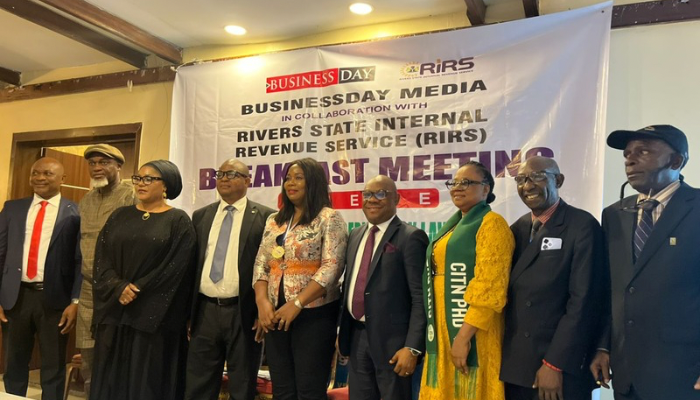
Companies and organisations especially in the Niger Delta have been shown clearly how they can make more profit from the new tax laws which came into effect on January 1, 2026.
The insights and strategies emerged at the first BusinessDay/Rivers Internal Revenue Service (RIRS) breakfast meeting on new tax regime held at the Hotel Presidential in Port Harcourt Thursday, March 19, 2026.
John Ohaka, professor and Dean, Faculty of Administration & Management, Rivers State University (RSU), who delivered the lecture on ‘Leveraging Nigeria’s Tax Laws to Enhance Profitability,’ showed the clauses that businesses and companies could exploit to make more profit, going forward.
He mentioned the numerous exemptions now listed in the new laws, urging companies to study very deeply and create more income from them.
Ohaka also listed the new tax incentives that companies could leverage to create more wealth and more profit. One of the new developments, according to him, is digitization of tax payment as well as electronic invoicing system.
The expert said these would reduce fraud and inconsistency and reduce taxes paid by businesses, thus encouraging self-compliance. The overall impact, he said, is that it would reduce tax payable by companies and boost government revenue, especially those in Rivers State.
He also stressed that the country’s new tax laws heavily favour the poor and vulnerable.
He said, “Taxation remains one of the most significant policy instruments available to governments for mobilizing revenue, redistributing income, and stimulating economic growth.
“In Nigeria, the tax system is designed not only to generate public revenue but also to create incentives that encourage investment, entrepreneurship, and corporate profitability,” he said.
Rivers revenue agency, BusinessDay explore tax reforms, SMEs growth and profitable
The organisers, RIRS and BusinessDay Newspaper, in their different presentations, linked effective tax administration to business growth and profitability.
The organisers led business owners in Rivers, Abia and Bayelsa states in exploring issues surrounding Nigeria’s tax laws and enhanced profitability for entrepreneurs in the South-South geopolitical zone.
The business owners included members of the Port Harcourt Chamber of Commerce, Mines, Industry and Agriculture (PHCCIMA), state chapter of the Manufacturers Association of Nigeria (MAN) and Yenagoa Chamber of Commerce, Mines, Industry and Agriculture (YCCIMA).
Israel Egbunefu, Executive Chairman, Rivers State Internal Revenue Service (RIRS), described the collaboration with BusinessDay as a step in the right direction and suited for promoting tax education and efficiency tax administration.
“I wish to commend BusinessDay for this sustained leadership in promoting economic literacy, responsible policy discourse, and constructive engagement, between government institutions and the business community.
“This initiative reflects a sheer commitment to strengthening Nigeria’s fiscal governance and improving the business environment.
Egbunefu said the RIRS and BusinessDay collaboration is strategic adding that, “It is aligned directly with our institutional vision to build a tax system that is transparent, efficient, equitable, and responsive to stakeholder needs.”
He pointed out that tax administration now extends beyond premium collection. “It is fundamentally about building public trust, fostering voluntary compliance, strengthening institutional credibility, and supporting the sustainable development.
“This breakfast meeting today, therefore, provides an invaluable platform for dialogue, clarity, and partnership between tax administration,” he said.
He said RIRS, in its reform and modernization agenda, “has pursued an ambitious reform agenda that is focused on institutional strengthening and service delivery improvement.
“Our key priorities include comprehensive digitalization of our tax and traditional processes, elimination of revenue decades, strengthening transparency and accountability mechanisms, improving taxpayer service experience, enhancing inter-agency collaboration, promoting peace of doing business within the United States.
“These reforms are guided by a clear objective to create a fair, predictable, and technology-driven tax system that supports economic growth and spares on confidence.
“Taxation remains the most sustainable source of funding for sustainable development. It provides resources necessary for substantial investment, healthcare delivery, professional advancement, and social protection.
“A strong income-directed revenue base also reduces dependency on external applications and enhances fiscal decisions.
“However, revenue organization must always be accompanied by activity and responsible stewardship principles that remain central to our operation, especially in the environment.
“We are focused on promoting voluntary compliance. Our study philosophy is anchored on three fundamental pillars, education, engagement, and enforcement.
“We believe that informed taxpayers are more willing to comply, and that continuous engagement fosters trust and partnership. Enforcement, therefore, serves only as a last resort.
“This gathering is intended to advance the first two pillars by creating a conducive environment for dialogue, communication, and mutual understanding, supporting the private sector. The private sector remains the engine of economic growth and investment.
“Our administration recognizes businesses not merely as taxpayers but as critical partners in development. Accordingly, we remain committed to eliminating multiple taxation, harmonizing revenue procedures, simplifying compliance processes, providing clarity and credibility in tax obligations, strengthening dispute resolution mechanisms.
These measures are essential to enhancing investor confidence and sustaining economic growth and profitability under the new tax regime.
“The new tax regime has offered lots of concessions for the poor and vulnerable. The future of sustainable development depends significantly on the strength, fairness, and efficiency in our tax system.
“We therefore commend on this valuable initiative and look forward to a productive partnership and living taxpayer awareness, strengthening second voluntary compliance, and promoting fiscal responsibility.
“Together we can build a tax system that supports developers, empowers businesses, and secures prosperity for future generations.
Patrick Ijegbai, BusinessDay’s General Manager, Business Development and Partnerships, South-East/ South-South, said the breakfast meeting is a unique opportunity to take an incisive look at the new tax regime and the inherent opportunities for profitability that it offers Nigerians and businesses across all sectors of the economy.
“I am particularly delighted that the Rivers State Internal Revenue Service (RIRS) under the able leadership of the Executive Chairman, Sir Israel Egbunefu, saw the advantages of this meeting and decided to partner with us to deepen conversations around tax issues in the new law as it affects citizens, residents and businesses in Rivers State,” he said.

Join BusinessDay whatsapp Channel, to stay up to date
Open In Whatsapp