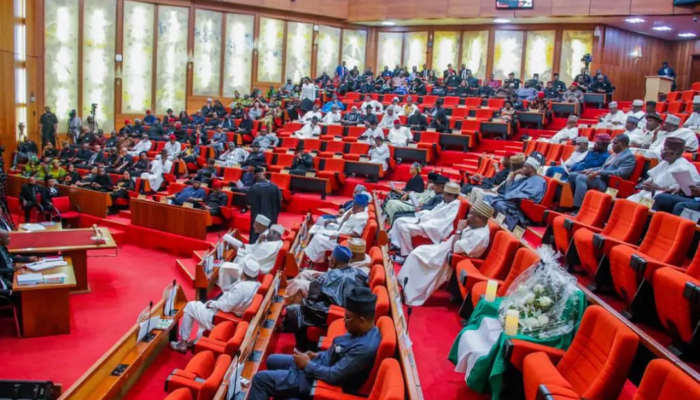
The House of Representatives degenerated into a rowdy session on Wednesday as lawmakers clashed over a proposal to summon President Bola Tinubu to appear before the Green Chamber over slow implementation of the 2025 budget.
The row began when Benedict Etanabene, the member representing Okpe/Sapele/Uvwie Federal Constituency of Delta State, raised a point of privilege to draw the attention of the House to a June 29 circular issued by the Accountant-General of the Federation, Shamseldeen Ogunjimi.
Etanabene argued that the circular had generated widespread concern and warranted urgent legislative scrutiny. He maintained that, given the significance of the directive, the House should invite President Tinubu to appear before lawmakers to explain the issues arising from it.
Lawmakers wanted Tinubu to explain persistent delays in the implementation of the 2025 budget and the poor funding of Ministries, Departments and Agencies (MDAs).
During consideration of a motion sponsored by Alex Ikwechegh, the member representing Aba North/Aba South Federal Constituency of Abia State, on the slow release of appropriated funds and its impact on government projects nationwide.
Moving the motion, Ikwechegh lamented what he described as the poor implementation of the 2025 Appropriation Act, despite budgetary approvals granted by the National Assembly.
He told lawmakers that submissions by ministers and heads of MDAs during the ongoing 2026 budget defence sessions revealed that several agencies received little or no capital releases throughout the 2025 fiscal year, leaving many projects abandoned or stalled.
According to him, the situation has also triggered repeated protests by indigenous contractors who have not been paid for completed and certified projects, with many now facing financial distress after obtaining bank loans to execute government contracts.
The lawmaker recalled that President Tinubu, at a Federal Executive Council meeting in December 2025, directed the immediate payment of verified contractor liabilities estimated at about N1.5 trillion. He, however, expressed concern that despite the directive, legislative approvals and assurances by the Ministry of Finance, many MDAs were yet to receive the necessary releases.
Ikwechegh also drew the attention of the House to a June 29, 2026 circular issued by the Accountant-General of the Federation, Shamseldeen Ogunjimi, which reportedly suspended payments for zonal intervention and constituency projects pending verification by the Federal Ministry of Special Duties and Intergovernmental Affairs.
As part of his prayers, he urged the House to commend the President for directing the settlement of contractors’ liabilities while calling for the immediate implementation of the directive to prevent further disruption to government projects.
However, the atmosphere in the chamber changed dramatically when Ikwechegh proposed that President Tinubu be invited to appear before the House to explain the slow pace of budget implementation, the continued funding constraints and their implications for infrastructure development and national security.
“We want to use this opportunity to invite the President of the Federal Republic of Nigeria to this very hallowed chamber to come and explain to the Nigerian people why projects are not being implemented despite trillions of naira appropriated,” he said.
The proposal immediately split the House.
While some lawmakers argued that the President should personally address the legislature on the challenges affecting budget implementation, others maintained that under the Constitution, accountability for implementing the budget rests with ministers and heads of government agencies, who should be summoned instead.
The disagreement intensified after Godwin Oga Amobi proposed an amendment seeking the postponement of the House’s planned Open Week to enable lawmakers concentrate on resolving the budget implementation challenges. The amendment was seconded by Sani Lawan.
Tempers flared further when Yusuf Gagdi opposed the prayer seeking to invite the President, insisting that Nigeria’s constitutional framework assigns executive responsibilities to ministers and heads of agencies rather than the President in his personal capacity.
Gagdi urged the House to divide the motion and take separate votes on the controversial prayer to invite the President and the other resolutions contained in the motion.
His submission sparked loud protests from members across the chamber, with lawmakers shouting over one another in a chaotic exchange that repeatedly disrupted proceedings.
Amid the disorder, Abbas Tajudeen, the Speaker repeatedly appealed for calm before ruling against splitting the question for separate votes, insisting that the House would proceed in accordance with its established rules and procedures.

Join BusinessDay whatsapp Channel, to stay up to date
Open In Whatsapp