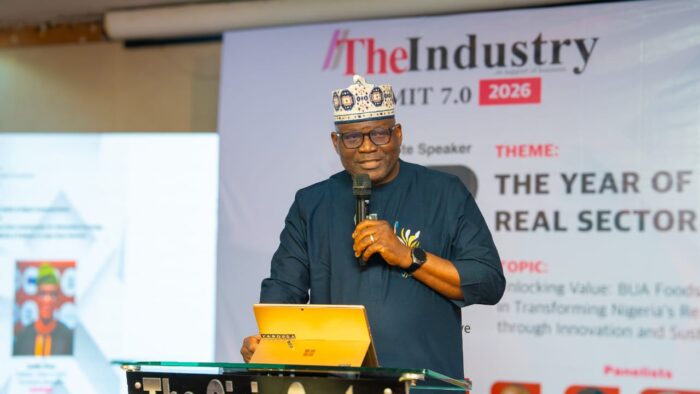
Nigeria’s economic future hinges on a decisive shift toward the real sector, with stronger coordination between government, financiers and industry players, according to Ayodele Abioye, managing director of BUA Foods Plc.
Speaking at the Industry Summit 2026 in Lagos, Abioye said growth driven by consumption and financial flows alone would be insufficient to sustain Africa’s largest economy, stressing that productivity in agriculture, manufacturing and logistics must take centre stage.
“Nigeria’s economic future will not be built in boardrooms alone or on balance sheets—it will be built in farms, factories, laboratories, warehouses, and logistics corridors,” he said.
The remarks come as fresh data underscore the growing weight of the non-oil economy. Nigeria’s gross domestic product expanded by 4.07 percent year-on-year in the fourth quarter of 2025, with full-year growth of 3.87 percent, largely driven by real sector activities, according to official statistics cited by Abioye.
Agriculture, which contributed about 25.67 percent to nominal GDP in the period, grew by roughly 4 percent despite security and climate-related challenges, while manufacturing posted modest expansion of about 1.1 percent, reflecting lingering constraints around energy, foreign exchange and logistics.
Abioye noted that the non-oil sector now accounts for more than 96 percent of Nigeria’s GDP, signalling a gradual decoupling from crude oil dependence. However, he warned that low productivity remains a critical bottleneck, limiting the sector’s ability to deliver broad-based prosperity.
“While the real sector employs millions, output per worker remains low relative to peer economies,” he said. “This gap highlights the urgent need for technology adoption, scale, energy efficiency and deeper value chain integration.”
He pointed to recent government reforms—ranging from agricultural self-sufficiency drives to infrastructure investments and trade policy adjustments—as early steps yielding results. Still, he stressed that policy consistency and implementation would be crucial to unlocking long-term gains.
At the company level, BUA Foods is ramping up investments across its value chain, from large-scale agriculture to processing and distribution, as part of a broader strategy to reduce import dependence and strengthen domestic supply capacity.
Abioye said the company has expanded production capacity by more than 40 percent in recent years and plans an additional 55 percent increase, aimed at improving food availability and supporting national food security.
Beyond scale, he highlighted the firm’s focus on sustainability and human capital development, including alignment with global reporting standards and partnerships with farmers, regulators and research institutions.
The company’s backward integration initiatives have also brought thousands of smallholder farmers into formal supply chains, helping to stabilise incomes and improve productivity, he said.
Abioye urged a coordinated approach to sustaining momentum in the real sector, calling on policymakers to ensure a predictable business environment, while financial institutions provide long-term capital tailored to productive investments.
“The private sector must invest responsibly, innovate boldly and operate sustainably, while academia must drive applied knowledge and local solutions,” he said.
With Nigeria’s population continuing to grow rapidly and global economic conditions remaining uncertain, Abioye said the stakes for reforming the real sector have never been higher.
“The transition is not optional,” he added. “It is essential for building a productive, resilient, and inclusive economy.”

Join BusinessDay whatsapp Channel, to stay up to date
Open In Whatsapp