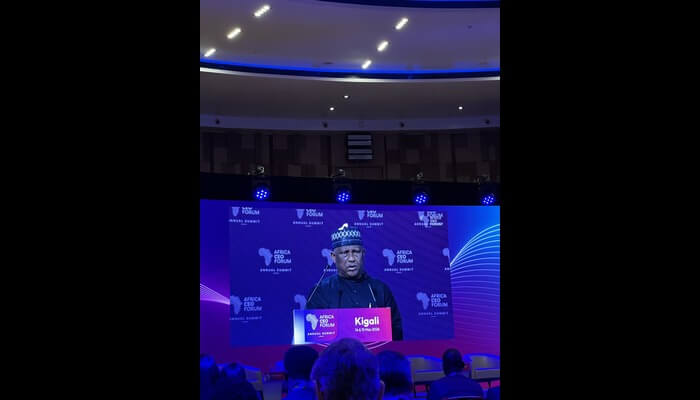
Kigali|| Abdul Samad Rabiu, chairman of BUA Group, said Africa risks missing the economic potential of one of the world’s most ambitious trade integration efforts — the African Continental Free Trade Area (AfCFTA) — unless governments dismantle visa restrictions, border bottlenecks and administrative barriers that continue to hinder cross-border commerce across the continent.
For Rabiu, Africa’s second-richest man, the issue is no longer whether Africa has the market size, resources, or capital to industrialise. The bigger problem is whether governments are willing to build the systems needed to make regional trade work in practice.
“At BUA Group, as we expanded our regional investments, we actively sought to support several African markets under the AfCFTA framework. While some countries embraced extension of the agreement, others were less supportive,” the billionaire industrialist said at the Africa CEO forum Thursday.
“The framework exists; implementation remains complicated,” he added.
Read also: Nigeria, Rwanda agree to deepen bilateral cooperation
That frustration reflects a broader concern among African manufacturers and investors who argue that while the AfCFTA has advanced politically, the realities on the ground still resemble a fragmented continent defined by border friction, policy inconsistency, and protectionist instincts.
Rabiu pointed to what he described as administrative barriers and legacy import structures that continue to limit companies seeking to expand across African markets under the trade agreement.
He disclosed that BUA itself faced challenges trying to enter one African market despite the AfCFTA framework.
The comments are significant because they come from one of Africa’s largest industrial investors, whose businesses span cement, sugar, food processing and infrastructure-intensive sectors that depend heavily on cross-border trade efficiency.
Read also: Nigeria’s SEC sees data driving intelligent investing decisions
The promise behind the AfCFTA remains enormous. The trade pact, conceived in 2019 and becoming operational in 2021, aims to create a unified market of more than 1.4 billion people, reduce tariffs, deepen regional supply chains and accelerate industrialisation across a continent with the world’s most youthful population.
Yet intra-African trade remains among the lowest globally, accounting for roughly 15 percent of Africa’s total trade, compared with about 60 percent in Europe and 40 percent in North America, according to various multilateral estimates.
For manufacturers, the barriers are often less about tariffs and more about the hidden costs of doing business across borders — poor logistics, slow customs systems, inconsistent regulations and visa restrictions.
Rabiu’s personal experience of being denied entry into an African nation on a trade mission due to an expired visa highlights a contradiction — Africa is attempting to create a single market without fully enabling the free movement of the people expected to drive it.
Industry experts have long argued that the success of AfCFTA depends not only on tariff reductions but also on deeper institutional reforms, including harmonised customs systems, digital border infrastructure, transport connectivity and coordinated industrial policy.
Read also: AfCFTA: Why logistics will determine Africa’s trade competitiveness
Rabiu echoed that position, calling for integrated industrial corridors, modern ports, efficient rail systems, digital customs platforms and cross-border energy infrastructure to reduce trade friction and improve competitiveness.
His argument also tied AfCFTA directly to industrialisation.
Africa, he noted, continues exporting raw commodities, from cocoa and crude oil to iron ore and minerals, while much of the processing, manufacturing and downstream value creation happens abroad.
That model, he argued, leaves African economies vulnerable to external shocks and limits job creation.
“Economies with domestic processing capacity are more resilient in times of shock,” Rabiu said.
“The current situation in the Middle East underscores the importance of local value addition. Nigeria offers a strong African example with the new refining capacity.”

Join BusinessDay whatsapp Channel, to stay up to date
Open In Whatsapp