Nigeria presents a striking paradox on the world stage. While Afrobeats stars dominate the global cultural narrative by headlining the biggest sporting events on earth; the country’s national football team, the Super Eagles, failed to qualify for the 2026 FIFA World Cup. As Nigerian musicians are reaping international acclaim and massive financial windfalls, Nigerian football is missing out on substantial financial rewards and national prestige.
As the tournament concluded with Spain’s victory, Nigerian artists like Burna Boy, Davido, Rema, and Ayra Starr featured prominently on the official FIFA World Cup 2026 album and live events largely self-driven through talent, innovation, and private enterprise, without significant government intervention in the music sector. Artists and labels have independently built international networks, secured major label deals, and leveraged digital platforms to dominate charts and stages worldwide.
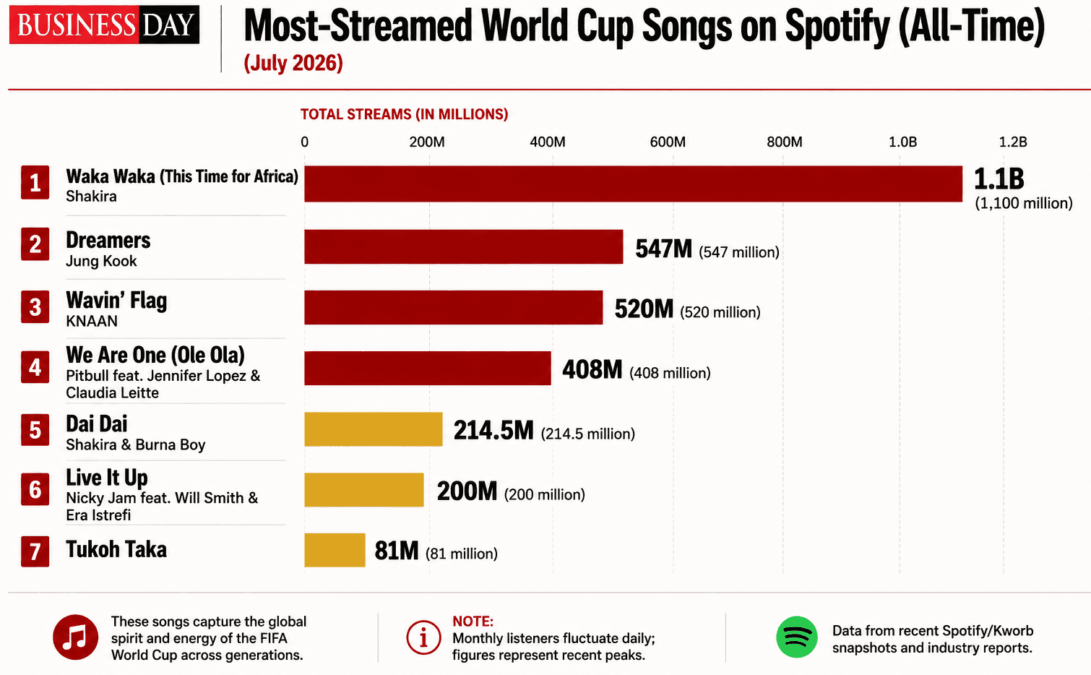
Burna Boy made history alongside Shakira with “Dai Dai,” the tournament’s standout anthem that topped global streaming charts and earned him performance slots at both the opening ceremony and the first-ever World Cup final halftime show, making him the first African artist to achieve this, Rema collaborated with LISA and Anitta on “Goals.” Davido linked with Major Lazer and Nelly Furtado on “No Place Like Home,” and Ayra Starr featured with Latto on “Show Me.” Earlier reports cited the album passing 336 million, with Dai Dai (Shakira & Burna Boy) as a standout.
Industry insiders view this moment not as a fluke, but as the elevation and exportation of Afrobeats uniqueness to the world. Okoeguale Ehizojie, popularly known as Dadaboy Ehiz, noted that Afrobeats is no longer a newcomer to these global stages. With Davido’s performance at the previous World Cup and Burna Boy’s historic appearance at both the 2026 opening ceremony and halftime show, the genre has reached its pinnacle, leveraging football’s status as the world’s most-watched sport. “We’ve had Rema perform at the Ballon d’Or, Tems performed at the FIFA Club World Cup final halftime show at MetLife Stadium, the first Nigerian/African artist in that slot, and Burna Boy headlining the kick-off show before the Champions League final; we can’t quantify Afrobeats anymore,” Ehiz said.
Amanda Uzoagba views this development as a significant catalyst, noting that it has revitalised interest in Afrobeats’ versatility and solidified the genre’s essential role in the global music ecosystem. She suggests that this heightened visibility will likely drive future cross-genre collaborations and attract a new wave of investment. Locally, Uzoagba identifies two key benefits: the potential for foreign exchange (FX) inflows to support emerging talent, and the breathing room for other developing genres to mature and eventually attract investment of their own.
Addressing future expectations, Ehiz added, “We get people asking what is next for Afrobeats, and people point at the Super Bowl, but that is just an American sport, and it’s not as global as football.” This perspective is underscored by viewership data: while the 2026 Super Bowl (Super Bowl LX) drew a significant US audience of 125.6 million across various platforms, it remains a fraction of the global reach achieved by international football tournaments.
Other Nigerian artists with prior World Cup ties include Femi Kuti (2010 opening ceremony in South Africa) and Davido (2022 in Qatar). These performances and features provided massive visibility. FIFA World Cup music initiatives have historically amplified artists’ careers through billions of streams, increased sales, touring opportunities, and brand partnerships.
Historically, FIFA projects a cumulative six billion range of global reach across broadcast, digital and out-of-home for recent World Cups. This year, 2026 is expected to be among the highest due to North American hosting and strong digital/streaming. YouTube alone saw over 1.7 billion unique viewers for related content, with the final drawing peaks over 27 million concurrent on official streams.
FIFA, Music, and global synergy
Music has long been integral to FIFA World Cups, creating emotional soundtracks that unify fans and elevate the event’s cultural impact. Themes enhance atmosphere in stadiums, broadcasts, and promotions. Shakira exemplified this with her 2010 hit “Waka Waka (This Time for Africa),” which became a global phenomenon, boosting her status as the “queen of World Cup hits.” It transcended football, symbolising African pride and achieving massive commercial success.
Similarly, K’naan‘s “Wavin’ Flag” (2010) propelled the Somali-Canadian artist to new heights. The song’s adoption as a Coca-Cola anthem turned it into a worldwide hit, significantly raising his profile, streams, and career trajectory beyond the tournament.
The benefits of featuring on the World Cup for African artistes are immense. Part of those ggodies include upfront fees, potentially millions for top names, though specifics vary and some performances emphasize exposure over direct pay, akin to Super Bowl halftime show models. Other gains include streaming royalties from platforms like Spotify and Apple Music, where hits rack up billions of plays during and after the event, publishing rights which add ongoing revenue, and long-term gains, including heightened awareness, fan growth, festival bookings, and endorsements, especially as “Dai Dai” already shattered streaming records. In addition, artists benefit from streams via standard royalty structures (mechanical, performance, and synchronization rights), though exact splits depend on contracts. FIFA and labels drive promotion, ensuring substantial downstream earnings.
The Football Side: missed millions and lingering scandals
In contrast, the Nigeria Football Federation (NFF) managed to squander both prestige and capital. Missing the expanded 48-team tournament meant
forfeiting at least $10 million in guaranteed FIFA participation payouts including $2.5 million in preparation costs, with group-stage exits netting about $9-10 million. Further progression yields far more, up to $50 million for the champions. Some of these unearned financial benefits could have been plugged back in the country’s economy as another non-oil revenue alternative.
The Super Eagles’ failure was largely self-inflicted: a chaotic qualifying campaign marred by erratic managerial changes, poor tactical execution, and recurring scandals over unpaid player allowances that triggered training boycotts. This meant that the NFF missed these funds, tourism boosts, kit sales and the loss of generational talent currently excelling in Europe but never getting the opportunity to represent their home country in their prime.
These failures have drawn severe public backlash. Former captain Mikel John Obi and popular creators like C.Mobike have publicly called out the NFF, describing it as an “extremely incompetent set of people” plagued by embezzlement, lack of integrity, and a culture of unaccountability.
He points out how the federation single-handedly sabotages Nigerian teams through poor decisions, such as benching reliable players during crucial penalty moments, leading to missed opportunities like World Cup qualification. According to Mobike, the NFF’s focus remains narrow and superficial, often limited to the Super Eagles, while broader issues like, owing players bonuses, and failing to develop grassroots and domestic football persist, effectively “repainting a collapsing building” rather than fixing systemic rot.
He has actively pushed for reform by raising a public petition to overhaul the NFF and its electoral system. In late 2025, he announced the petition on Change.org, urging Nigerians to sign and demand transparency, accountability, and a football system that truly serves the people and not just officials. He emphasized that ordinary citizens must get involved by pressuring the NFF Congress, Ministry of Sports, and National Assembly, highlighting how the current setup has ruined domestic leagues like the NPFL and stifled talent development across the country.
In juxtaposition, Afrobeats artists navigated global stages through merit and entrepreneurship, bypassing bureaucratic hurdles. While the NFF grapples with internal challenges, the music industry exports Nigerian culture profitably and independently.
As Nigerian sports look toward 2030, the music industry provides a shinning light: purge administrative corruption, build transparent structures, and let undeniable talent lead the way.

Join BusinessDay whatsapp Channel, to stay up to date
Open In Whatsapp