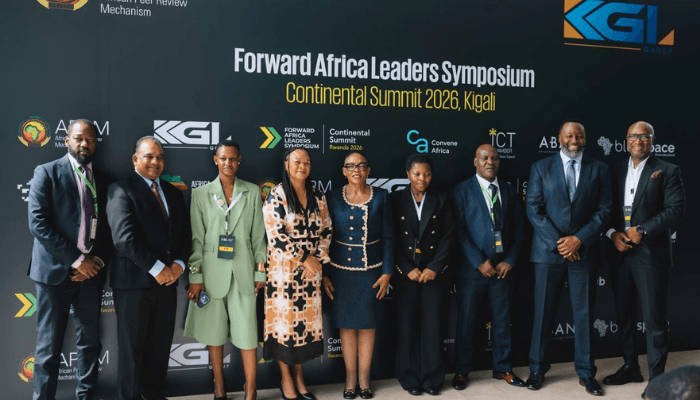
Alex Appau Daddey, executive chairman of KGL Group, has called on African governments to create stronger investor-friendly policies that will encourage more private capital to flow into digital infrastructure and innovation across the continent.
Speaking at the 2026 continental summit of the Forward Africa Leaders Symposium in Kigali, the executive chairman said African economies must deliberately position themselves to attract and retain investments that can drive long term growth and resilience.
Read also: Digital transformation in trust services: Opportunities and risks
Daddey said African leaders must work more closely with businesses and financial institutions to create conditions that make investing in local digital infrastructure more attractive than moving capital abroad.
“Capital flows where incentives, certainty and opportunity are aligned,” he said. “There must therefore be alignment between government policy, private sector leadership and financial institution support. We must make it more attractive to invest in African digital infrastructure than export African capital.”
He argued that African companies should not only participate in markets but actively shape them through innovation, technology and strategic investment.
Read also: Visa sees faster shift to digital payments across West Africa
According to him, KGL Group has focused on building digital solutions and modernising public revenue systems through subsidiaries.
He added that the group is also supporting startups and small businesses while pursuing mergers and acquisitions through its investment arm.
Read also: FIFA considers expanding 2030 World Cup to 66 teams
The summit in Kigali followed recommendations from the 2025 edition of the symposium held at the NASDAQ in New York City. Discussions this year centred on digital infrastructure as the foundation for Africa’s digital transformation and artificial intelligence ambitions.
Hannah Awuku, Executive director of the Forward Africa Symposium, said Africa is at a critical moment as emerging technologies continue to reshape the global economy.
“Artificial intelligence, digital finance, sovereign data systems, digital public infrastructure and advanced technologies are rapidly redefining global competitiveness,” she said. “Africa must not simply participate in this transition. Africa must shape it.”
The African Peer Review Mechanism, one of the summit’s major partners, said digital governance remains central to the continent’s future development strategy.
Marie Antoinette Rose Quatre, CEO APRM Continental Executive Secretariat, said the organisation is prioritising electronic governance through peer learning, institutional reforms and technical capacity building programmes for member states.
“Africa must think beyond digital inclusion to digital ownership of the technology we depend on,” she said. “This includes ownership of our data, ownership of the digital infrastructure that powers our economies, ownership of our innovation ecosystems and ownership of the policies and governance systems that will power the next wave of economic growth.”
She warned that countries that fail to build strong technological and institutional capacity risk being left behind in the era of artificial intelligence.
Organisers of the summit said discussions and recommendations from the gathering are expected to shape policy conversations around Africa’s next phase of economic development, particularly as countries seek to address fragmented regulations, uneven digital capabilities and weak institutional coordination that continue to slow the growth of integrated digital economies across the continent.

Join BusinessDay whatsapp Channel, to stay up to date
Open In Whatsapp