

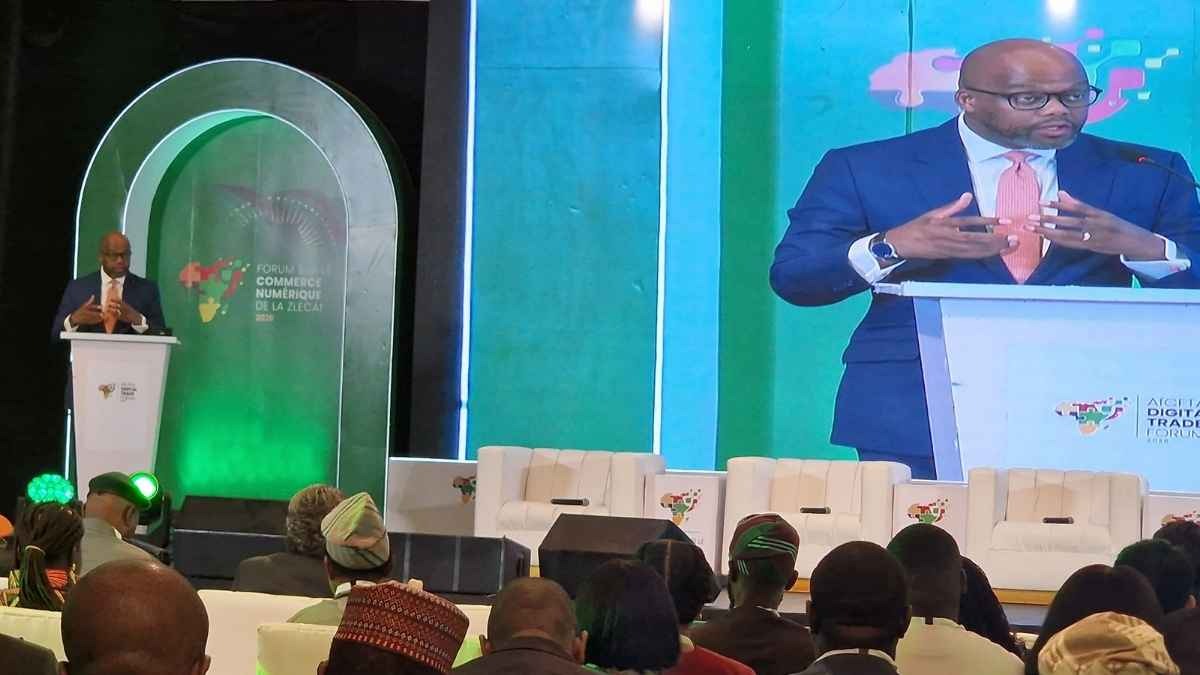
Africa needs more than 500 additional data centres over the next nine years if it is to attain sovereignty and build a competitive digital trade economy, according to the African Continental Free Trade Area (AfCFTA) Secretariat.
Speaking in Lagos at the AfCFTA Digital Trade Forum, Wamkele Mene, secretary-general of the secretariat said this is part of required investment in infrastructure to support cross-border electronic commerce under the 8-year-old agreement seeking to unify a 3 trillion naira market.
“Our studies indicate that our continent, by the end of 2035, will require over 700 data centres to enable us to process our own data, manufacture our own data and to manage our own data,” Mene said.
The Africa Data Centre Association, in its latest 2026 report, identified that the continent’s data centre market is still “developing” with an estimated 220 to 230 facilities across 38 countries, accounting for less than one percent of global capacity. Its capacity, currently 360 MW with some ongoing projects, is concentrated in a few hubs in South Africa, Egypt, Kenya, and Nigeria.
The mathematics leaves the continent with about 500 facilities short of what it needs.
The secretary said that the expansion of data centre capacity would be central to unlocking Africa’s growing digital economy, which the secretariat reported is currently valued at about $180 billion and projected to exceed $700 billion by 2050. According to him, building to meet up with European and American markets with thousands more centres is the “most immediate opportunity in our economy.”
“In Africa, we have 900 million smartphone users by the year 2022, double the number of the United States and Europe combined. By the year 2022, 40 percent of the world’s youth will be here in our continent. We must harness this dividend,” he said.
The Africa Data Centre Association pointed out that while some governments invest in national data centres, most carrier-neutral facilities and hyperscale campuses are owned by foreign companies and financed by private equity.
“Here in Nigeria, for example, many of the data centres, are private sector investments with the support of government,” Mene told BusinessDay. While he lauded the model, he said the states must step up federal investment in the energy infrastructure that is needed to compete and grow.
“We need governments to invest in power generation, because as you know, these data centres consume a lot of power. So it has to be both public and private sector,” he said.
Read also: How tech-savvy Nigerian youths are driving Africa’s digital trade
The AfCFTA secretariat’s findings mixes with stakeholder perception of the role of Artificial Intelligence in powering digital trade solutions particular to Africa, including language diversity.
“We’re a continent of over 2,000 languages. The versatility of that is great but it does portend some disadvantages as well and we think that is an area that artificial intelligence can help” said Olumide Balogun, head of Google, East and West Africa.
“We want open datasets that help someone who speaks Swahili talk to someone who speaks Igbo without having to learn the language.”
Data centres have been described as factories of the digital economy as they house the specialised hardware and computing power needed to train and operate advanced AI models.
Jumoke Oduwole, minister of trade and investment in Nigeria, one of the continent’s entitled digital trade champions, pointed out that Africa houses the mineral resources that serve as foundational hardware and energy infrastructure required to train and operate AI models, which is most often imported.
The minister said the continent must harness it, assuring investors in the sector of profitability and sustainability on policies.
Yet, the collective environmental footprint of data centres remains substantial. A medium-sized data center can consume up to roughly 110 million gallons of water per year for cooling purposes, equivalent to the annual water usage of approximately 1,000 households, according to findings by the Environmental and Energy Study Institute.
Larger data centers can each drink up five million gallons per day, or about 1.8 billion annually, usage equivalent to a town of 10,000 to 50,000 people.
The AfCFTA secretary described this as a problem that must be solved by state authorities. “That has to be solved at national level. We won’t be able to solve that problem today.” Mene said.
“Governments are developing investment strategies to attract investors, particularly in digital technology. They have to consider power and other resources like water that are required for that investment strategy to bring in big tech,” he added.

Join BusinessDay whatsapp Channel, to stay up to date
Open In Whatsapp


