Africa is losing an estimated $7 billion every year as more than half a million patients travel abroad for medical treatment, draining scarce foreign exchange from the continent and exposing deep gaps in healthcare systems.
From Nigeria and Kenya to Ghana and Tanzania, patients routinely fly to countries such as India, Turkey, the United Arab Emirates, the United Kingdom and the United States for treatment ranging from cancer care to heart surgery.
The reasons are often similar: limited access to advanced diagnostic equipment, shortages of specialised doctors, and weak health insurance systems that leave patients uncertain about the quality of care at home.
Health experts say the trend has created a costly cycle where money that could strengthen African hospitals instead flows to foreign healthcare systems.
Nigeria, Africa’s most populous country, has become one of the biggest sources of medical tourism on the continent. For years, wealthy Nigerians, including politicians and business leaders, have travelled abroad for treatment.
Nigerians historically spent between $1.2 billion and $3.6 billion annually on foreign healthcare. However,
Though, recent Central Bank of Nigeria data indicates a sharp, massive decline in medical tourism spending, up to 96 percent in 2025, due to improved local healthcare capacity, foreign exchange constraints, and higher costs, analysts estimate that Nigeria still spends hundreds of millions of dollars each year on overseas medical care. Patients often seek treatment for cancer, kidney disease, cardiac surgery and organ transplants in hospitals in India, Europe and the Middle East.
The problem is not limited to wealthy patients. Many middle-class families also travel abroad after raising funds or selling property to pay for treatment.
Health economists say the growing dependence on foreign healthcare highlights the urgent need to strengthen hospitals across Africa.
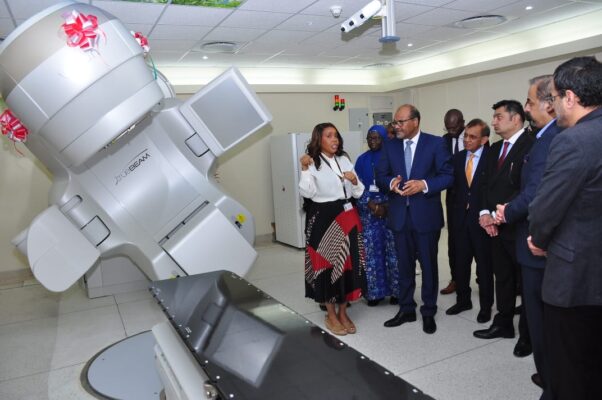
“Africa carries a large share of the global disease burden but lacks enough advanced treatment centres,” Mansoor Saleh, founding director of the cancer centre at Aga Khan University Hospital told BusinessDay during the lunch of the TrueBeam linear accelerators, machines at the hospital in Nairobi.
According to him, cancer alone is becoming one of the most pressing health challenges on the continent as populations grow, age and become more urban.
But the systems required to diagnose and treat the disease have not expanded at the same pace.
“For millions of patients across Africa, survival often depends on access to accurate diagnosis and modern therapeutics. Unfortunately, those resources remain limited in many countries,” Saleh decried.
Why Africans travel abroad
Many African countries still lack sufficient radiotherapy machines, advanced imaging systems and specialised oncology centres.
Some countries have only one or two radiotherapy machines serving millions of people, far below global standards.
Experts say modern cancer care requires a combination of pathology testing, advanced imaging such as MRI and PET-CT scans, surgery, chemotherapy and radiotherapy.
Without these integrated services, patients often have no choice but to seek care abroad.
The shortage of specialist doctors also contributes to the problem.
Across Africa, many trained physicians migrate to Europe, North America and the Gulf states in search of better pay and working conditions.
This brain drain has left hospitals struggling to retain experienced oncologists, surgeons and medical physicists.
The result is a healthcare system where patients often lack confidence in local treatment options.
But some health leaders say that perception is beginning to change.
Across Africa, a growing number of hospitals are investing in advanced technologies and specialist training in an effort to reduce medical tourism.
One of the institutions positioning itself as a regional hub for advanced cancer care is the Aga Khan University Hospital in Nairobi.
The hospital recently installed two state-of-the-art TrueBeam linear accelerators, machines designed to deliver highly precise radiation therapy for cancer patients.
According to Angela Waweru, consultant radiation oncologist at the hospital, the systems allow doctors to deliver targeted radiation therapy with exceptional accuracy.
The machines support advanced techniques such as volumetric modulated arc therapy, which enables radiation beams to rotate around the patient while adjusting intensity in real time.
The hospital also uses imaging technologies including MRI scans, PET-CT imaging and cone-beam CT, allowing clinicians to confirm tumour location immediately before treatment.
Another feature is motion-management technology that synchronises radiation therapy with a patient’s breathing cycle, ensuring that moving organs such as the lungs or liver are treated safely.
The centre also uses surface-guided radiotherapy, which employs optical cameras to track patient movement and automatically pause treatment if a patient shifts position.
Artificial intelligence is increasingly used in treatment planning to help identify organs at risk and design radiation plans more efficiently.
These innovations allow doctors to treat complex cancers more quickly.
For instance, prostate cancer patients who previously required several weeks of radiotherapy can now complete treatment in just a few sessions using stereotactic body radiotherapy.
The hospital has already treated hundreds of patients using the new systems.
A regional hub for specialised treatment
Rashid Khalani, chief executive of Aga Khan University Hospital in Nairobi, said the goal is to make the institution a destination for patients across Africa.
He said Africans should not feel compelled to travel outside the continent for treatment that can be provided locally.
“We want patients from across Africa to come here for treatment when the services are not available in their own countries,” Khalani said.
By building world-class facilities within Africa, he said, the continent can begin to reverse the medical tourism trend and save billions of dollars in foreign exchange.
“That money should remain in Africa and be reinvested in our own healthcare systems,” he said.
Kenya moves to curb medical tourism
The Kenyan government has also taken steps to discourage unnecessary medical travel abroad.
Officials say authorities are increasingly restricting access to foreign currency for patients seeking treatment overseas when the same procedures can be performed within the country.
The policy aims to conserve scarce dollars while encouraging citizens to use local hospitals.
According to Shaukat Abdulrazak, principal secretary for science, research and innovation, Kenya has made major investments in cancer treatment and research.
He said the government’s Social Health Authority programme is also expanding health insurance coverage for millions of citizens.
More than 29 million Kenyans have registered for the programme, which includes coverage for cancer treatment.
Health leaders say stronger insurance systems are critical if African patients are to trust local healthcare systems.
Despite recent progress, Khalani said Africa must take broader steps if it hopes to reverse the medical tourism trend.
One of the most important measures, he said, is implementing the Abuja Declaration, which commits African governments to allocate at least 15 percent of national budgets to healthcare.
More than two decades after the declaration was signed, most countries have yet to reach that target.
Khalani said governments must also invest more in medical education and ensure doctors are paid competitive salaries.
“If you do not pay doctors well and create the right working environment, they will leave,” he said.
Retaining skilled professionals is essential not only for expanding treatment capacity but also for reducing the risk of medical negligence caused by overstretched healthcare systems.
He also stressed the need for continuous investment in medical equipment and technology.
Cancer treatment, for example, requires expensive infrastructure including radiotherapy machines, diagnostic laboratories and specialised training for medical physicists and oncology nurses.
Hospitals must constantly upgrade equipment to keep pace with medical advances.
Khalani said African governments could also adopt policies similar to Kenya’s approach by discouraging patients from travelling abroad when equivalent treatment exists within the country or elsewhere on the continent.
Such policies, he said, would encourage patients to seek care locally while strengthening regional healthcare systems.
A turning point
Health experts believe Africa is at a turning point in its healthcare development.
The cost of building advanced cancer centres remains high, with comprehensive facilities costing tens of millions of dollars.
But supporters say these investments could ultimately save billions currently spent on overseas treatment.
More importantly, they could save lives.
Behind every statistic, Abdulrazak said, is a patient and a family struggling to access care.
As more hospitals invest in advanced technologies and research, Africa could gradually transform from a continent that exports patients to one that attracts them.
“If we build the right systems and invest in our people, there is no reason Africa cannot provide world-class healthcare for its own citizens,” he said.

Join BusinessDay whatsapp Channel, to stay up to date
Open In Whatsapp