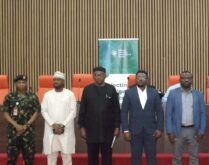
The African Continental Free Trade Area (AfCFTA) Secretariat has signed a Memorandum of Understanding (MoU) with Bergmans Security Consultant and Supplies Limited to implement the AfCFTA Customs Modernisation Project (ACMP).
Bashir Adeniyi, Comptroller-General of the Nigeria Customs Service (NCS) speaking after the signing ceremony which took place in Lagos on the sideline of the Digital Trade Forum 2026 described the agreement as a landmark step towards achieving true trade facilitation under the AfCFTA.
According to Adeniyi, African countries currently operate different customs management systems, making cross-border trade unnecessarily complex.
“In Nigeria, we moved from Automated System for Customs Data (ASYCUDA) to NICIS and now to B’Odogwu, our indigenous customs processing platform. Other countries such as Ghana, Cameroon, Uganda and Morocco operate different systems. What this agreement will achieve is interoperability, allowing these systems to communicate seamlessly,” Adeniyi said.
He explained that once implemented, customs declarations made in one African country would be recognised and processed electronically in another, eliminating duplication and significantly reducing delays at border crossings.
“If you make a declaration in Ghana, it should not be difficult for the Nigerian Customs system to process it as an import. This is what the agreement means, and it is truly historic,” Adeniyi said.
The Customs boss noted that although Africa has discussed trade facilitation for decades, lack of digital integration among customs administrations has remained a major bottleneck.
“We have been talking about growing intra-African trade for years. This is one of the silver bullets that can help us leapfrog towards that objective.”
Addressing concerns about revenue generation, Adeniyi dismissed suggestions that trade facilitation and customs revenue are competing priorities.
He argued that simplifying border procedures would ultimately boost government earnings.
“If we get trade facilitation right, we reduce delays, lower the cost and time of doing business, and businesses will clear more goods faster. Ultimately, higher trade volumes will translate into increased customs revenue,” he explained.
He also expressed confidence that the platform would integrate smoothly with Nigeria’s ongoing National Single Window initiative and similar digital trade systems being introduced across Africa.
Adeniyi said the immediate focus would be deploying the platform, building awareness among stakeholders and training customs personnel across participating countries.
He added that customs administrations are already collaborating through existing continental structures and expressed optimism that significant interoperability could be achieved within one year.
Wamkele Mene, Secretary-General of the AfCFTA Secretariat, said the partnership aligns directly with the continental trade bloc’s ambition to simplify trade for African businesses, especially small and medium-sized enterprises (SMEs).
According to him, the Secretariat had closely monitored Nigeria’s customs modernisation programme and considered it a successful model capable of being replicated across Africa.
“We have been observing the excellent work done in Nigeria in digitising customs operations, improving revenue collection and modernising border management. The continent has much to gain from this model,” Mene said.
He explained that the MoU marks the beginning of a broader effort to establish a modern, digital and interoperable customs ecosystem capable of supporting Africa’s single market ambitions.
“Our objective is to create a continental customs system where economic operators can move goods efficiently across borders. This partnership with Bergmans Security will help us realise that vision.”
Mene stressed that interoperability would have the greatest impact on SMEs, informal traders and smallholder farmers, who often bear the highest costs associated with border delays.
“When businesses can clear goods quickly, affordably and efficiently, they benefit directly. That is the promise of digital customs.”
He cited the Ghana-Togo border as an example where one-stop border posts exist physically but still lack digital interoperability, forcing traders to undergo multiple customs procedures.
For Bergmans Security Consultants and Supplies Limited, the agreement represents the export of a homegrown Nigerian technology to the rest of Africa.
Saleh Ahmadu, chairman of BSCS, said the company has spent the last five years developing and deploying customs technology in Nigeria, proving that locally developed solutions can address Africa’s trade challenges.
“Our system was built in Nigeria, for Africa. AfCFTA evaluated different international solutions but found that our platform was better suited to African realities,” Ahmadu said.
He disclosed that implementation would begin with at least six African countries before expanding across the continent.
“The goal is to build one African customs platform that allows customs administrations to work together seamlessly.”
Adeniyi also described the partnership as a significant milestone for Nigeria’s technology ecosystem.
He noted that previous customs modernisation programmes relied heavily on foreign technology providers that often failed to fully deliver on their commitments.
“For decades, we depended on foreign service providers for customs modernisation. Today, we have a Nigerian company that has developed a working solution, and Africa is recognising its value,” he said.
According to the Customs chief, widespread adoption of interoperable digital platforms could remove one of the biggest obstacles to implementing the AfCFTA by allowing customs administrations across the continent to exchange data in real time, simplify documentation and accelerate cargo clearance.
The stakeholders call for partnership that could lay the digital foundation needed to unlock faster cross-border commerce, lower transaction costs and deepen intra-African trade under the AfCFTA.

Join BusinessDay whatsapp Channel, to stay up to date
Open In Whatsapp