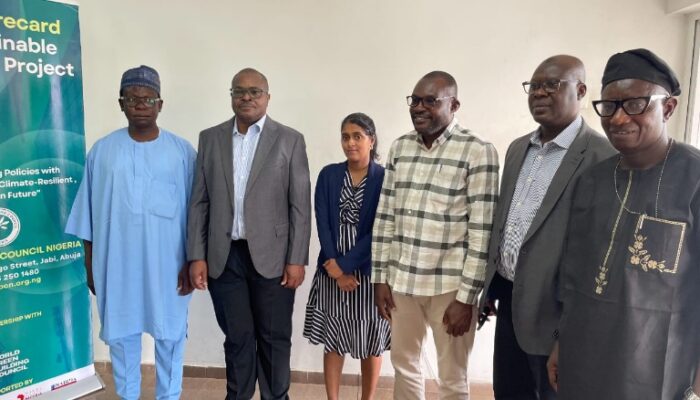
With nearly 70 percent of Nigerians living in informal settlements vulnerable to floods, heatwaves, and other climate risks, the Green Building Council Nigeria (GBCN) has called for urgent reforms to make the nation’s building and construction sector climate-resilient and economically sustainable.
Speaking at a media roundtable on the Nationally Determined Contributions (NDC) Scorecard for Sustainable Buildings Project, Danjuma Waniko, president, GBCN, said Nigeria’s housing crisis is no longer just about deficits — it is about survival in the face of escalating climate threats.
“Most of our urban settlements are growing before our very eyes, often without planning or infrastructure that can withstand the impacts of climate change,” Waniko said.
“About 70 percent of our people live in informal settlements or slums that are highly exposed to flooding, heatwaves, and rising temperatures. When we talk about sustainable buildings, we’re not just talking about structures — we’re talking about people’s lives and livelihoods.”
Waniko explained that the NDC Scorecard Project, part of the World Green Building Council’s global Be Bold on Buildings campaign, aims to help Nigeria turn its climate commitments into measurable actions within the built environment. Nigeria is one of five countries — alongside Brazil, Colombia, Egypt, and the Philippines — selected for the initiative.
According to Waniko, buildings account for nearly 40 percent of global greenhouse gas emissions and over 50 percent of extracted natural resources, making the construction sector central to tackling climate change. “Our mission at GBCN rests on three imperatives — achieving net-zero carbon emissions by 2060, promoting resource circularity, and strengthening urban resilience,” he said.
The GBCN, he added, has been collaborating with the Federal Ministry of Housing and Urban Development, the Energy Commission of Nigeria, and the National Environmental Standards and Regulations Enforcement Agency (NESREA) to align sustainability goals with national policy frameworks.
One major outcome, he noted, is the renewed effort to update Nigeria’s 2006 National Building Code to reflect modern realities such as energy efficiency and climate-smart design.
Also speaking, Sangeetha Ramaraj, technical and innovation officer at GBCN, said the NDC Scorecard project is designed as a bottom-up initiative that takes into account Nigeria’s local realities.
“We conducted workshops and consultations in 14 states, assessing existing policies and identifying enforcement gaps,” she said. “The findings led to a beta scorecard and an action plan proposing eight key strategies for achieving a sustainable and resilient built environment.”
She explained that the project has now entered its implementation phase, which involves regional rollouts across the country.
“We’re working with state governments and local authorities to integrate these strategies into planning, construction, and housing policies,” Ramaraj noted.
Usman Abdurrahman, chair, GBCN’s Education and Knowledge Development Group, said collaboration is key to success.
“To make our cities climate-resilient, professionals in architecture, building, and engineering must work hand in hand with policymakers,” he said. “Without strong policies and enforcement, progress will be difficult.”
Read also: Internet services gradually recover as Amazon Web Services restores operations
He added that regional workshops held in Lagos and Abuja have begun to yield results, with upcoming sessions in Port Harcourt and other zones aimed at deepening subnational engagement.
Waniko concluded that sustainable construction is no longer optional. “Climate change is already here.
Our cities are on the frontlines,” he said. “We must design, build, and manage our spaces differently — not just to cut emissions, but to safeguard lives and ensure that urban growth becomes a driver of resilience, not vulnerability.”

Join BusinessDay whatsapp Channel, to stay up to date
Open In Whatsapp