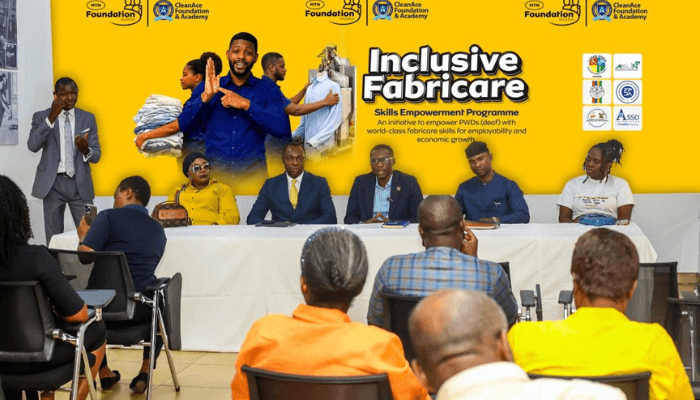
In a country grappling with high youth unemployment and persistent skills shortages across key sectors, the MTN Foundation and CleanAce Foundation have launched a specialised vocational training programme aimed at equipping persons with hearing impairments with employable skills in Nigeria’s growing fabric care industry.
The initiative, unveiled in Lagos on June 23, will train 30 hearing-impaired participants in professional fabric care and dry-cleaning operations, addressing two challenges simultaneously: the shortage of skilled manpower in the sector and the economic exclusion of persons living with disabilities.
The six-month programme combines classroom instruction, hands-on technical training, industry internships and certification, creating a structured pathway into formal employment and entrepreneurship. For the organisers, the programme is not merely a social intervention but a workforce development strategy.
Nigeria’s disability population remains one of the country’s most underutilised economic assets. Despite legislation promoting inclusion, many persons with disabilities continue to face barriers to education, employment and economic participation.
Speaking at the launch, Eniibukun Adebayo, founder of CleanAce Group, said the programme emerged from practical experience rather than theory.
According to him, the idea was inspired by the exceptional performance of a hearing-impaired employee whose rapid mastery of technical fabric care skills challenged long-held assumptions about disability and workplace productivity. “We gave one person an opportunity, and the way he performed was fantastic. What other people would have learned in a month, he learned within a week,” Adebayo said.
That experience led CleanAce to develop its own inclusion-focused training programme, which has already graduated six cohorts. The partnership with MTN Foundation, he said, provides the scale required to expand its impact. Beyond inclusion, Adebayo noted that the initiative responds to a pressing industry challenge.
Nigeria’s fabric care and dry-cleaning sector continues to expand alongside urbanisation and rising demand for professional laundry services, yet operators face a chronic shortage of trained personnel.
As Chairman of the Fabricare Professionals and Dry Cleaners Association, Adebayo disclosed that more than 200 dry-cleaning businesses across the country are prepared to absorb qualified graduates from the programme.
Participants who successfully complete the training could earn upwards of ₦200,000 monthly, while others may establish independent businesses within the sector. Successful trainees will receive government-recognised certification developed in partnership with the Lagos State Office for Disability Affairs and the Lagos State Technical and Vocational Education Board, providing credentials equivalent to a semi-diploma qualification.
For the MTN Foundation, the programme aligns with its broader commitment to disability inclusion and economic empowerment. Edward Fagbohun, senior manager, programme implementation at MTN Foundation, said disability equity remains a central pillar of the organisation’s social investment strategy. “In this part of the world, disability is often viewed through the lens of stigma. We want to help change that narrative and demonstrate that there is ability in disability,” he said.
Fagbohun added that the foundation intends to conduct a comprehensive impact assessment at the end of the pilot phase to determine opportunities for expansion. The initiative has also received strong backing from government and advocacy groups.
Omolade Sonubi, human resource director at LASODA, described the programme as an example of how the private sector can create practical pathways for disability inclusion. “You have demonstrated that disability is not a liability. There is ability in disability,” she said, while calling on more corporate organisations to adopt inclusive hiring and training practices.
She pointed to companies that have successfully integrated deaf employees into their workforce, arguing that inclusion should become a mainstream business practice rather than an exception.
Similarly, Olubowale Sodeinde, chairman of the Lagos Chapter of the Association of Sign Language Interpreters of Nigeria, described the initiative as a significant step towards expanding economic opportunities for deaf Nigerians. “Many deaf people do not need to be on the streets begging. If they are given opportunities like this, they can earn a living and contribute meaningfully to society.”
Funmilola Ogunro, founder of Friends of the Deaf International Foundation, said the programme reflects a shift from charity-based approaches towards empowerment and economic participation. “Instead of seeing persons with disabilities as recipients of charity, they are being given an equitable opportunity to excel.”
Perhaps the most compelling testimony came from Moses Peter Abba, a hearing-impaired employee of CleanAce, whose experience helped inspire the programme.
Abba recalled arriving in Lagos in 2017 and struggling to secure employment despite numerous applications. His fortunes changed when he joined CleanAce. “When I first saw the professional ironing equipment, I thought it looked highly technical,” he said. “They encouraged me to learn. Within a week, I had mastered it, and after two weeks, I was working independently.”
His story illustrates a broader reality often overlooked in conversations about disability and employment: capability is frequently constrained not by impairment, but by limited access to opportunity.
As Nigeria seeks to expand its productive workforce and accelerate economic inclusion, initiatives such as the Inclusive Fabricare Skills Empowerment Programme may offer a model for how business, philanthropy and government can work together to unlock talent that has long remained on the margins.
Registration for the inaugural cohort is now open to Lagos residents registered with LASODA who possess a minimum of a secondary school certificate. The training will be conducted at CleanAce’s facility in Lagos, where participants will receive technical instruction, workplace exposure and certification designed to improve employability within one of Nigeria’s growing service industries.

Join BusinessDay whatsapp Channel, to stay up to date
Open In Whatsapp