The Independent National Electoral Commission INEC have directed the broadcast media to strictly adhere to the equal time obligations and be guided by the official leadership records held by INEC.
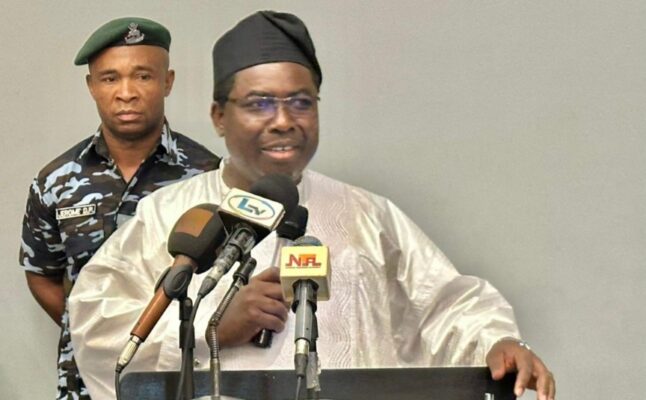
INEC Chairman, Joash Amupitan stated this during his presentation on the management; an assessment of the 2026 Nigeria Electoral Act 2026 on broadcast media coverage of the election organised by broadcasting organisation of Nigeria, BON in Abuja.
He said information space plays a dominant role in our electoral journey to the point that it is often said that elections are won or lost in the information space.
“Your airwaves have become the primary infrastructure of our democracy. If they are clear, the nation sees the truth; if they are clouded by misinformation, the sovereign will of the people is threatened.
The role of broadcast media in electoral processes has become increasingly central to democratic governance, particularly in developing democracies where access to information is uneven and often mediated through radio and television.
“In Nigeria, broadcast media remain the most influential platforms for political communication, shaping public opinion, framing electoral narratives, and influencing voter behaviour. As such, the management of the airwaves during election periods goes beyond regulation to a fundamental issue of democratic integrity and legitimacy.
The increasing significance of media in elections has also heightened concerns about unequal access, misinformation, hate speech, and the potential for media capture by political elites. These challenges have necessitated regulatory interventions aimed at ensuring fairness, accountability, and transparency in political broadcasting.
However, such interventions must be carefully calibrated to avoid undermining the constitutional guarantee of freedom of expression enshrined in the Constitution of the Federal Republic of Nigeria, 1999 (as amended). The tension between regulation and liberty thus lies at the heart of electoral media governance.
The enactment of the Electoral Act 2026 represents a significant milestone in Nigeria’s electoral reform trajectory. The Act introduces provisions designed to regulate political advertising, guarantee equitable access to broadcast platforms, and curb the dissemination of harmful or inciting content. While these measures are commendable in their objectives, they also raise critical questions regarding their scope, implementation, and implications for media independence and operational viability. This paper, therefore, undertakes a critical assessment of the 2026 Electoral Act as it relates to broadcast media coverage of elections. It interrogates the legal and institutional framework governing electoral broadcasting, evaluates the strengths and limitations of the current regime, and proposes reforms aimed at achieving a more balanced and effective regulatory system.
CONCEPTUAL AND THEORETICAL FRAMEWORK
A proper understanding of the management of the airwaves in the context of electoral regulation requires clarity of key concepts that underpin the discourse, particularly “broadcast media,” “airwaves,” and “electoral fairness”, which are clarified hereunder.
Broadcast media refers to communication channels that transmit audio and visual content to a wide and heterogeneous audience simultaneously, primarily through radio and television. In Nigeria, broadcasting operates within a regulated spectrum, commonly described as the “airwaves,” which constitutes a finite public resource subject to state control and allocation. The legal characterisation of the airwaves as a public good imposes a corresponding obligation on the State to ensure that access to such a resource is equitable, particularly during electoral periods when political communication assumes heightened significance.
The notion of “airwaves management” therefore extends beyond technical spectrum allocation to encompass regulatory control over content, access, and distribution of broadcast opportunities. It involves striking a balance between competing interests: freedom of expression, political competition, and public order. In the electoral context, this management becomes particularly sensitive, as the allocation of airtime directly affects the visibility of political actors and, by extension, the fairness of the electoral process.
Electoral fairness, in this regard, is closely tied to the principle of equal opportunity in political competition. It requires that all political parties and candidates have reasonable access to the media to present their programmes to the electorate. The denial or unequal distribution of broadcast access can distort voter perception and undermine the credibility of elections. As noted by the Supreme Court in Attorney-General of the Federation v Abubakar, the electoral process must be conducted in a manner that ensures fairness, transparency, and equality of participation. Although the case did not directly concern media regulation, its articulation of electoral fairness provides a useful normative anchor for analysing broadcast obligations during elections. Furthermore, political communication through broadcast media plays a central role in shaping public opinion. In a country such as Nigeria, where literacy levels and internet penetration vary significantly, radio and television remain dominant sources of political information.
Consequently, the regulation of these media platforms has far-reaching implications for democratic participation and voter enlightenment.
The regulation of broadcast media in the electoral process engages a number of interrelated theoretical perspectives which collectively illuminate the tensions between freedom of expression, equity in political competition, and state regulation of a scarce public resource. Chief among these are the public sphere theory, media pluralism, the fairness doctrine, and regulatory theory. Each provides a distinct lens through which the management of the airwaves under the Electoral Act 2026 may be critically interrogated.
LEGAL AND INSTITUTIONAL FRAMEWORK IN NIGERIA
The regulation of broadcast media in the electoral process in Nigeria is anchored on a complex interaction of constitutional provisions, statutory enactments, and institutional mandates. Central to this framework are the guarantees of freedom of expression under the Constitution, the regulatory provisions of the Electoral Act 2026, and the oversight roles of key institutions such as the Independent National Electoral Commission (INEC) and the National Broadcasting Commission (NBC). The effectiveness of airwaves management during elections depends largely on how these legal and institutional elements operate in practice.
Constitutional Framework
The starting point for any analysis of media regulation in Nigeria is the Constitution of the Federal Republic of Nigeria 1999, which guarantees the right to freedom of expression, including the freedom to receive and impart ideas and information without interference. This provision forms the constitutional foundation for media operations and political communication in Nigeria. However, the right is not absolute. Section 45 of the Constitution permits restrictions on the exercise of fundamental rights, including freedom of expression, in the interest of defence, public safety, public order, public morality, or public health. In the electoral context, this creates a constitutional basis for regulating broadcast content to prevent incitement, hate speech, and misinformation.
Importantly, the Constitution recognises the right of individuals to own, establish, and operate media outlets, subject to conditions laid down by law. This has facilitated the growth of private broadcasting in Nigeria. Nevertheless, section 39(3) reserves to the Federal Government the power to regulate the ownership and operation of television and wireless broadcasting stations. This underscores the characterisation of the airwaves as a public resource, thereby justifying state intervention in their management.
The courts have also played a role in defining the contours of media freedom. In Director of SSS v Olisa Agbakoba, the Supreme Court emphasised that freedom of expression is essential to democratic governance, although it may be subject to lawful restrictions. Similarly, in Arthur Nwankwo v The State, the court underscored the importance of free political discourse in a democratic society. These decisions reinforce the principle that while regulation is permissible, it must not unduly stifle political expression. Thus, the constitutional framework establishes a delicate balance, as it protects media freedom while simultaneously empowering the State to regulate broadcasting in the public interest. This tension lies at the heart of airwaves management during elections.
The Electoral Act 2026
The Electoral Act 2026 provides the principal statutory framework for the regulation of electoral processes, including the use of broadcast media during political campaigns. Although building on prior electoral legislation, the Act introduces a more structured approach to campaign regulation and media engagement. The relevant provisions are contained in sections 99-101 of the Act. The key issues are highlighted below:
Regulation of political campaigns and media use- Equal access to media platforms in electoral processes
A key feature of the Act is its emphasis on equal access to media platforms. Specifically, section 99 (2)-(5) provides as follows:
(2) State apparatus, including the media, shall not be employed to the advantage or disadvantage of any political party or candidate at any election.
(3) Media time shall be allocated equally among the political parties or candidates at similar hours of the day.
(4) At any public electronic media, equal airtime shall be allotted to all political parties or candidates during prime times at similar hours each day, subject to the payment of appropriate fees.
(5) At any public print media, equal coverage and visibility shall be allotted to all political parties.
The above provisions of section 99 are central to the principle of equal access to media platforms in electoral processes. Their relevance can be understood from several interrelated perspectives. First, subsection (2) establishes a non-partisanship obligation on the State. By prohibiting the use of state apparatus, including publicly owned media, to favour or disadvantage any political actor, it seeks to prevent incumbency advantage. In many electoral systems, governments control significant media infrastructure; without this safeguard, ruling parties could dominate public discourse and distort electoral competition. Thus, this provision reinforces the idea that public media are a public trust, not a partisan instrument.
Secondly, subsections (3) and (4) operationalise the principle of equality of opportunity in political communication. By requiring equal allocation of media time at similar hours, especially during prime time, they go beyond mere formal access and address qualitative equality. Airtime at off-peak hours is not equivalent to prime-time exposure; therefore, these provisions ensure that all parties can reach comparable audiences. This directly supports electoral fairness by preventing unequal visibility among contestants. With 23 registered political parties, the Act mandates fairness and balance. You must provide a level playing field, ensuring that no single interest group monopolises the airwaves.
Furthermore, subsection (5) extends the same logic to print media, mandating equal coverage and visibility. This is significant because electoral influence is not confined to electronic broadcasting; newspapers and other print outlets shape public opinion, agenda-setting, and voter perception. Equal coverage helps to ensure that no candidate is systematically marginalised in public discourse. Collectively, these provisions give practical effect to the democratic ideal that elections must be free, fair, and competitive.
Equal access to media platforms enables voters to receive diverse viewpoints, compare political alternatives, and make informed choices. Without such guarantees, the electoral process risks becoming skewed in favour of those with greater access to media power, thereby undermining both the credibility of elections and the legitimacy of the resulting government. It is worthy of note that any violation of subsections (3) and (4), which require equal allocation of airtime and fairness in broadcast scheduling, constitutes a criminal offence and punishment upon conviction is, for a public media, a fine of ₦2,000,000 in the first instance and ₦5,000,000 for subsequent conviction. For principal officers and other officers of the media house, the punishment is a fine of ₦1,000,000 or imprisonment for a term of six months.
The punishment regime elevates compliance from a regulatory expectation to a matter of legal obligation, signalling the importance the law attaches to electoral fairness in media coverage. Political parties and candidates are entitled to reasonable opportunities to present their programmes to the electorate through broadcast media. This reflects an attempt to operationalise the principle of electoral fairness by mitigating the structural advantages enjoyed by incumbents and financially dominant candidates.
Moderation of Content of Political Broadcasts
The Act prohibits certain conduct at political campaigns by addressing the content of political broadcasts, particularly by prohibiting the dissemination of hate speech, incitement, and false information capable of undermining electoral integrity. On this note, section 96(1) provides that “A political campaign or slogan shall not be tainted with abusive language directly or indirectly likely to injure religious, ethnic, tribal or sectional feelings.” In a plural society like Nigeria, such expressions can deepen divisions and trigger conflict. The provision, therefore, seeks to ensure that political messaging remains inclusive and non-discriminatory. Similarly, “Abusive, intemperate, slanderous or base language, insinuations or innuendoes designed or likely to provoke violent reaction or emotions shall not be employed or used in political campaigns.” This is intended to prevent campaigns from degenerating into hostility, misinformation, or personal attacks that may destabilise the electoral environment. These provisions are aimed at regulating the tone and content of political campaigns in order to preserve peace and electoral integrity, thereby promoting issue-based campaigning, discouraging hate speech, and helping maintain public order and peaceful political competition during elections. This aligns with the constitutional allowance for restrictions in the interest of public order and democratic stability. However, the challenge lies in defining the boundaries of such restrictions without encroaching upon legitimate political expression.
The Act criminalises and punishes these acts. For aspirants and candidates, their liability upon conviction is a maximum fine of ₦5,000,000 or imprisonment for a term of 12 months, while a political party is liable upon conviction to a fine of ₦10,000,000 in the first instance, and ₦5,000,000 for any subsequent offence.
Regulation of campaign timelines and media usage
The Act prohibits broadcasting 24 hours preceding or on polling day. It is provided that “Any person, print or electronic medium that broadcasts, publishes, advertises or circulates any material for the purpose of promoting or opposing a particular political party or the election of a particular candidate over the radio, television, newspaper, magazine, handbills, or any print or electronic media whatsoever called within 24 hours immediately preceding or on polling day commits an offence under this Act.” This provision establishes a “media blackout period” immediately before and on polling day, and its purpose is to protect the integrity of the voting process. First, it prohibits any person or media organisation, whether print or electronic, from broadcasting or publishing political campaign materials within 24 hours before polling day and throughout election day itself. This includes advertisements, endorsements, or any content designed to promote or oppose a political party or candidate. The scope is deliberately wide, covering radio, television, newspapers, magazines, handbills, and all forms of electronic media. The rationale is to create a quiet period in which voters can reflect on their choices without last-minute persuasion, propaganda, or misinformation. Elections are not merely about campaigning; they are also about deliberation and independent decision-making. By restricting campaign messages at this critical stage, the law seeks to prevent undue influence, emotional manipulation, or the spread of false information that could distort voter judgment.
Secondly, the provision promotes fairness among contestants. Without such a restriction, wealthier or more media-connected candidates could dominate the final hours of campaigning, overwhelming opponents and skewing the electoral playing field. The blackout period therefore, reinforces the principle of equality of opportunity in political competition.
Thirdly, it enhances electoral order and stability. The final hours before voting are particularly sensitive; unregulated political messaging could inflame tensions, spread divisive narratives, or even incite unrest. By criminalising such conduct, the law aims to maintain public order and confidence in the electoral process. In essence, this provision balances freedom of expression with the need for free and fair elections, ensuring that the voting environment is calm, reflective, and free from last-minute distortions of the democratic will.
In addition to the above, section 98 of the Act places limitations on political broadcasts and campaigns by political parties. This provision regulates both the timing of political campaigns and the prohibition of last-minute media influence before elections. First, subsection (1) establishes a defined campaign window, allowing political parties to canvas for votes beginning 150 days before polling day and ending 24 hours before the election. This ensures that campaigning is structured, predictable, and does not extend indefinitely. Importantly, the 24-hour restriction introduces a “cooling-off period”, during which voters are expected to reflect on their choices without active political persuasion. Subsection (2) reinforces this cooling-off period by criminalising political advertising within the final 24 hours before polling. It specifically prohibits political parties or their agents from using broadcast media or newspapers to promote or oppose candidates during this period. The provision recognises the powerful influence of last-minute media messaging and seeks to prevent undue manipulation of voter sentiment immediately before voting. The imposition of a fine of up to ₦2,000,000 serves as a deterrent against violations. The provision promotes electoral fairness, orderliness, and informed decision-making, while curbing the risk of last-minute propaganda capable of distorting the electoral process.
Notwithstanding these provisions, the Act raises critical questions regarding enforcement and accountability. While it establishes obligations, it does not always provide sufficiently robust mechanisms for ensuring compliance. This creates a gap between legal expectations and practical realities.
The Act reflects an emerging awareness of the need to balance freedom of expression with electoral integrity. Rather than imposing blanket restrictions, it adopts a moderated approach that permits political communication.

Join BusinessDay whatsapp Channel, to stay up to date
Open In Whatsapp