The banking industry capital base remained strong at the end of 2014 financial year. Industry equity capital increased by 27.27 percent from N227.42 billion in 2013 to N289.43 billion in 2014 due to the recapitalization exercise embarked upon by some banks, Nigeria Deposit Insurance Corporation (NDIC) has said.
Today, banks’ capital has become very important, not only to meet regulatory requirements, but also to remain internationally competitive as they continue to expand and widen the scope of operations beyond the shores of this country.
This may be responsible for mass rush by some banks last year for capital raising. Specifically, some banks including Access bank plc, UBA, Stanbic IBTC last year embarked on capital raising through rights issue to meet up with Basel II capital requirements.
The reserves increased by 11.77 percent from N2.38 trillion in 2013 to N2.66 trillion in 2014, due to increase in retained profit. The adjusted shareholders’ funds (Tier 1 capital) increased marginally by 0.89 percent from N2,418.75 billion in 2013 to N2,440.20 billion in 2014. Similarly, the total qualifying capital increased by 19.25 percent from N2,415.40 billion in 2013 to N2,880.40 billion in 2014.
The NDIC’s 2014 annual report show that the capital to risk-weighted asset (CAR) of the DMBs declined by 1.26 percentage points from 17.18percent in 2013 to 15.92 percent in 2014, but exceeded the minimum capital adequacy threshold of 10 percent.
The report revealed that as at December, 31 2014, three out of 24 banks failed to meet the minimum prudential CAR of 10 percent compared to one bank in 2013. The banks needed to recapitalize to meet the volume of their operations.
Also, the banking industry asset quality was strong in 2014 as revealed by the non-performing loans (NPL) in 2014. The banking industry non-performing loans to total loans ratio improved from 3.20 percent in 2013 to 2.81 percent in 2014 and was within the regulatory threshold of five percent. All the banks in the industry operated within the regulatory limit of five percent.
Notwithstanding the improvement, the volume of NPLs increased by 10.26 percent from N321.66 billion in 2013 to N354.84 billion in 2014.
The banking industry total loans and advances stood at N12.63 trillion in 2014, showing an increase of 25.73 percent over N10.04 trillion granted in 2013.
The banking industry total operating expenses increased by 3.23 percent from N1.55 trillion in 2013 to N1.60 trillion in 2014. Similarly, interest expense grew by 2.88 percent from N796.73 billion in 2013 to N819.67 billion during the period under review. Also, Return on Assets (ROA) and Return on Equity (ROE) declined marginally by 1.70 percent and 1.76 percent from 2.33 percent and 20.71 percent to 2.29 percent and 20.34 percent in 2013 and 2014 respectively. Yield on earning assets also declined to 11.71 percent in 2014 from 13.10 percent in 2013.
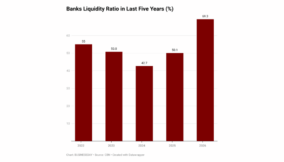
The banking industry liquidity risk was moderate during the period under review. The industry average liquidity ratio rose from 50.63 percent in 2013 to 53.65 percent in 2014 and was well above the prudential minimum threshold of 30 percent. Individually, all the DMBs in the industry had liquidity ratios in excess of the minimum prudential requirement of 30 percent, as at 31st December 2014, indicating that all DMBs were sufficiently liquid.
The improved liquidity in the banking industry may be attributed to the impact of Federal Government statutory allocations to the various tiers of government. Also, there was remarkable increase in the ratio of loans and advances to total deposits as it increased from 57.95 percent in 2013 to 68.11 percent in 2014. The ratios were within the maximum prudential threshold of 70 percent for the DMBs in 2013 and 2014.
HOPE MOSES-ASHIKE

Join BusinessDay whatsapp Channel, to stay up to date
Open In Whatsapp