


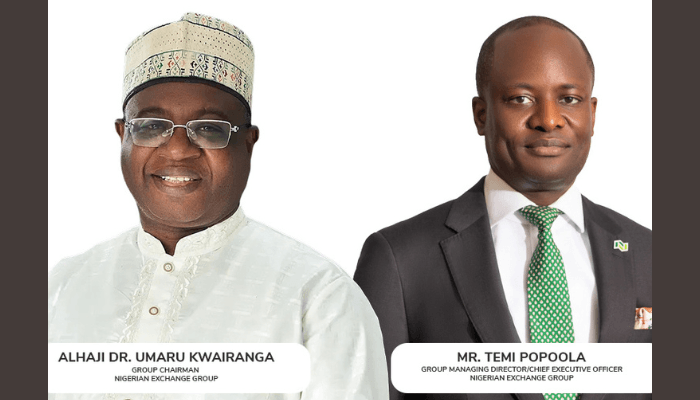
Nigerian Exchange Group Plc (NGX Group) has presented its 2025 financial results at its 65th Annual General Meeting (AGM) held last Wednesday in Lagos.
The annual general meeting was held at a time when Nigeria’s capital market is sustaining momentum into 2026, supported by an evolving market structure, steady investor participation, and ongoing reforms.
NGX Group reported profit before tax (PAT) of N15.6 billion in the year ended December 31, 2025, with shareholders approving a N3 dividend per share and a one-for-three bonus share issue, alongside key resolutions reinforcing governance continuity and capital structure.
While the results reflect a solid financial year, their significance lies in what they represent: a market building on recent performance and gradually strengthening its underlying structure.
Momentum extending into 2026
Market activity in the early months of 2026 indicates that the trajectory observed in recent periods is holding. Trading volumes remain elevated, investor participation is steady, and the market continues to respond more consistently to policy signals and corporate fundamentals. This pattern suggests a market increasingly shaped by sustained participation rather than episodic flows, an important marker of maturity and depth.
Evolving composition of investor participation
A defining feature of current market dynamics is the evolving balance between domestic and foreign investors. Recent data underscores this shift. As at March 2026, total transactions on the Exchange stood at approximately N1.74 trillion, with domestic investors accounting for about 83.44 percent, compared to 16.56 percent from foreign investors. On a year-to-date (YtD) basis, domestic participation remains dominant at 86.94 percent, with foreign participation at 13.06 percent.
Domestic participation continues to anchor the market, reflecting stronger local institutional depth and growing retail engagement. This trend is being reinforced by broader economic reforms, which are supporting domestic capital mobilisation and reducing reliance on more volatile external flows. At the same time, foreign investor participation remains an important, though more measured, component of the market. Recent activity indicates a gradual return of offshore investors, alongside a more deliberate and selective engagement with Nigerian assets. This evolving mix suggests a market that is becoming more balanced, supported by domestic resilience while maintaining global relevance.
Infrastructure now driving market behaviour
A key factor underpinning this sustained momentum at the market is infrastructure. NGX Invest, the Group’s digital primary market platform, continues to shape how capital is raised and accessed. By broadening participation in primary market transactions, it is contributing to a more inclusive and accessible market structure.
Structural improvements in market operations are also advancing. Following the earlier transition to a T+2 settlement cycle, the market is set to move to a T+1 settlement cycle in May 2026, further enhancing efficiency, reducing settlement risk, and aligning Nigeria more closely with leading global markets.
In parallel, the recent extension of trading hours is expected to improve price discovery, deepen liquidity, and provide greater flexibility for both domestic and international investors. These developments reflect a market that is actively modernising, with structural enhancements beginning to influence behaviour and participation in real time.
Market confidence and global relevance
The current phase of market development is also reflected in how Nigeria is being assessed by global investors. There are increasing indications that the market is undergoing a broader re-rating, as improved policy direction, more predictable foreign exchange conditions, and strengthening infrastructure reshape investor perceptions.
Within this context, the Nigerian capital market is also beginning to serve a more complete function, supporting not only capital inflows but credible exit opportunities for investors. This evolution signals a market that is becoming more investable, with clearer pathways for both entry and exit.
NGX Group’s expanding role
Within this evolving environment, NGX Group’s role continues to deepen. Beyond facilitating trading, the Group is increasingly shaping how the market functions, through infrastructure development, product expansion, and ecosystem engagement.
This evolving role was further demonstrated in a recent strategic engagement convened by NGX Group in Lagos, which brought together chief executives of leading African exchanges to advance cross-border listings and deepen capital market integration across the continent. The discussions focused on creating more efficient pathways for issuers to raise capital across multiple jurisdictions and enhancing investor access to pan-African investment opportunities.
Such initiatives signal a shift towards a more interconnected African market, where capital formation is increasingly supported by regional collaboration rather than confined within national boundaries.
Sustainability also remains central to NGX Group’s long-term positioning. On the market front, initiatives such as the NGX Net-Zero Programme reflect a growing focus on supporting issuers in aligning with global sustainability frameworks and accessing climate-linked capital. Beyond the market, the Group continues to advance its social impact agenda through programmes such as Project BLOOM (Bringing Life to Our Overlooked Minors), which focuses on addressing child malnutrition and improving health outcomes in underserved communities.
In parallel, NGX Group has strengthened its engagement with global and regional development finance institutions, including the International Finance Corporation (IFC) to promote market development, deepen capital formation, and support sustainable investment flows. These partnerships reflect a growing alignment between capital market development and broader economic and social objectives.
Leadership perspective
Speaking at the AGM, Umaru Kwairanga, chairman of NGX Group, emphasised the importance of sustaining both performance and institutional strength.
He said, “What we are seeing is a market that is becoming more structured, more disciplined, and better anchored on strong fundamentals. The responsibility before us is to sustain this progress, by reinforcing governance, ensuring policy alignment, and maintaining the institutional credibility required to support long-term investor confidence.”
Temi Popoola, group managing director/chief executive officer, highlighted the Group’s focus on execution and market development. He said, “This next phase is about deepening momentum. Our focus is on scaling infrastructure, broadening participation, and unlocking new pathways for capital formation. By continuing to innovate and strengthen market access, we are positioning the Exchange to support a more dynamic, liquid, and globally competitive capital market.”
Outlook: Sustaining, deepening momentum
Looking ahead, the focus shifts from performance to durability. The key question is whether the current trajectory can be sustained and deepened through consistent policy implementation, continued infrastructure development, and stable investor participation.
Early indicators suggest that the market is on this path. Liquidity remains resilient, participation is broadening, and upcoming enhancements, including the transition to a T+1 settlement cycle and extended trading hours, are expected to further strengthen market efficiency and responsiveness.
For NGX Group, this translates into a continued focus on expanding access, improving market quality, and strengthening the underlying infrastructure that supports capital formation.
Ultimately, the next phase of market development will be defined not just by growth, but by consistency. As alignment between policy, infrastructure, and investor behaviour continues to strengthen, the Nigerian capital market is increasingly positioned to deliver more stable, inclusive, and long-term value, both domestically and within the broader African financial landscape.

Join BusinessDay whatsapp Channel, to stay up to date
Open In Whatsapp


